
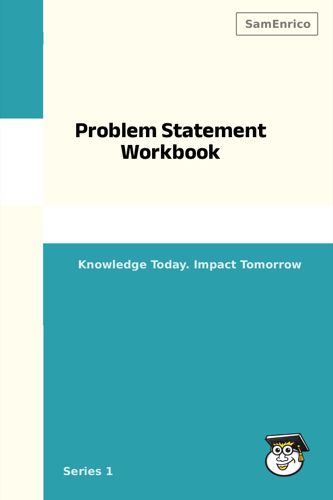
Problem Statement Workbook eBook
Articulate customer pain points with evidence befo
by Bedard Zelda
Articulate customer pain points with evidence before proposing solutions.
Formats
Free sample
Chapter 1: The Opinion Massacre--–- The conference room smelled of stale coffee and overconfidence. Fourteen people sat around a polished walnut table, each holding a marker like a weapon. On the whiteboard, someone had written "Q3 PRIORITIES" in aggressive capital letters. Below it, a list of features. No problems.
Just solutions. A product manager from the mobile team was arguing for a new onboarding flow. A sales director wanted a pricing page redesign. An engineer was quietly drawing an architecture diagram for a feature nobody had asked for. The VP of Product sat at the head of the table, nodding at each idea, asking only one question: "How long will it take?"Not once in ninety minutes did anyone ask: "What problem are we actually solving?"Someone from customer support raised a hand timidly.
"Actually, we have fifty-seven support tickets about the export function timing out." The room went silent for exactly two seconds. Then the product manager said, "That's interesting, but let's stay focused on the roadmap."The roadmap. Not the customer. The roadmap.Six months and four hundred thousand dollars later, the new onboarding flow launched to a 2% adoption rate. The pricing page redesign correlated with a 15% drop in conversions.
The architecture diagram was never used. And the fifty-seven support tickets about the export function had grown to two hundred and thirty-one. The company eventually fixed the export bug with a two-hour code change by a junior developer. But by then, the product manager had been promoted (for "decisive leadership"), the sales director had moved to a competitor, and the support team had stopped speaking up in roadmap meetings.This is not a cautionary tale. This is Tuesday.The Most Expensive Sentence in Business There is a sentence spoken in thousands of conference rooms every day.
It has destroyed more value than any competitor, any market downturn, any regulatory change. The sentence is short. It sounds reasonable. It is almost always wrong."I think the customer wants..."What follows those six words is almost never data. It is status.
It is politics. It is the loudest voice in the room asserting dominance over the quietest evidence. It is a product manager defending their annual bonus. It is a founder protecting their original vision. It is a salesperson repeating what one customer said in a rushed call.The sentence is an opinion masquerading as insight.
And the business world has built entire industries on the assumption that opinions are a valid substitute for evidence.They are not.This book exists because the gap between "I think" and "We have observed" is where projects go to die. Not dramatically. Not with a single explosion. But slowly, expensively, and in a way that everyone notices only after the money is gone and the customer has churned.The Anatomy of a Bad Idea (Before It Was Obvious)Let us examine the anatomy of a bad idea before anyone knew it was bad. Bad ideas do not arrive wearing a sign that says "I am about to waste your budget." They arrive dressed in confidence.
They are championed by well-meaning people. They are debated in meetings where everyone is too polite to say "What evidence do you have?"Consider the following scenario, which has played out in some form in every organization that has ever built anything:A product manager named Sarah has an idea. She noticed during a user testing session that three out of eight participants hesitated on a particular screen. She writes a one-pager proposing a redesign of that screen. She estimates two weeks of engineering time.
She presents it at product review. The head of product says "I like it." The engineering lead says "We can do that." The design lead sketches some wireframes overnight. The feature ships. Usage does not change. Sarah moves on to her next idea.What happened here?
Sarah committed the fundamental error of product development: she confused a symptom with a problem. Hesitation is not a problem. Hesitation is an observation. The problem is the reason for the hesitation. Maybe the label was unclear.
Maybe the network was slow. Maybe the user was distracted by a notification. Maybe the user was hesitating because they were reading content that was perfectly fine but required a moment of thought. Sarah never found out. She solutioned her way from an observation to a feature without ever passing through the problem.This book exists to prevent that journey.What This Workbook Is (And Is Not)Let us be clear about what you are holding.This is not a book you read while drinking coffee in an armchair.
This is a laboratory. It is a bias-killing machine. It is a series of confrontations between what you believe and what you can prove. It contains worksheets, exercises, and (if you are honest with yourself) moments of genuine discomfort when you realize how many decisions you have made based on nothing more than confidence.You will not finish this workbook and feel smarter. You will finish this workbook and feel more capable.
There is a difference. Smart people have opinions. Capable people have evidence. You are here to become capable.This workbook is organized into five phases:The Warm-up (Chapters 1-2): Learning to spot the difference between a hypothesis and a hunch. Building the falsification mindset that will protect you from self-deception.The Fieldwork (Chapters 3-5): Going into the world to collect evidence.
Observing customers. Quantifying pain. Building an evidence file that can withstand scrutiny.The Politics & Power (Chapter 6): Understanding whose pain actually matters. Mapping stakeholders. Identifying the economic buyer.The Sensemaking (Chapters 7-10): Diagnosing root causes.
Conducting impact interviews. Prioritizing problems by stakeholder-weighted value.The Output (Chapters 11-12): Framing the problem at the right level of abstraction. Producing the final "No-BS Problem Statement" that will guide solution design.Throughout this journey, you will encounter a symbol: 🚫💡. This is the Golden Rule marker. It means "Stop.
You are proposing a solution without a validated problem statement." When you see this symbol in later chapters, it is a reminder that you have violated the only rule that matters. Do not skip past it.The Golden Rule (The Only Rule That Matters)Here it is. The single principle that separates effective teams from teams that are merely busy:No solution is proposed until a problem statement has been validated with evidence.Read that again. Slowly.No solution. Not even a small one.
Not even a "quick win." Not even something that will "only take an hour." Not even something the CEO asked for. Not even something you personally believe in with your entire soul.Problem first. Evidence second. Solution third. In that order.
Always. No exceptions.This rule sounds simple. It is not simple. It is brutally difficult because it requires you to sit in the discomfort of not knowing. It requires you to admit that your brilliant idea might be wrong.
It requires you to delay gratification while you go gather evidence instead of building something. It requires you to tell the VP of Product "I don't know yet" when they ask for a timeline.The Golden Rule is not popular. It is not fast. It is not what got you promoted in…
This is the end of the free sample. Get the eBook to keep going. Buy now
About this book
Details
- Author
- Bedard Zelda
- Publisher
- SamEnrico
- Language
- English
- Genre
- Non-Fiction, Startup Guide, Problem Validation
- Released
- 2026-06-07
- Pages (approx.)
- 144
- Available as
- eBook, Audiobook

Read better in the ZLOADR app
Your eBooks on your phone or tablet. Sign in with your SamEnrico account and start reading.
More by Bedard Zelda
 Stress Perfectionism Health CostBedard Zelda$11.99
 Framing Techniques for InfluenceBedard Zelda$11.99
 Sexual Sobriety Affirmations AudioBedard Zelda$11.99
 Embers of the First Flame: How Fire Shaped HumanityBedard Zelda$11.99
 Learn to Play the Irish BouzoukiBedard Zelda$11.99
 Manager Financial Planning & AnalysisBedard Zelda$11.99
 Remote Presentation Vocal TipsBedard Zelda$12.99
 How to Become a MailerBedard Zelda$11.99