
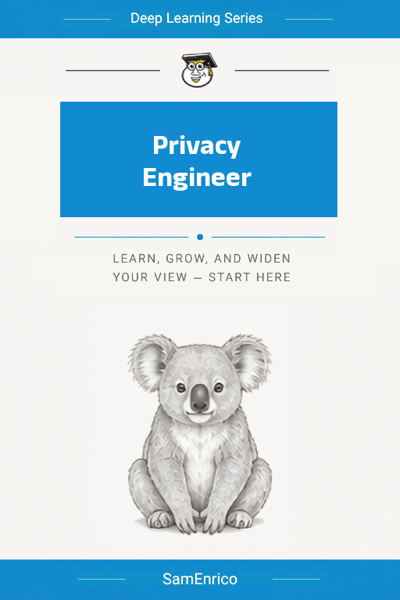
Non-FictionInformativeEducational
Privacy Engineer eBook
A Coursebook on Privacy Engineer
A Coursebook on Privacy Engineer
Formats
Free sample
Chapter 1: The 3 AM Pager Duty Call--The first time you realize you’re not just a coder anymore happens around 3:15 on a Tuesday morning. Your phone vibrates against the nightstand—not the gentle buzz of a text message, but the aggressive, staccato pulse of a Pager Duty alert. You groan, fumble for the device, and squint at the screen. The alert reads: “DSAR Failure – Customer ID 88472 – Unauthorized Data Returned.” Your stomach drops.You stumble to your laptop, open the logs, and begin tracing. The data subject access request came in at 2:47 AM.
An automated pipeline collected records from seventeen different microservices, assembled them into a JSON package, and delivered them to the customer’s secure portal. But there’s a problem. The audit trail shows that customer ID 88472 received not only their own data, but also the medical history, home address, and payment details of a complete stranger.Someone else’s most sensitive information just landed in the wrong hands because of code you wrote.This is not a hypothetical. This exact scenario plays out somewhere in the tech industry every single week. The engineer on call that night—let’s call her Maya—didn’t write malicious code.
She didn’t skip her security training. She didn’t ignore a warning from her manager. She simply built a system that made an assumption: that a join across two databases would always match the correct user ID, that a tenant isolation check would never fail, that a logging statement wouldn’t accidentally capture raw request bodies containing someone else’s data.Maya is a privacy engineer now, whether her job title says so or not. And this chapter is about how you became one too, even if you didn’t notice when it happened.The Personal Information Service Economy Let us rewind fifteen years. You are building a payroll system for a regional grocery chain.
The application receives an employee’s Social Security Number, calculates their paycheck, stores the result for exactly seven years per labor law, and then deletes the SSN. That is the transaction. The data is a means to an end, and the end is a paycheck.Now fast forward to today. You are building a social media application. The user signs up with their email address.
The system stores that email. It also stores their location, their browsing history on the site, every post they like, every post they scroll past without liking, how long they hover over an image, what time of day they are most active, their device type, their operating system version, their screen resolution, their battery level at the time of each session, and the unique advertising ID from their phone. None of this information is strictly necessary for the user to post a photo. But all of it is valuable because the business model is not a transaction—it is the continuous extraction of data as the product itself.This shift is the defining economic transformation of the twenty-first century. We have moved from a product-based economy to a Personal Information Service Economy, where software’s primary function is not to facilitate a discrete exchange but to act as an always-on, everywhere-present sensor suite that feeds a data processing pipeline.
The grocery chain payroll system generated data as a byproduct. The social media application generates data as its entire reason for existence.Consider the numbers. In 2005, the average person interacted with roughly two databases per day—a bank account and perhaps a work timesheet. By 2025, the average person interacted with over 200 databases daily: every swipe of a loyalty card, every scroll through a news feed, every voice command to a smart speaker, every step tracked by a fitness watch, every stoplight that captured a license plate. Each of those interactions generates a record.
Each record flows through a system designed by an engineer. And each of those engineers has become, whether they know it or not, a steward of someone else’s life.The Birth of a New Engineering Discipline Software engineering historically had two ethical constraints: correctness and performance. Does the code do what it is supposed to do? Does it do it quickly enough? These are measurable, testable, and teachable.
A junior engineer can learn to write a unit test. A senior engineer can optimize a query. These skills are universal across domains.Privacy adds a third constraint: legitimacy. Not just can the code do something, but should it? Not just does the data move correctly from point A to point B, but does the user understand and agree to that movement?
Not just can we store this information, but for how long are we permitted to keep it? These are not questions that traditional engineering training prepares anyone to answer.This is why privacy engineering emerged as a distinct discipline around 2010, accelerated massively after the European Union’s General Data Protection Regulation took effect in 2018, and became a mandatory competency for any company handling European or Californian user data by 2020. But the discipline did not emerge from universities or professional certifications first. It emerged from the 3 AM pages, from the lawsuits that named individual engineers, from the regulatory fines that reached into the hundreds of millions of dollars, and from the growing realization that “the lawyers will handle privacy” was a catastrophic fantasy.The security engineer’s classic nightmare is a data breach: an external attacker who bypasses firewalls, exploits a buffer overflow, and exfiltrates millions of credit card numbers. The privacy engineer’s nightmare is different and, in some ways, more insidious.
It is the entirely internal, entirely lawful, entirely compliant data flow that nevertheless violates user trust. It is the dark pattern that makes “unsubscribe” buried under three layers of menus. It is the data retention policy that says “we delete after 30 days” while the backup tapes retain information for seven years. It is the consent banner that says “we use cookies to improve your experience” while selling your browsing history to a hundred different advertising exchanges.The security breach requires an attacker. The privacy violation requires only an engineer who didn’t know to ask the right question.The Modern Data Lifecycle: Where Value Extraction Happens To understand the privacy engineer’s job, we must first understand where data goes after it leaves the user’s device.
The modern data lifecycle has five stages, and each stage is an opportunity for both value creation and harm.Collection is the moment of first contact. A user types their name into a form. A GPS chip reports latitude and longitude. A camera captures a facial image. At this stage, the core privacy question is transparency: did the user know they were providing this data, and did they understand what they were agreeing to?
The most common failure at the collection stage is the “just in case” collection—gathering data not because it is needed for the current function, but because it might be useful someday for an unknown purpose. A weather app does not need your contact list, but thousands of weather apps request exactly that permission. An e-commerce site does not need your birth date to ship a pair of shoes, but many store it anyway. Engineers build…
This is the end of the free sample. Get the eBook to keep going. Buy now
About this book
Details
- Author
- Estrella Armand
- Publisher
- SamEnrico
- Language
- English
- Genre
- Non-Fiction, Informative, Educational
- Released
- 2026-06-02
- Pages (approx.)
- 154
- Available as
- eBook, Audiobook

Read better in the ZLOADR app
Your eBooks on your phone or tablet. Sign in with your SamEnrico account and start reading.
More by Estrella Armand
 Weekend Errand Batching StrategyEstrella Armand$11.99
 Gantt Chart Multi Project ViewEstrella Armand$11.99
 The Pain Hypervigilance Reduction GuideEstrella Armand$11.99
 Rainbow Bridge GuideEstrella Armand$11.99
 Relapse Prevention Planning WorkbookEstrella Armand$11.99
 The Battle of the Hydaspes: Alexander's Last Stand (326 BC)Estrella Armand$11.99
 How to Start a Cafeteria (unlicensed) Business (Beginners Guide)Estrella Armand$11.99
 Activity Essay WorkbookEstrella Armand$12.99
 Small Business AI Business Credit BuildingEstrella Armand$12.99
 Understanding Niemann–pick DiseaseEstrella Armand$17.99
You may also like
 Hong Kong Handover 1997Dunn Johnnie$11.99
 Zumba For Postnatal Recovery CourseNeal Christian$11.99
 Zumba for BeginnersLadner Nikia$11.99
 YouTube Comment Mining GuideHumes Pandora$12.99
 Worry Box MeditationCarlin Rudy$11.99
 Workplace Stress MeditationNguyen Lynn$11.99
 Workplace Stress and Sleep RepairHawley Ivory$11.99
 Workplace Perfectionism CureDelaney Jeffry$11.99
 Workplace Injustice Anger GuideWallen Isabelle$11.99
 Work Addiction and Burnout LinkGreenwood Ester$11.99
 Women in Yoga and WellnessBeattie Galina$11.99
 Women in Stand Up ComedyChun Evangeline$11.99