
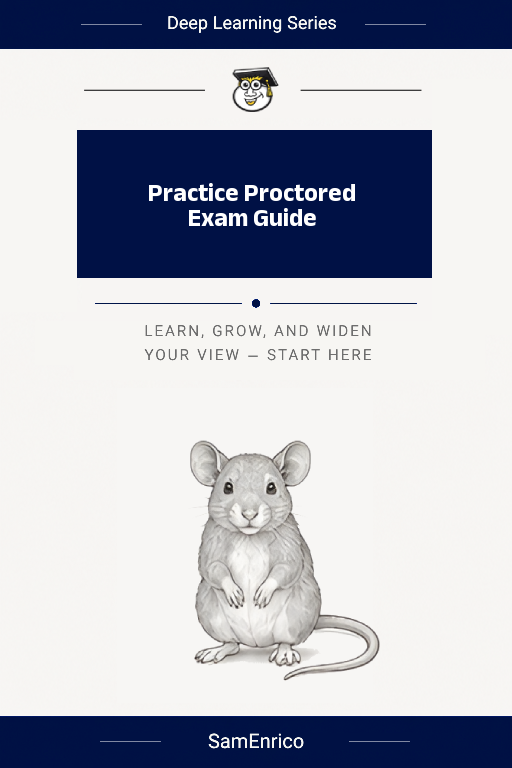
Non-FictionStudent's ShortcutPractice TestAnxiety Reduction
Practice Proctored Exam Guide eBook
Take mock proctored exams using free trials to und
Take mock proctored exams using free trials to understand flag triggers and reduce anxiety before the real test.
Formats
Free sample
Chapter 1: The Watched Student...--If you are reading this sentence, you have already felt it. That specific, crawling sensation that you are being watched—not by a person who could smile or nod or show mercy, but by something far less forgiving. An algorithm. A blinking webcam light. A line of text that says "Recording in Progress." Your shoulders tighten.
Your throat dries. You check your reflection in the dark lens of the camera and wonder: What does it see? What does it think? What happens if I move the wrong way?You are not alone. Over the past five years, the use of automated proctoring software has exploded across universities, certification boards, and professional licensing exams.
Millions of students sit for proctored exams every year, and nearly all of them report some degree of anxiety beforehand. But here is the truth that test-prep companies won't tell you and that your professors might not even know: the source of that anxiety is almost never the content of the exam. You have studied. You know the material. You have taken practice tests and scored well.
The fear comes from somewhere else entirely—from a small, dark box of uncertainty that sits between you and your score.This book exists to open that box.The Real Enemy Is Not the Webcam Let us start with a fact that might surprise you: research consistently shows that being recorded by a webcam does not, by itself, raise most people's anxiety levels. In study after study, participants who knew they were being recorded performed similarly to those who were not—provided they understood what the recording was for and how it would be used. The problem is not the camera. The problem is what you do not know about the camera.Consider this experiment. Two groups of students take the same proctored exam.
Group A receives a detailed explanation of exactly what the proctoring software detects: eye movement, background noise, face visibility, tab-switching. They are shown sample flags and told which ones trigger human review and which are simply logged as data. Group B receives the standard warning: "This exam is being proctored. Any suspicious behavior may result in academic penalties."Group A reports significantly lower anxiety. Group B reports confusion, hypervigilance, and fear.
Same software. Same webcam. Same exam. The only difference was certainty.This is the black box problem. When you cannot see inside a system, your brain does something remarkable and terrible: it imagines the worst possible version of that system.
You do not think, "The software might log a timestamp if I look away for ten seconds." You think, "If I look away, the AI will think I am cheating and I will fail and my entire future will collapse." That catastrophic leap is not a sign of weakness. It is a sign of a healthy brain trying to protect you from an unknown threat. But it is also completely wrong.What Actually Happens Inside the Proctoring Software Let me tell you what actually happens when you take a proctored exam. The software does not sit there like a hawk, waiting to devour you for a single mistake. It runs a series of relatively simple checks, most of which are designed to log data rather than penalize behavior.
Every few seconds, the software takes a snapshot of your face. It checks whether your eyes are visible, whether your mouth is covered, whether the lighting has changed dramatically. It records audio levels to detect conversations or unusual noise. It monitors your browser for attempts to open new tabs or copy text.That is it. Most of these checks are looking for patterns, not crimes.
A single glance away from the screen rarely triggers anything more than a timestamp. A brief cough or a quiet whisper to yourself is logged and almost immediately dismissed. Even a face that leaves the frame for a few seconds is usually marked as a low-priority event that no human ever reviews.The data from major proctoring services is remarkably consistent: only about one percent of all flags ever result in any kind of academic integrity review. The other ninety-nine percent are either automatically cleared or reviewed and dismissed within seconds. Most instructors never even look at the proctoring log for a given exam.
They receive a summary report that highlights only the most severe flags—tab-switching, copy-paste attempts, or extended periods of face absence. Everything else is noise.But you did not know that. And because you did not know that, you have been carrying around a fear that is almost entirely disconnected from reality.The False Positive Panic One of the most damaging myths about proctoring software is the idea that "false positives" are common and catastrophic. A false positive is when the software flags you for something you did not do—an accusation of cheating that is later shown to be incorrect. These do happen, but they are rare.
And when they do happen, they are almost never resolved by the software itself. A false positive flag is reviewed by a human being who looks at the timestamp, watches the video segment, and makes a judgment.Here is what that human judgment looks like in practice. A flag appears because a student looked down at their desk for fifteen seconds. The human reviewer watches the video. They see the student's eyes drop, then return to the screen.
They see no phone, no notes, no second person. They click "dismiss" and move on. The entire process takes about twenty seconds. The student never even knows it happened.The fear of false positives is, in many ways, more damaging than the flags themselves. Students who believe they might be falsely accused tend to sit unnaturally still during exams.
They keep their eyes locked on the screen even when they need to think. They suppress natural behaviors like looking away to recall information or mouthing words to process a difficult question. These unnatural behaviors are actually more likely to trigger flags than natural ones because they look like attempts to hide something.A student who nervously glances around the room every few minutes is rarely flagged. A student who stares rigidly at the screen without blinking looks like someone trying to read notes taped to the monitor. The software does not know the difference.
It only sees patterns.Inoculation Theory: Why Exposure Kills Fear There is a well-established psychological principle called Inoculation Theory. It works like this: if you expose someone to a small, manageable version of a stressor, they develop resistance to the full version. Vaccines work this way. So do fire drills, flight simulators, and military training exercises. The principle is universal: controlled exposure to a threat, in an environment where failure is safe, builds psychological immunity.This book is an inoculation program for proctoring anxiety.
Over the next eleven chapters, you will expose yourself to every aspect of the proctoring experience—not in your real exam, but in a safe, free, low-stakes sandbox environment where nothing matters and no one is judging you. You will trigger flags on purpose. You will whisper and look away and leave your seat. You will see exactly what happens when…
This is the end of the free sample. Get the eBook to keep going. Buy now
About this book
Details
- Author
- Quiroz Deeann
- Publisher
- SamEnrico
- Language
- English
- Genre
- Non-Fiction, Student's Shortcut, Practice Test, Anxiety Reduction
- Released
- 2026-06-01
- Pages (approx.)
- 151
- Available as
- eBook, Audiobook

Read better in the ZLOADR app
Your eBooks on your phone or tablet. Sign in with your SamEnrico account and start reading.
More by Quiroz Deeann
 Pornography and Technology Addiction CourseQuiroz Deeann$11.99
 Parents in PrisonQuiroz Deeann$11.99
 HIIT App Selection GuideQuiroz Deeann$11.99
 Hearing Preservation After 70Quiroz Deeann$11.99
 Smoking Quitline Strategy GuideQuiroz Deeann$11.99
 The Forgotten Ice Hunter: How a Humble Shepherd Unlocked Europe's Frozen SecretsQuiroz Deeann$11.99
 The Queen’s Secret: How a 1969 Royal Wedding Almost Sparked a Diplomatic CrisisQuiroz Deeann$11.99
 Understanding CardiospasmQuiroz Deeann$17.99
 Women in B2B Sales Middle EastQuiroz Deeann$12.99
 How to Start a Curtains (made-up) Business (Beginners Guide)Quiroz Deeann$11.99
 Land Use & Zoning LawQuiroz Deeann$11.99
You may also like
 Hong Kong Handover 1997Dunn Johnnie$11.99
 Zumba For Postnatal Recovery CourseNeal Christian$11.99
 Zumba for BeginnersLadner Nikia$11.99
 YouTube Comment Mining GuideHumes Pandora$12.99
 Worry Box MeditationCarlin Rudy$11.99
 Workplace Stress MeditationNguyen Lynn$11.99
 Workplace Stress and Sleep RepairHawley Ivory$11.99
 Workplace Perfectionism CureDelaney Jeffry$11.99
 Workplace Injustice Anger GuideWallen Isabelle$11.99
 Work Addiction and Burnout LinkGreenwood Ester$11.99
 Women in Yoga and WellnessBeattie Galina$11.99
 Women in Stand Up ComedyChun Evangeline$11.99