
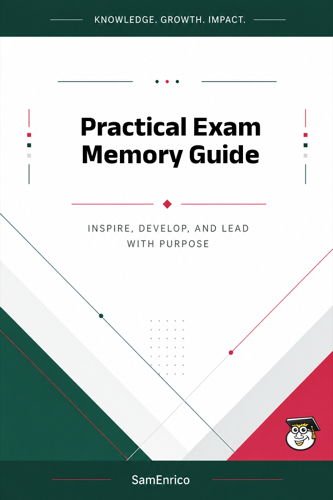
Practical Exam Memory Guide eBook
Remembers step by step procedures.
Remembers step by step procedures.
Formats
Free sample
Chapter 1: The Blank Page...--–- The fluorescent lights hummed overhead. The proctor said, "You may begin." You turned to the first question. You knew this material. You had spent forty-seven hours last month alone on this subject. The question asked for a seven-step procedure.
You wrote step one. Then step two. Then—nothing. The pen hovered. Your mind, a moment ago crowded with knowledge, was now a white void.
You could feel the shape of the missing information, like a word on the tip of your tongue, but it would not come. The clock ticked. You wrote something, anything, and moved on. Later, walking to your car, the entire sequence returned to you, fully formed and painfully correct. You were not stupid.
You were not unprepared. You were experiencing what cognitive psychologists call the "Blank Page Phenomenon," and it has nothing to do with how much you studied.This chapter exists to solve a single, devastating problem: you know the material, but you cannot retrieve the order under pressure. Most students who fail procedural exams do not fail because they never learned the steps. They fail because their brain, under the unique physiology of exam stress, cannot access the steps in the correct sequence. Understanding why this happens is not academic curiosity—it is the foundation upon which every technique in this book is built.
If you skip this chapter, the rest of the book will feel like random tricks. If you master this chapter, you will understand why memory palaces work, why cramming fails, and why your brain is not broken.The Two Memory Systems Living Inside Your Head Your brain does not have one memory system. It has dozens. For the purpose of passing exams that require step-by-step procedures, two systems matter: semantic memory and procedural memory. Most students have never heard these terms, and that ignorance is the primary cause of procedural exam failure.Semantic memory is the system that stores facts, concepts, meanings, and general knowledge about the world.
When you know that Paris is the capital of France, that water freezes at zero degrees Celsius, or that the mitochondria is the powerhouse of the cell, you are using semantic memory. This system is declarative—you can state the fact aloud. It is also relatively resilient under moderate stress. A student who forgets a single fact during an exam might feel frustrated, but the damage is contained to that one item.Procedural memory is the system that stores sequences of actions, step-by-step processes, and learned procedures. When you know how to tie your shoes, how to start a car with a manual transmission, or how to perform a medical hand wash, you are using procedural memory.
This system is not declarative in the same way. You cannot simply "state" a procedure—you must execute it in order. Under stress, procedural memory is far more fragile than semantic memory because it operates like a chain. Break one link, and the entire sequence collapses.Here is the critical insight that changes everything: exams that ask for step-by-step procedures are testing your procedural memory, but most study methods train your semantic memory. You are using a hammer to turn a screw.
The tool is wrong, not the craftsman.Consider the difference. A semantic memory question might ask: "What is the normal resting heart rate for an adult?" The answer is a fact: 60 to 100 beats per minute. You either know it or you do not. A procedural memory question might ask: "Describe the correct sequence for measuring a patient's radial pulse." The answer is a sequence: first, wash hands. Second, locate the radial pulse on the thumb side of the wrist.
Third, place the pads of your index and middle fingers over the artery. Fourth, count beats for fifteen seconds. Fifth, multiply by four. Sixth, document the result. This is not a fact.
It is a chain of actions. Knowing the individual facts (the pulse location, the counting method, the multiplication factor) does not guarantee that you can retrieve them in the correct order under pressure.The student who studies for a procedural exam by rereading the textbook, highlighting key facts, and making flashcards of individual steps is training semantic memory. They are learning the components of the procedure without learning the sequence. When the exam asks for the sequence, their brain has no stored order. The steps exist, but they are scattered, like loose pages from a book.
The Blank Page Phenomenon is not forgetting—it is disorganization.The Physiology of the Blank: What Cortisol Does to Sequences To understand why your brain blanks on procedures during exams, you must understand a hormone called cortisol. Cortisol is released by the adrenal glands in response to stress. In small amounts, it is helpful—it sharpens focus, increases alertness, and mobilizes energy. In large amounts, particularly when sustained over time, it impairs cognitive function.The relationship between cortisol and memory is not linear. Moderate stress can enhance memory formation.
High stress, especially when perceived as uncontrollable or threatening, impairs memory retrieval. The exam hall—with its ticking clock, silent proctor, and high stakes—is a high-stress environment for most students. Your body interprets the exam as a threat. It releases cortisol. Cortisol then acts on the hippocampus, the region of the brain most responsible for memory retrieval.Here is the specific mechanism that causes the Blank Page Phenomenon.
The hippocampus contains a high density of glucocorticoid receptors, which bind to cortisol. When cortisol levels rise too high, these receptors become overstimulated. The result is a temporary suppression of hippocampal function. Neural pathways that were clear and accessible during low-stress study sessions become difficult to activate under high stress. The information is still stored in your brain—it has not been erased—but the retrieval pathway is blocked.For semantic memory, this suppression might cause you to forget a single fact, like the capital of a country you studied.
Annoying, but recoverable. For procedural memory, the effect is catastrophic. Procedural memory is not stored as a single unit; it is stored as a chain of associations. Step one triggers step two, which triggers step three, and so on. When cortisol suppresses hippocampal function, it does not suppress all steps equally.
It tends to suppress the transition between steps—the associative link that tells your brain, "Step one is complete; now execute step two." Without that link, you complete step one and then freeze. You do not forget the individual steps. You forget which step comes next.This is why the Blank Page Phenomenon feels so strange. You can remember step one. You can remember step three if someone prompts you.
But step two is gone. And without step two, step three cannot be accessed because your brain's retrieval system is sequential. The chain is broken. This is not a failure of storage. It is a failure of sequential retrieval under stress.The Catastrophic Cascade: How One Broken Step Destroys an Entire Procedure Let us walk through what happens inside your brain during a procedural exam blank.
You read the question. It asks for a twelve-step procedure. You have studied this procedure for three weeks. You begin writing.Step one comes easily. Your…
This is the end of the free sample. Get the eBook to keep going. Buy now
About this book
Details
- Author
- Starr Cortney
- Publisher
- SamEnrico
- Language
- English
- Genre
- Non-Fiction, Self-Help, Procedural Memory
- Released
- 2026-06-05
- Pages (approx.)
- 140
- Available as
- eBook, Audiobook

Read better in the ZLOADR app
Your eBooks on your phone or tablet. Sign in with your SamEnrico account and start reading.
More by Starr Cortney
 Franchising Your Local Brand Across Borders Bribery LawsStarr Cortney$11.99
 Sperm Health 90 Day CycleStarr Cortney$11.99
 HCG for Testosterone MaintenanceStarr Cortney$11.99
 Self Esteem Secure Attachment GuideStarr Cortney$11.99
 Stimulant Stigma GuideStarr Cortney$11.99
 Alcoholism Recovery for Older AdultsStarr Cortney$11.99
 House Hacking Retirement GuideStarr Cortney$11.99
 The Ice Road to Berlin: The Soviet Winter Offensive That Shattered the Reich (1945)Starr Cortney$11.99
 Operation Greif: The Nazi Ghost Division That Almost Changed WWIIStarr Cortney$11.99
 How to Produce Interior Water-based StainStarr Cortney$11.99
 UAE VAT Group Registration HandbookStarr Cortney$12.99
 Student CV and Cover Letter GuideStarr Cortney$12.99