
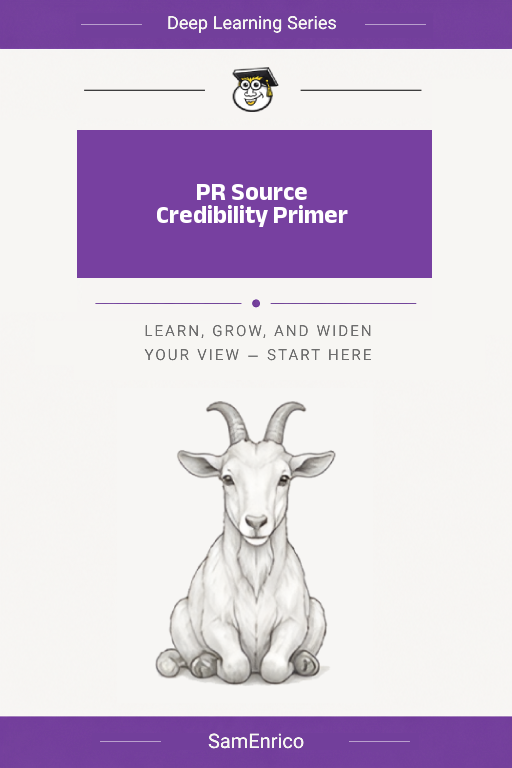
Non-FictionFirst 30 DaysPR for BeginnersAuthority Guide
PR Source Credibility Primer eBook
Build your online authority with LinkedIn profile,
by Chester Lupe
Build your online authority with LinkedIn profile, past media, and testimonials. Covers adding headshots, crafting bios, and why reporters choose sources with social proof.
Formats
Free sample
Chapter 1: Eleven Seconds to Trust––It was 3:47 on a Tuesday afternoon when Emily, a senior reporter at a national business outlet, opened her three hundred and twelfth pitch of the week. The email subject line read: “Expert Available: Supply Chain Crisis.” She almost deleted it immediately. Almost. But something made her click.The pitch claimed the sender was a “leading supply chain strategist” who had “worked with Fortune 500 companies” and possessed “deep expertise in logistics optimization.” Emily had seen these exact phrases—verbatim—in seventeen other pitches that same morning. She opened the sender’s Linked In profile.
The headshot was a stiff, poorly lit corporate photo from what looked like 2012. The banner was a generic stock image of shipping containers. The “About” section was written in the third person, filled with words like “passionate” and “synergy-driven.” The last three posts were republished articles from other people, with no original commentary. There were no testimonials. No past media mentions.
No evidence that this person had ever been quoted anywhere.Emily closed the profile. She deleted the pitch. Total time invested: eleven seconds.This is not an outlier. This is the daily reality of modern journalism. And it is the single greatest opportunity you are currently missing.Welcome to the Proof Gap.The Problem That No One Is Talking About Let us begin with an uncomfortable truth.
For most of modern media history, credibility was assumed until proven otherwise. If you had a title—doctor, professor, CEO, consultant—and you were willing to speak on the record, a reporter would likely quote you. The barrier to entry was low because the cost of fraud was high. Fabricating expertise required elaborate schemes, fake credentials, and a willingness to risk public exposure.That world is gone.In its place is something far more treacherous. Generative AI can now produce plausible-sounding expert content in seconds.
Fake bylines, fabricated quotes, synthetic video interviews, and entire fake personas are being generated daily. A 2025 study by Vayner X and Muck Rack found that fifty-six percent of consumers have lost trust in traditional news over the past five years. More critically for our purposes, sixty-five percent of consumers specifically flag a “lack of clear evidence, data, or sources” as the primary credibility killer. They want proof. They demand verification.
And journalists, whose careers depend on accuracy, have become the front line of this verification war.This creates what I call the Proof Gap. The Proof Gap is the distance between what you claim about your expertise and the verifiable evidence you provide to support that claim. When the Proof Gap is wide—when your claims are grand but your evidence is thin—reporters ignore you. When the Proof Gap is narrow—when every claim is backed by visible, verifiable proof—reporters seek you out.Here is the brutal reality that most experts refuse to accept. Your self-proclaimed expertise is worthless.
Every person who emails a reporter claims to be an expert. Every Linked In profile claims to be a thought leader. Every website claims to be the best in its industry. Claims are air. Claims are noise.
Claims are the reason Emily deleted that pitch in eleven seconds.What matters now is proof.The Three Questions Every Reporter Asks in Eleven Seconds Before we go further, I need you to understand exactly what happens when a reporter encounters your name for the first time. This is not theoretical. I have interviewed dozens of journalists from outlets ranging from the Wall Street Journal to industry trade publications. Their workflows are remarkably consistent.When a reporter receives a pitch or sees a name in a HARO query response, they open three tabs simultaneously. First, your Linked In profile.
Second, a Google search of your name plus the word “quoted” or “cited.” Third, your personal website or company bio page. They spend approximately eleven seconds on this initial scan. In that eleven seconds, they are looking for answers to exactly three questions.Question one: Does this person look like a credible professional? This is visual. Headshot quality, banner professionalism, consistent branding across platforms.
If you look sloppy or outdated, they close the tab.Question two: Has anyone else already vetted this person? This is social proof. Past media mentions, testimonials from recognizable clients or colleagues, engagement metrics on their content. If other people have trusted you, the reporter’s risk is lower.Question three: Does this person’s claimed expertise match their visible activity? This is algorithmic and human.
If you claim to be a cybersecurity expert but your last six Linked In posts are about leadership, productivity, and your vacation, the reporter flags you as either unfocused or fraudulent.If you fail any of these three questions in those eleven seconds, you are done. The reporter does not give you a second chance. They do not click to page two of Google. They do not read your full bio. They delete your pitch, close your profile, and move to the next name on their list.The Credibility Triangle: Your New Framework for Proof The rest of this book is built on a single framework that answers those three reporter questions systematically and verifiably.
I call it the Credibility Triangle. It has three corners, and every corner must be strong. Weakness in any corner breaks the triangle and costs you opportunities.Corner one is Linked In Authority. This is the visual and algorithmic proof that you are an active, engaged, recognized expert in your field. It includes your headshot and banner, which signal professionalism in five seconds.
It includes your headline and “About” section, which must be optimized for the search terms reporters use. It includes your posting history, which must demonstrate consistent, topical expertise. And it includes your engagement metrics—specifically saves and substantive comments—which signal to both the algorithm and human reporters that your content provides lasting value. Chapters two, three, five, nine, and ten of this book are devoted exclusively to building this corner of the triangle.Corner two is Past Media Performance. This is the verifiable evidence that other journalists and outlets have already judged you credible enough to quote.
A single mention in a tier-one publication is worth more than a hundred self-proclaimed credentials. But here is the catch that most people miss. Having past media mentions is not enough. The way you present them determines whether a reporter sees you as established or irrelevant. A raw hyperlink to a 2019 interview signals that you have not done anything lately.
A native PDF of a recent mention, with your quote highlighted and context provided, signals that you are actively building your authority. Chapter seven is dedicated entirely to curating and presenting your past media performance.Corner three is Verified Testimonials. This is the third-party validation that you deliver results, not just opinions. But not all testimonials are equal. A generic “Jane is great to work with” is worse than useless—it signals that no one could think of anything specific to say about you.
A data-rich testimonial that includes specific metrics—“Jane increased our share of voice by forty percent in three months”—is gold. A video testimonial, where a recognizable client looks into a camera and says…
This is the end of the free sample. Get the eBook to keep going. Buy now
About this book
Details
- Author
- Chester Lupe
- Publisher
- SamEnrico
- Language
- English
- Genre
- Non-Fiction, First 30 Days, PR for Beginners, Authority Guide
- Released
- 2026-05-30
- Pages (approx.)
- 156
- Available as
- eBook, Audiobook

Read better in the ZLOADR app
Your eBooks on your phone or tablet. Sign in with your SamEnrico account and start reading.
More by Chester Lupe
 Empty Quarter Gas TankChester Lupe$11.99
 Portal Theories National Park MysteriesChester Lupe$11.99
 Sexual Addiction and ADHD LinkChester Lupe$11.99
 Harvard Extension Admissions GuideChester Lupe$11.99
 The Sky Pioneers: Gaspar Schott and the Birth of High-Altitude ScienceChester Lupe$11.99
 Tangaroa’s Wrath: The Storm That Swallowed the SunChester Lupe$11.99
 SMB Cybersecurity OutlookChester Lupe$12.99
 Understanding Homocystinuria Due to Defect In Methylation Cbl EChester Lupe$17.99
 A Beginners Guide to Benchrest shooting (Volume 1)Chester Lupe$11.99
 Night AuditChester Lupe$11.99
You may also like
 Hong Kong Handover 1997Dunn Johnnie$11.99
 Zumba For Postnatal Recovery CourseNeal Christian$11.99
 Zumba for BeginnersLadner Nikia$11.99
 YouTube Comment Mining GuideHumes Pandora$12.99
 Worry Box MeditationCarlin Rudy$11.99
 Workplace Stress MeditationNguyen Lynn$11.99
 Workplace Stress and Sleep RepairHawley Ivory$11.99
 Workplace Perfectionism CureDelaney Jeffry$11.99
 Workplace Injustice Anger GuideWallen Isabelle$11.99
 Work Addiction and Burnout LinkGreenwood Ester$11.99
 Women in Yoga and WellnessBeattie Galina$11.99
 Women in Stand Up ComedyChun Evangeline$11.99