
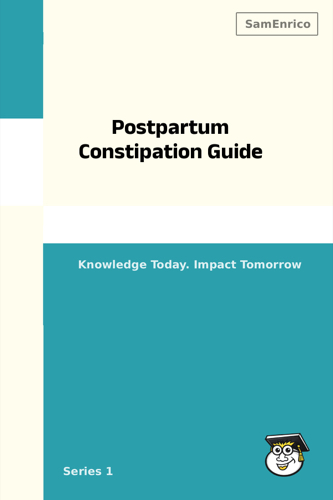
Postpartum Constipation Guide eBook
Prevention and treatment of painful bowel movement
Prevention and treatment of painful bowel movements after birth.
Formats
Free sample
Chapter 1: The Unspoken Crisis...--The first bowel movement after giving birth is one of the most feared, least discussed, and poorly managed medical events in modern postpartum care. If you are reading this book, you have likely already heard whispers from other mothers—a grimace, a half-joke about "the first poop," or perhaps a more honest confession from a close friend who told you it was worse than labor itself. Or, more frighteningly, you may have heard nothing at all, and you are about to discover this reality on a hospital toilet, alone, exhausted, and terrified.This chapter exists to ensure that does not happen to you. Or, if you have already experienced that trauma, this chapter exists to tell you that what happened was not normal, not your fault, and not something you must repeat.The Great Postpartum Silence Let us begin with a simple question: why does almost no one warn pregnant women about this? Consider the exhaustive preparation that surrounds childbirth.
You likely attended prenatal classes where you practiced breathing techniques for labor. You packed a hospital bag with specific items for your delivery. You read books about the stages of labor, the signs of transition, and the moment of birth. You discussed pain management options with your obstetrician. You may have hired a doula.
You prepared for the baby's arrival with a nursery, car seat, and onesies in multiple sizes.And yet, almost no standard prenatal curriculum includes a single word about what happens when you try to pass stool after delivery.This silence is not accidental. It is the product of multiple intersecting failures in women's healthcare. First, there is the clinical separation of specialties: obstetricians manage pregnancy and birth; primary care manages everything else; and the pelvic floor falls into a strange no-man's-land between urology, gynecology, and physical therapy. Second, there is the scheduling reality of postpartum care: the infamous "six-week checkup" occurs long after the most acute bowel issues have either resolved or become chronic. Third, and most damning, there is the cultural script that tells new mothers their suffering is normal, expected, and even noble.This last point deserves special attention.
New mothers are told, implicitly and explicitly, that their bodies are no longer their own. Pain is reframed as sacrifice. Discomfort becomes devotion. When a mother says, "It hurts to use the bathroom," the response is often a sympathetic smile and a dismissive, "That's just how it is after having a baby."It is not. And that belief is causing real harm.Why This Chapter Matters Before Any Other You may wonder why anatomy comes before hydration, diet, or the psychological strategies that will fill later chapters.
The answer is simple: you cannot fix what you do not understand. Constipation after birth is not the same as the occasional constipation you may have experienced during pregnancy or at other times in your life. It is a fundamentally different mechanical problem with distinct causes, and treating it with generic constipation advice—drink more water, eat more fiber, take a laxative—can actually make things worse.Consider the difference between a traffic jam caused by too many cars on the highway and a traffic jam caused by a collapsed bridge. The first responds to simple solutions: spread out the traffic, add more lanes, stagger driving times. The second requires bridge repair before any traffic can flow at all.
Postpartum constipation is the collapsed bridge, not the rush hour.Your body has just undergone a profound physical event, whether you delivered vaginally or by cesarean section. Organs have been displaced. Muscles have been stretched, torn, or surgically incised. Swelling compresses structures that normally function without conscious thought. Anesthesia and pain medications slow down systems that rely on rhythmic contraction.
And on top of all of this, you are exhausted, likely dehydrated from labor, possibly anemic, and suddenly responsible for keeping a newborn alive while your own body screams for attention.No amount of prune juice will fix that by itself.The Vaginal Birth: A Mechanical Story Let us walk through what happens to the body during a vaginal delivery, focusing specifically on the structures involved in defecation. If this description feels graphic, remember that the graphic nature is precisely the point. We have been taught to politely avert our eyes from the mechanics of birth, and that politeness has left mothers unprepared.During a vaginal delivery, the baby passes through the birth canal, which is bordered by the pelvic floor muscles. These muscles form a sling-like hammock across the bottom of the pelvis, with openings for the urethra, vagina, and rectum. Under normal circumstances, these muscles maintain resting tone—they are neither fully contracted nor fully relaxed—and they contract reflexively during coughing, sneezing, or lifting to maintain continence.During labor, these muscles stretch to an extraordinary degree.
The baby's head, typically about 10 centimeters in diameter, passes through an opening that is normally closer to 2-3 centimeters. This stretching is not gentle. It is mechanical deformation of muscle tissue, connective tissue, and nerves. Some women experience tearing of the perineum—the area between the vaginal opening and the anus—ranging from first-degree tears (involving only the skin) to fourth-degree tears (extending through the anal sphincter and into the rectal lining). Others receive an episiotomy, a surgical incision made to enlarge the vaginal opening, which then requires suturing after birth.Even in the absence of visible tearing, the pelvic floor muscles are stretched and weakened.
The pudendal nerve, which supplies sensation and motor function to the perineum and anal sphincter, can be compressed or damaged during a prolonged second stage of labor. This nerve damage can reduce sensation in the rectum, meaning you may not feel the urge to have a bowel movement as clearly as you did before pregnancy. The result is that stool remains in the rectum longer, becoming harder and more difficult to pass.Simultaneously, the rectum itself has been compressed. During the final stages of labor, the baby's head presses directly against the posterior wall of the vagina, which is immediately adjacent to the anterior wall of the rectum. This pressure can cause bruising, swelling, and temporary changes in rectal sensation.
In some cases, the pushing efforts of labor can cause hemorrhoids to prolapse—meaning they bulge out of the anus—or can worsen pre-existing hemorrhoids to the point of thrombosis (blood clotting within the hemorrhoid, which is exquisitely painful).The Cesarean Section: A Different Set of Challenges If you delivered by cesarean section, you may be reading this chapter and thinking it does not apply to you. After all, nothing passed through your pelvic floor. Your perineum is intact. You avoided the stretching, tearing, and direct compression of vaginal birth.This is both true and dangerously misleading. Cesarean section mothers experience a completely different set of mechanical obstacles to normal bowel function, and they are equally likely to suffer from severe postpartum constipation.First, consider the surgery itself.
A cesarean section involves an incision through the abdominal wall, the fascia (the tough connective tissue covering the abdominal muscles), and the uterus. During the procedure, the intestines are exposed to air, which can temporarily disrupt their normal motility. The manipulation of…
This is the end of the free sample. Get the eBook to keep going. Buy now
About this book
Details
- Author
- Mccollum Katlyn
- Publisher
- SamEnrico
- Language
- English
- Genre
- Non-Fiction, Health & Wellness, Digestive Health
- Released
- 2026-06-10
- Pages (approx.)
- 139
- Available as
- eBook, Audiobook

Read better in the ZLOADR app
Your eBooks on your phone or tablet. Sign in with your SamEnrico account and start reading.
More by Mccollum Katlyn
 Highway Anger De escalationMccollum Katlyn$11.99
 Teens Anticipatory Grief GuideMccollum Katlyn$11.99
 Customer Persona SnapshotMccollum Katlyn$11.99
 Breast Ultrasound ExplainedMccollum Katlyn$11.99
 Boundary Setting for MilitaryMccollum Katlyn$11.99
 OCD and Intrusive ThoughtsMccollum Katlyn$11.99
 Constraints for SalespeopleMccollum Katlyn$11.99
 The Silk Road Ambush: The Han Dynasty's Clash of EmpiresMccollum Katlyn$11.99
 The Dragonmaster’s Gambit: A Spy Among the ScaledMccollum Katlyn$11.99
 How to Produce Packaging TraysMccollum Katlyn$11.99
 How to Produce Contact Lens Care KitsMccollum Katlyn$11.99
 SWOT Analysis Essay PromptsMccollum Katlyn$12.99
You may also like
 Postpartum Constipation ReliefDerr Romona$11.99
 Lactose Intolerance Relief GuideMchenry Carmelita$11.99
 Lactose Intolerance GuideGilbert Elena$11.99
 Fiber Types and BenefitsMora Deidre$11.99
 Diarrhea Management GuidePridgen Kerstin$11.99
 Keto Constipation Relief GuideShore Wes$11.99
 Constipation Relief ExercisesHardwick Dreama$11.99
 Chloride And DigestionThornburg Shawanda$11.99
 The Microbiome ResetSimms Isaiah$11.99
 Low FODMAP Meal PrepRoberge Codi$11.99
 Ginger Oil Digestion GuideMusser Marietta$11.99
 Low Carb For IBS ReliefSchwarz Enriqueta$11.99