
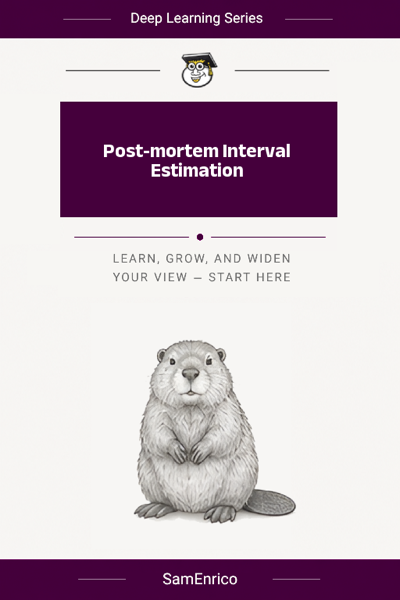
Post-mortem Interval Estimation eBook
A Coursebook on Post-mortem Interval Estimation
by Hass Lucinda
A Coursebook on Post-mortem Interval Estimation
Formats
Free sample
Chapter 1: The Dead Witness...---– The body lay on a cold stainless steel table, its silent testimony written in shades of purple and green, in the stiffness of locked joints, in the slow decay of cells that had stopped dividing hours or days before. A detective stood in the corner of the morgue, arms crossed, jaw tight. “I need a time,” he said. “Not a range. Not a probability.
I need to know when he died so I can figure out who killed him.” The forensic pathologist looked up from the corpse and replied, with the patience of someone who had delivered this news a hundred times before, “I can give you a probability. I can give you a confidence interval. I can tell you which methods work best for this body in this environment. But I cannot give you a single number, because the dead do not wear wristwatches.”That exchange, or something very much like it, has played out in medical examiner offices around the world every single day for the past century. And it captures, in a single uncomfortable moment, everything this book is about.
Post-mortem interval estimation—the science of determining how long a person has been dead—is not a simple matter of reading a biological stopwatch. It is a messy, multivariable, context-dependent puzzle that integrates physics, chemistry, entomology, botany, and statistics. It is also one of the most consequential determinations a forensic pathologist can make, because the difference between a death occurring at 8 PM versus midnight can mean the difference between a conviction and an acquittal, between a life sentence and a walk out of the courthouse a free person.This book will teach you how to do it right. Not by memorizing a single formula or relying on a single method—that path leads to error and, in court, to humiliation under cross-examination. But by understanding the principles that govern every post-mortem change, the strengths and weaknesses of each method, and, most importantly, how to integrate multiple independent lines of evidence into a coherent, defensible estimate.What Is Post-Mortem Interval and Why Does It Matter?Let us begin with the definition, because precision in language is the foundation of precision in science.
The post-mortem interval, universally abbreviated as PMI, is the time elapsed between the moment of death and the moment the body is discovered or examined. That sounds straightforward. It is not. The moment of death is rarely observed. The moment of discovery is often hours, days, or even years after the fact.
Between those two points, the body undergoes a continuous, complex series of changes—some physical, some chemical, some biological—each of which is influenced by a host of environmental and individual factors. The forensic scientist’s job is to work backward from the observed state of the body to an estimate of how long it has been since death occurred. It is, in essence, a reverse engineering problem with an incomplete set of blueprints.Why does PMI matter so much in death investigations? The answer is woven into the fabric of criminal law. In a homicide investigation, the first question is often not who killed the victim but when the victim died.
That timeline determines whose alibis are credible, whose phone records are relevant, whose DNA at the scene makes sense or raises suspicion. Consider a classic case: a man is found stabbed in his apartment. His estranged wife says she left him alive at 9 PM. His neighbor reports hearing a scream at 10 PM. A suspect’s phone places them near the apartment at 11 PM.
If the PMI is 9:30 PM, the wife’s alibi collapses. If the PMI is 11:30 PM, the suspect’s phone becomes damning. The difference of two hours can change everything.But PMI matters beyond homicide. In suicides, the interval helps reconstruct the decedent’s final actions. In accidents, it helps determine whether the death was instantaneous or whether the victim might have survived with different medical care.
In mass disasters, PMI helps identify remains by correlating with last known alive times. In suspicious deaths where the body has been moved, inconsistencies in PMI estimates from different methods can reveal that the corpse did not die where it was found. The PMI is not merely a number. It is a narrative anchor around which the entire story of a death is built.The Two Great Divisions: Early PMI and Extended PMIThroughout this book, you will encounter a fundamental distinction that shapes every methodological choice: the difference between early PMI (hours to days) and extended PMI (weeks to years). These are not arbitrary categories.
They reflect the fact that different physiological processes dominate at different times after death, and that the accuracy and precision of PMI estimates change dramatically as time passes.For the first 24 to 48 hours after death, the body still resembles a recently living organism. Core temperature is dropping in a predictable pattern. Muscles are stiffening and then relaxing. Blood is settling into dependent tissues. Chemical gradients in the vitreous humor of the eye are still changing in approximately linear ways.
During this early window, estimates can be surprisingly precise—sometimes within two to four hours under optimal conditions. This is the golden period of PMI estimation, when physics and chemistry give us our sharpest tools.Beyond the first few days, however, the landscape changes. Putrefaction sets in. Gases bloat the abdomen. Skin discolors and slips from underlying tissues.
Insects arrive and begin their predictable succession. The body no longer cools like a simple physical object; it generates its own heat through bacterial metabolism. Chemical markers become non-linear or plateau. Precision degrades from hours to days, then from days to weeks. By the time only bones remain, we are measuring in years or decades, and confidence intervals widen accordingly.Understanding this division is not just academic.
It dictates your entire approach at a death scene. A body that is still warm to the touch demands a rectal thermometer, a Henssge nomogram, and a careful recording of ambient temperature. A body that is bloated and discolored requires insect collection, decomposition scoring, and a completely different mental toolkit. A skeleton in the woods sends you to the radiocarbon lab and the entomologist who specializes in bone-colonizing beetles. The skilled practitioner recognizes the stage at a glance and selects methods accordingly.The Environmental Orchestra: Factors That Play Every Body Like an Instrument If you take only one concept from this chapter—one idea that will inform every subsequent page of this book—let it be this: every post-mortem method is a measurement of a process, and every process is modulated by its environment.
You cannot estimate PMI without accounting for temperature, humidity, body habitus, clothing, burial, and a dozen other variables. Ignore them at your peril.Temperature is the single most important environmental factor affecting PMI estimation. It influences literally every post-mortem change. Body cooling (algor mortis) accelerates in cold environments and slows in warm ones. Rigor mortis develops faster at higher temperatures and resolves sooner.
Putrefaction, driven by bacterial enzymes, roughly doubles in rate for every 10°C increase in temperature—a relationship known as the Q₁₀ coefficient. Insect development, measured in accumulated degree days, is entirely temperature-dependent. Even…
This is the end of the free sample. Get the eBook to keep going. Buy now
About this book
Details
- Author
- Hass Lucinda
- Publisher
- SamEnrico
- Language
- English
- Genre
- Non-Fiction, Informative, Educational
- Released
- 2026-05-04
- Pages (approx.)
- 160
- Available as
- eBook, Audiobook

Read better in the ZLOADR app
Your eBooks on your phone or tablet. Sign in with your SamEnrico account and start reading.
More by Hass Lucinda
 Thunberg's Transatlantic SailHass Lucinda$11.99
 After Funeral Small Talk HandbookHass Lucinda$11.99
 Mindful Dog Walking GuideHass Lucinda$11.99
 Fading Food Diary RecordingHass Lucinda$11.99
 The Nobel And Penicillin StoryHass Lucinda$11.99
 The Phantom Plague: The Medical Mystery of the Pacific's Lost ExpeditionHass Lucinda$11.99
 The Last Vote of the OracleHass Lucinda$11.99
 One Page Franchise Marketing GuideHass Lucinda$12.99
 Freemium Data Caps GuideHass Lucinda$12.99
 Understanding Gonadal DysgenesisHass Lucinda$17.99
 How to Become a Distiller IiHass Lucinda$11.99