
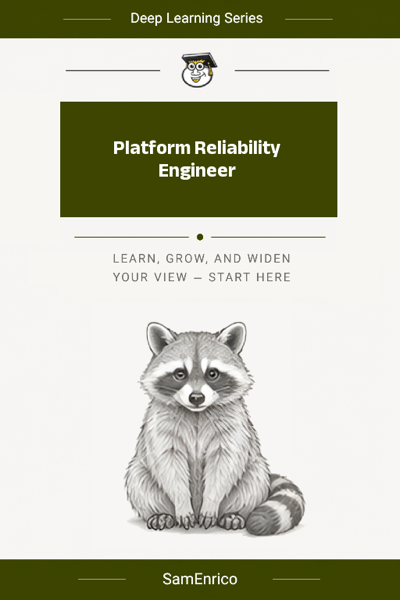
Platform Reliability Engineer eBook
A Coursebook on Platform Reliability Engineer
A Coursebook on Platform Reliability Engineer
Formats
Free sample
Chapter 1: The Burnout Pipeline--–- The pager screamed at 3:17 AM. Again. The same alert, the same CI runner, the same disk-full condition that I had manually fixed forty-seven times over the past six months. As I sat up in bed, blinking at the blinding blue light of my laptop, I realized something that would take me another two years to articulate properly: I was not an engineer anymore. I was a janitor with an on-call rotation.This is not a unique story.
In fact, it is the single most common origin story for every Platform Reliability Engineer I have ever met. We did not set out to build platforms. We set out to ship features, to solve interesting problems, to write code that made users happy. But somewhere along the way, the infrastructure grew teeth. The scripts multiplied.
The cloud console became a second home. And the term “Dev Ops” – originally a beautiful vision of shared responsibility – became a death sentence for work-life balance.This book is not a gentle introduction to platform engineering. It is not a vendor comparison guide or a collection of Kubernetes YAML templates. This book is an argument. An argument that the way most organizations approach “platforms” is fundamentally broken, that the burnout you are feeling is not a personal failing but a systemic one, and that there is a different way to do this job – a way that trades the 3 AM pager for something resembling a normal human life.The Great Lie of “You Build It, You Run It”Let us start with a confession.
The Dev Ops movement, for all its virtues, accidentally created a monster. The original promise was beautiful: break down the wall between developers and operations. Have developers understand how their code runs in production. Have operations understand the pressures of feature delivery. Shared responsibility.
Shared learning. Shared success.But somewhere in the mid-2010s, this beautiful vision curdled into something dark. “You build it, you run it” became “you build it, you are woken up at 3 AM for it.” The nuance vanished. The idea that responsibility could be shared – not dumped – was lost. And the industry began demanding that every developer be a Kubernetes expert, a Terraform wizard, a networking guru, and a feature-shipping machine all at once.This is impossible.
Not difficult. Not challenging. Impossible.Human cognitive load has limits. You cannot simultaneously hold a complex React component tree in your working memory while debugging an etcd quorum issue. You cannot deeply understand a new machine learning algorithm while manually restarting a failed CI runner for the forty-eighth time.
The brain does not work that way. And yet, the industry standard became exactly this: hire “full-stack developers” and expect them to be full-stack all the way down to the bare metal.The Cognitive Load Crisis The term “cognitive load” comes from educational psychology, but it has found a second home in platform engineering. Cognitive load is the total amount of mental effort being used in working memory. And here is the critical insight: human working memory is extremely limited. The classic study by George Miller put the number at “the magical number seven, plus or minus two” – but more recent research suggests that number is closer to four.
You can hold about four things in your head at once before something drops out.Now consider what a developer needs to know to deploy a simple web service in a typical modern organization:First, the application itself. The business logic, the API design, the database schema, the authentication flow. That is already pushing the limits of working memory.Second, the containerization layer. The Dockerfile syntax, the multi-stage builds, the layer caching, the security scanning. That is another mental model entirely.Third, the orchestration layer.
The Kubernetes pod specifications, the services, the ingresses, the config maps, the secrets, the persistent volumes, the network policies. That is a universe of its own.Fourth, the infrastructure layer. The Terraform modules, the VPC configurations, the IAM policies, the load balancers, the auto-scaling groups, the database instances. That is yet another cognitive domain.Fifth, the CI/CD layer. The pipeline syntax, the build stages, the artifact management, the deployment strategies, the rollback procedures.
That is the fifth distinct mental model.Sixth, the observability layer. The metrics, the logs, the traces, the dashboards, the alerts, the SLOs. That is the sixth.Seventh, the security and compliance layer. The encryption at rest, the encryption in transit, the vulnerability scanning, the policy enforcement, the audit logging. That is the seventh.No human can hold all seven of these mental models simultaneously.
It is not a skill issue. It is not a training issue. It is a biological limitation of the human brain. And yet, we have built an industry on the implicit assumption that this is possible.The Definition of a Platform Reliability Engineer This is where the Platform Reliability Engineer – the PRE – enters the story. The PRE is not a super-developer who can hold all seven mental models at once.
The PRE is the person who builds the abstraction layer that reduces the cognitive load for everyone else.Let me define the role precisely, because there is enormous confusion in the industry about what a PRE actually does. The PRE sits at the intersection of three disciplines:Platform Engineering. The PRE builds the Internal Developer Platform – the IDP. This is not a single tool. It is a collection of capabilities that allow developers to self-serve infrastructure without needing to understand every detail.
The IDP provides the Golden Paths, the reusable blueprints, the scaffolding tools, the policy enforcement. The PRE is the architect of this system.Site Reliability Engineering. The PRE keeps the platform running. This means defining Service Level Objectives for the platform itself, measuring Service Level Indicators, managing error budgets, running incident response, and relentlessly eliminating toil. The PRE is the operator of this system.Product Management.
The PRE treats the platform as a product. This means the developers who use the platform are customers. Their needs must be researched. Their feedback must be incorporated. Their satisfaction must be measured.
The platform must compete for adoption against the alternative – which is developers bypassing the platform entirely and creating their own shadow infrastructure. The PRE is the product manager of this system.These three roles are in constant tension. The platform engineer wants to build elegant abstractions. The SRE wants to keep things stable and boring. The product manager wants to ship features that customers actually want.
A good PRE navigates these tensions rather than pretending they do not exist.The “Platform as a Product” Mindset The most important shift in thinking – and the one that will appear throughout this book – is the move from “platform as a project” to “platform as a product.”A project has a start date, an end date, a budget, and a list of deliverables. When the deliverables are shipped, the project ends. The team disbands. Everyone moves on to the next project.A product has none of these things. A product has a continuous lifecycle.
It has a roadmap, not a deadline. It has a product manager, not a project manager. It has users, not stakeholders. It has retention metrics…
This is the end of the free sample. Get the eBook to keep going. Buy now
About this book
Details
- Author
- Cambell Eboni
- Publisher
- SamEnrico
- Language
- English
- Genre
- Non-Fiction, Informative, Educational
- Released
- 2026-06-02
- Pages (approx.)
- 145
- Available as
- eBook, Audiobook

Read better in the ZLOADR app
Your eBooks on your phone or tablet. Sign in with your SamEnrico account and start reading.
More by Cambell Eboni
 The Funnel for BootstrappersCambell Eboni$11.99
 TM Effortless Technique GuideCambell Eboni$11.99
 The Governor and the FloodCambell Eboni$11.99
 IBS Yoga Poses GuideCambell Eboni$11.99
 Password Hash Leak Customer AlertCambell Eboni$11.99
 The Silent Architect: How a White House Staffer Shaped Global PolicyCambell Eboni$11.99
 The Deep-Sea Alchemist: Unlocking the Secrets of the Atlantic's Rare ElementsCambell Eboni$11.99
 Understanding Cleft Lip And/or Palate With Mucous Cysts of LowerCambell Eboni$17.99
 Bottleneck Scheduling GuideCambell Eboni$12.99
 Business Plan Version ControlCambell Eboni$12.99
 A Beginners Guide to Amun-Re (Volume 1)Cambell Eboni$11.99