
Non-FictionInformativeEducational
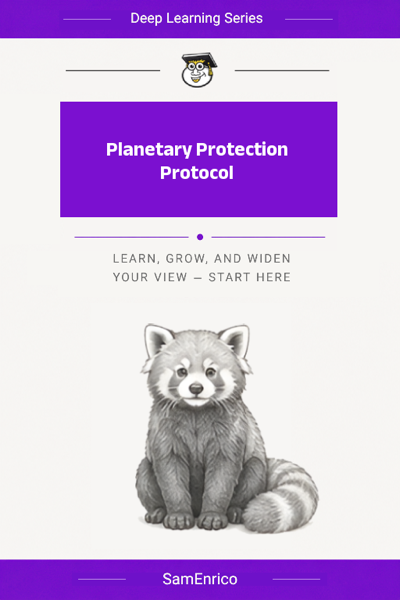
Planetary Protection Protocol eBook
A Coursebook on Planetary Protection Protocol
A Coursebook on Planetary Protection Protocol
Formats
Free sample
Chapter 1: The Invisible War...--–- The sterility cabinet hissed open, and Dr. Elena Vasquez stared at the object inside: a fleck of dust no larger than a grain of sand, suspended in a sealed glass vial. Beneath the electron microscope, it resembled a crumpled paper bag—until she adjusted the focus. There, clinging to the surface, were twelve perfect spheres. Spores.
Bacillus spores. They had survived three months in a vacuum chamber, two weeks of ultraviolet radiation equivalent to a Martian year, and a temperature cycle that swung from minus eighty degrees Celsius to a hundred and twenty. They were not just alive. They were dormant, patient, and waiting.The vial had never left the cleanroom. The spores had arrived there on the sleeve of a technician who had followed every protocol: the bunny suit, the double gloves, the air shower, the sticky mats at every door.
And yet, one spore had clung to a weave of fabric, shaken loose during assembly of a lander destined for Mars. That lander was now sitting on a launch pad in Florida, its thrusters primed, its sample cache empty, its sterilization certificate signed in triplicate. Elena had signed it herself.She reached for the phone and dialed the number she hoped she would never need to call: the Planetary Protection Officer at NASA Headquarters. It was two in the morning in Washington, but the voice that answered was alert, wary, and already resigned. "How bad?" asked Dr.
Marcus Thorne. Elena looked back at the microscope. "Twelve spores," she said. "On the sample handling arm. We missed them." There was a long silence.
Then Marcus spoke again, each word deliberate: "Then we have a decision to make. Do we tell the world, delay the launch, and admit that our best cleanroom is never clean enough? Or do we say nothing, fly as planned, and hope that the spores stay dormant, that the Martian environment kills them, that nobody ever finds out?"This is the opening scene of a story that has not yet happened—but could, at any moment, on any mission to any world. The choice between total honesty and calculated risk is not a hypothetical exercise for graduate students. It is the daily reality of planetary protection, the invisible war that began not with rockets, but with a question: What happens if we bring something back?
Or worse, if we take something with us?Planetary protection is not a checklist. It is not a regulatory burden imposed by bureaucrats who have never left low Earth orbit. It is the first test of humanity's ethical maturity as a multi-planetary species. Every time we send a probe to Mars, a lander to Europa, or a sample return mission to an asteroid, we are making a silent contract with the future. We are promising that we will not destroy the evidence of a second genesis before we know whether we are alone in the universe.
We are promising that we will not turn the solar system into a microbial petri dish, smeared with the fingerprints of Earth.This chapter is about why that promise is so difficult to keep. It is about the two directions of contamination: forward, from Earth to the cosmos, and backward, from the cosmos to Earth. It is about the 1967 Outer Space Treaty, a document written in the language of Cold War diplomacy that somehow captured a timeless truth: some places are too valuable to own, and too fragile to exploit. And it is about the Tragedy of the Commons—the ancient insight that when nobody is responsible for a shared resource, everybody is responsible for its destruction.But unlike the oceans or the atmosphere, space has no border patrol, no environmental protection agency, no fleet of enforcement vessels. A fine cannot be collected a hundred million kilometers away.
A prison sentence cannot be served on the surface of Mars. The only enforcement mechanism is the conscience of the explorers themselves. And conscience, as every engineer knows, is not a redundant system.The Two Directions of Harm To understand planetary protection, you must first understand the difference between forward contamination and backward contamination. They are mirror images of the same problem, but they demand opposite solutions, and they carry different consequences for failure.Forward contamination is the transfer of Earth-origin organisms—bacteria, fungi, spores, even fragments of DNA—to another celestial body. It is the problem of the sneeze in the cleanroom, the fingerprint on the rover wheel, the unsterilized drill bit that pierces a Martian rock.
The risk is not that Earth life will die out there. The risk is that it will thrive.Consider the hardiest organisms on Earth: extremophiles. They live in boiling springs, acidic mine drainage, the radiation-drenched heart of nuclear reactors, the cryogenic darkness of Antarctic lakes. A spore of Bacillus subtilis can remain viable for decades, even centuries, waiting for the right combination of water, temperature, and nutrients. If such a spore lands in a Martian Special Region—an area where liquid water might exist, however briefly—it could germinate, replicate, and spread.
Within years, a patch of Mars could be colonized by Earth bacteria. Within decades, the native Martian biosphere (if it exists) could be outcompeted, assimilated, or simply overlooked because every sample returns the same DNA signature: Bacillus, Staphylococcus, Escherichia. We would never know if we had found life or brought it.This is not science fiction. In 2019, researchers at the University of California, Berkeley, demonstrated that Deinococcus radiodurans, one of the most radiation-resistant organisms known, could survive on the surface of Mars for over a million years if shielded by just a few centimeters of regolith. The spores we cannot see today are the invaders of tomorrow.Backward contamination is the reverse: the return of extraterrestrial organisms—or organic toxins, prion-like agents, or entirely novel biochemistries—to Earth.
This is the plot of every Hollywood pandemic thriller, but the reality is more mundane and more terrifying. We do not know what we might bring back. The Martian surface is bathed in ultraviolet radiation that would shred DNA; any organism that survived there would have to be radically different from any life we know. It might not use DNA at all. It might not use carbon.
It might not even be alive in any sense we recognize—a self-replicating crystal, a catalytic prion, a chemical cycle that parasitizes Earth biochemistry.The Mars Sample Return campaign, scheduled for the late 2020s and early 2030s, is designed to prevent backward contamination by sealing samples in a chain of containment that never breaks: from sterile drill bit to sealed tube, from tube to ascent vehicle, from ascent vehicle to Earth entry vehicle, from entry vehicle to a receiving facility that does not yet exist. But as the opening scene of this chapter suggests, chains are only as strong as their weakest link.The 1967 Outer Space Treaty: Eighty-Eight Words That Changed Everything The legal foundation of planetary protection rests on a single paragraph of a single treaty signed at the height of the Cold War. The Outer Space Treaty of 1967 is often called the Magna Carta of space law. It established that space is the province of…
This is the end of the free sample. Get the eBook to keep going. Buy now
About this book
Details
- Author
- Batten Annmarie
- Publisher
- SamEnrico
- Language
- English
- Genre
- Non-Fiction, Informative, Educational
- Released
- 2026-05-08
- Pages (approx.)
- 154
- Available as
- eBook, Audiobook

Read better in the ZLOADR app
Your eBooks on your phone or tablet. Sign in with your SamEnrico account and start reading.
More by Batten Annmarie
 Forgiveness for BetrayalBatten Annmarie$11.99
 Meditation For Temporomandibular JointBatten Annmarie$11.99
 Attempt Survivor Pilot StoryBatten Annmarie$11.99
 Vegan Heart Health GuideBatten Annmarie$11.99
 The Parent Meeting Scheduling GuideBatten Annmarie$11.99
 The Red Baron’s Last Flight: Love and Valor in the Skies of 1918Batten Annmarie$11.99
 Understanding Nevus of Ota Retinitis PigmentosaBatten Annmarie$17.99
 AI Business Credit Card Rewards OptimizerBatten Annmarie$12.99
 Ivy League Essay FormulaBatten Annmarie$12.99
 How to Start a Cakes (retail) Business (Beginners Guide)Batten Annmarie$11.99
You may also like
 Hong Kong Handover 1997Dunn Johnnie$11.99
 Zumba For Postnatal Recovery CourseNeal Christian$11.99
 Zumba for BeginnersLadner Nikia$11.99
 YouTube Comment Mining GuideHumes Pandora$12.99
 Worry Box MeditationCarlin Rudy$11.99
 Workplace Stress MeditationNguyen Lynn$11.99
 Workplace Stress and Sleep RepairHawley Ivory$11.99
 Workplace Perfectionism CureDelaney Jeffry$11.99
 Workplace Injustice Anger GuideWallen Isabelle$11.99
 Work Addiction and Burnout LinkGreenwood Ester$11.99
 Women in Yoga and WellnessBeattie Galina$11.99
 Women in Stand Up ComedyChun Evangeline$11.99