
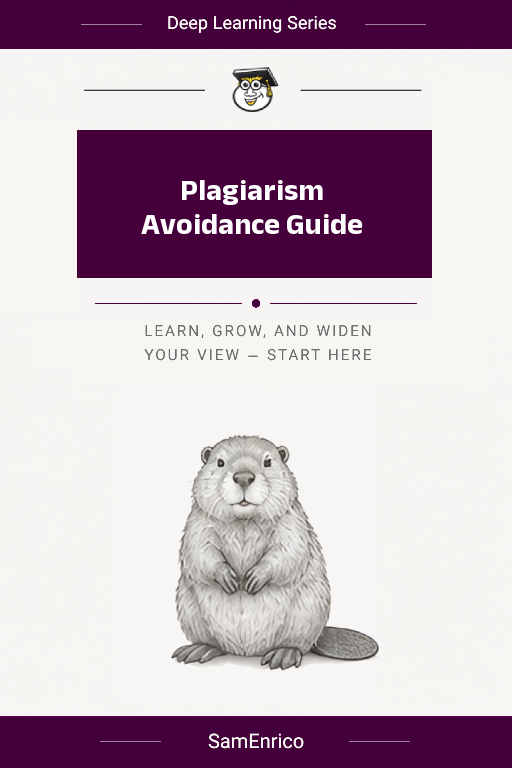
Plagiarism Avoidance Guide eBook
Cite properly to avoid academic dishonesty and uni
Cite properly to avoid academic dishonesty and unintentional plagiarism.
Formats
Free sample
Chapter 1: The S.A.F.E. System--You are sitting in a cramped dorm room at 2:47 AM. Your paper is due in nine hours. You have three sources open on your laptop, fourteen tabs in your browser, and a growing sense of dread that you have somehow accidentally copied someone else's work. You are not a cheater.
You would never deliberately steal another person's ideas. But you are exhausted, confused, and increasingly terrified that your professor's plagiarism detection software is about to light up like a Christmas tree.Let me tell you a secret. That feeling of dread is not your conscience telling you that you are a bad person. It is your brain telling you that you do not have a system.Most students who commit accidental plagiarism do not lack ethics. They lack process.
They read a source, take messy notes, and weeks later cannot remember which phrases came from the source and which were their own summary. They write their papers in a panic, rushing to meet a deadline, and forget to add quotation marks or page numbers. They paraphrase by changing a few words while keeping the original sentence structure, not realizing that this is still plagiarism.This book exists to give you a system. Not a collection of random rules that you will forget as soon as you close the cover, but a simple, memorable framework that you can apply to every paper, every source, every citation decision. I call it the S.A.F.E.
System. Learn it. Use it. And never lie awake at 2:47 AM terrified of an email from your professor again.The S.A.F.E. System has four steps.
Each step is one word. Each word tells you exactly what to do.S – Separate your notes.A – Attribute every borrowed idea.F – Flag your own contribution.E – Examine your finished paper.That is it. Four steps. Four words. A lifetime of academic integrity.But before I teach you how to use each step, you need to understand why the S.A.F.E.
System works. It works because it is built on the three core principles of academic honesty. These principles are not arbitrary rules invented to torture students. They are the foundation of all scholarly work, from a first-year composition paper to a Nobel Prize-winning scientific study.Principle One: Always acknowledge when you are drawing on someone else's work or ideas.This is the fundamental rule of academic integrity. Whenever you use words, ideas, data, images, or any other product of another person's intellectual labor, you must give them credit.
This applies whether you are quoting directly, paraphrasing, summarizing, or simply being inspired by a concept you encountered in your reading.Why does this matter? Two reasons. First, fairness. Intellectual work has value. When someone spends years researching and writing a book, they deserve recognition when you benefit from their labor.
Second, scholarly rigor. Your reader needs to know where your ideas come from. When you make a claim, they need to be able to trace it back to its source, verify it, and explore it further.Without acknowledgment, you are not just being unfair. You are making your reader’s job impossible. They cannot verify what they cannot trace.Principle Two: Make the boundaries of your contribution clear.Your reader should never have to guess which ideas are yours and which came from your sources.
This is why citations appear at specific points in your text rather than only in a bibliography at the end. Every time you shift from your own analysis to someone else’s idea, you signal that shift with a citation.Here is a mistake that even advanced students make. They assume that a bibliography is enough. They list all their sources at the end of the paper and think their work is done. It is not.
A bibliography tells your reader what you read. It does not tell them where you used each source. Did you use Smith on page one or page ten? Did you use Jones to support your argument or to disagree with it? Without in-text citations, your reader has to guess.
And guessing is not scholarship.The bibliography is a map of the territory you explored. In-text citations are the trail markers showing exactly where you went. You need both.Principle Three: Give your reader enough information to locate your sources.A proper citation is not just a name and a date. It is a set of instructions for finding the exact source you used. This is why different citation styles require different elements.
They all require enough information for someone else to track down what you found.Think about what you would need to find a book. The author’s name. The title. The publisher. The year of publication.
Maybe the edition if it is not the first. That is what a book citation includes. For a journal article, you also need the journal title, volume number, issue number, and page range. For a website, you need the URL and the date you accessed it, because websites change.If you omit any of these elements, you are making your reader’s job harder. In the worst case, you are making it impossible.
A citation without a page number is like a map without a street name. Your reader knows the general location but cannot find the exact spot.These three principles are not complicated. But applying them consistently requires practice, attention to detail, and a systematic approach. That is where the S.A.F.E. System comes in.
Each step of the S.A.F.E. System directly implements one or more of these principles.Step S – Separate your notes implements Principle Two (make boundaries clear) and Principle Three (give enough information). When you separate your notes into direct quotations, paraphrases, and your own reactions, you are building clarity from the very beginning. You are not waiting until the writing stage to figure out what is yours and what belongs to someone else. You are making that decision when you first encounter the source, when the information is fresh and your memory is reliable.Step A – Attribute every borrowed idea implements Principle One (always acknowledge).
This step is simple in concept but difficult in execution. Every time you use words or ideas from a source, you add a citation. Every time. No exceptions. The difficulty is that you will forget.
You will read a source, take notes, and three weeks later when you are writing your paper, you will not remember which ideas came from that source and which came from your own brain. That is why Step S (Separate) is so important. If your notes are already separated, attribution becomes much easier.Step F – Flag your own contribution implements Principle Two (make boundaries clear) and Principle One (acknowledgment from the other direction). Flagging your own contribution is the mirror image of attribution. Attribution tells your reader where you borrowed from.
Flagging tells your reader where you are contributing something new. Together, they create a complete picture of your intellectual work. Your reader can see exactly what you borrowed and exactly what you added.Step E – Examine your finished…
This is the end of the free sample. Get the eBook to keep going. Buy now
About this book
Details
- Author
- Hutchens Edyth
- Publisher
- SamEnrico
- Language
- English
- Genre
- Non-Fiction, Student's Shortcut
- Released
- 2026-06-01
- Pages (approx.)
- 117
- Available as
- eBook, Audiobook

Read better in the ZLOADR app
Your eBooks on your phone or tablet. Sign in with your SamEnrico account and start reading.
More by Hutchens Edyth
 Financial Stress First Aid HandbookHutchens Edyth$11.99
 Multivariate Validation TestingHutchens Edyth$11.99
 MILD Lucid Dreaming ProtocolHutchens Edyth$11.99
 Thunberg Climate Strikes BookHutchens Edyth$11.99
 Orrin HatchHutchens Edyth$11.99
 Addressing Religious DifferencesHutchens Edyth$11.99
 Prevent Defense Caution GuideHutchens Edyth$11.99
 Hustle Culture RejectionHutchens Edyth$11.99
 Habit Cheat SheetHutchens Edyth$11.99
 The Silk Road Spice Masters: Jan Huyghen van Linschoten and the Secrets of the EastHutchens Edyth$11.99
 The Siege of Hara: The Last Stand of the HashashinHutchens Edyth$11.99
 The Dancer's Guide to PentozalisHutchens Edyth$11.99
You may also like
 LSE Online Program LengthAgee Letisha$11.99
 Harvard Extension School for Working AdultsRoush Yer$11.99
 LSE Online Reading ListAshford Ludivina$11.99
 LSE Online Language RequirementsWhitten Daphine$11.99
 LSE Online Class SizeHughey Garret$11.99
 LSE Online Alumni MentorshipWild Lyla$11.99
 London School of Economics Alumni NetworkDutton Chantal$11.99
 Harvard Extension School Student SupportCantrell Christene$11.99
 Harvard Extension School Library AccessSantana Adah$11.99
 Harvard Extension School Degree CompletionBray Wyatt$11.99
 Harvard Extension School Course AuditingAbbott Craig$11.99
 Harvard Extension School Extension DiplomaNew Joane$11.99