
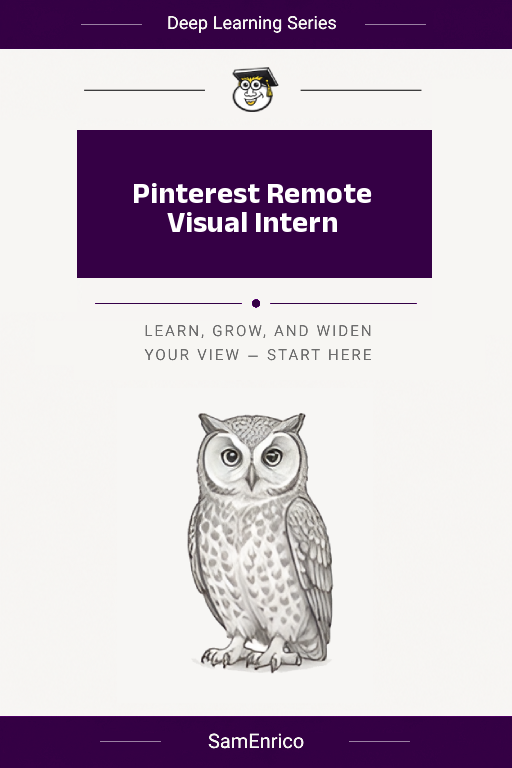
Non-FictionStudent's ShortcutVisual Tech InternshipPinterest Careers
Pinterest Remote Visual Intern eBook
Secure a virtual internship at Pinterest in visual
Secure a virtual internship at Pinterest in visual search image recommendation or content moderation with global teams.
Formats
Free sample
Chapter 1: The Visual Advantage--Most internship guides will tell you to polish your resume, grind Leet Code, and send out two hundred applications. That is the path to burnout, not to Pinterest. After analyzing the career trajectories of forty-seven former Pinterest interns across visual search, content moderation, and global operations, a different pattern emerges. The ones who received offers did not have perfect GPAs or ten previous internships. They had one thing the others lacked: they understood that Pinterest is not a social network.This misunderstanding is the single greatest filter in Pinterest's recruiting process.
Every year, thousands of talented students apply using strategies designed for Google, Meta, and Tik Tok. They talk about engagement metrics, viral loops, and time on platform. And every year, those applications go straight into the reject pile. Not because the candidates were unqualified, but because they were speaking the wrong language.Pinterest operates on a fundamentally different psychological model than other tech giants. Where Instagram optimizes for time spent and Tik Tok optimizes for virality, Pinterest optimizes for something far more subtle: inspiration.
The company's internal research has shown that users leave Pinterest feeling more optimistic about their future, while users of other platforms report increased anxiety and social comparison. This is not a marketing claim. It is a measurable outcome that drives every product decision, every algorithm update, and every interview question.If you are applying for a role in visual search, you cannot simply build a classifier that maximizes click-through rate. You must build a system that helps a bride planning a budget-friendly wedding feel less overwhelmed. If you are applying for content moderation, you cannot simply remove policy-violating content.
You must understand how systemic risks like gender-based violence or medical misinformation disproportionately harm vulnerable communities. If you are applying for global operations, you cannot simply coordinate across time zones. You must build the asynchronous workflows that make remote collaboration feel like serendipity, not a chore.This chapter rewires how you think about Pinterest before you write a single line of your application. By the end, you will understand the architectural difference between discovery and social networking, the three distinct internship tracks that most candidates never realize exist, and the psychological shift that separates successful candidates from the thousands who fail. More importantly, you will know exactly how to position yourself as someone who already thinks like a Pinterest employee before you have even submitted your resume.The Architecture of Inspiration: Why Pinterest Is Not a Social Network Let us start with a simple experiment.
Open Pinterest and scroll your home feed for five minutes. Then open Instagram and scroll for five minutes. Pay attention to how you feel afterward. If you are like most users, Pinterest leaves you with a quiet sense of possibility. You might have saved a recipe you want to cook, a hairstyle you want to try, or a renovation idea for a room you have been ignoring.
Instagram, by contrast, leaves you comparing your life to the curated highlights of others. One platform builds toward action. The other builds toward anxiety.This is not accidental. Pinterest's founding insight was that people use the internet for two fundamentally different purposes: social validation and personal planning. Social validation platforms reward performance.
You post a photo, wait for likes, and measure your worth in notifications. Personal planning platforms reward utility. You save an idea, organize it into a board, and later execute it in the real world. Pinterest chose the second path explicitly and has never wavered.The technical term for this is "visual discovery engine." Unlike a search engine like Google, which responds to explicit queries with text-based results, Pinterest surfaces ideas you did not know you were looking for. You might search for "living room paint colors" and discover a board about biophilic design that changes your entire approach to your apartment.
That moment of unexpected usefulness is the core unit of Pinterest's value proposition.This architectural choice has profound implications for how you should present yourself as a candidate. When a Pinterest interviewer asks "How would you improve the home feed?", they are not asking for a generic engagement optimization answer. They are asking how you would increase the density of "save-worthy" content. They want to hear about serendipity, about reducing the friction between inspiration and action, about helping users move from "that's nice" to "I am going to do that."The candidates who fail are the ones who answer with metrics like "increase click-through rate by 15 percent" or "boost daily active users by optimizing the ranking model." Those answers work at Meta. They get you rejected at Pinterest.
The candidates who succeed talk about "saves per session," "closeup rate," or "board completion percentage." They talk about reducing comparison anxiety. They talk about making the feed more diverse so that a user planning a wedding does not see only luxury venues but also creative budget options.Understanding this psychological difference is not optional. It is the price of entry.The Engagement Versus Inspiration Trap The tech industry has spent fifteen years optimizing for engagement. The logic is simple: more time on platform means more ads served means more revenue. Every metric from daily active users to session length to retention curves feeds into this single objective.
Pinterest has these metrics too. But they are not the primary objective.Pinterest's internal research team conducted a longitudinal study comparing user well-being across platforms. The results were striking. Users who spent time on Pinterest reported lower levels of social comparison, lower levels of appearance-related anxiety, and higher levels of future-oriented optimism. Users who spent the same amount of time on other platforms reported the opposite.
The correlation was strong enough that Pinterest began explicitly designing features to reduce engagement behaviors that correlate with negative mental health outcomes.Consider the "closeup" feature. When a user taps on a Pin to view it in detail, that is a closeup. On most platforms, closeups would be optimized to keep the user scrolling. Pinterest does the opposite. After a closeup, the algorithm is more likely to show Pins from the same board or related to the same project.
The goal is to help the user complete their planning session and then log off feeling satisfied, not to trap them in an infinite scroll.This philosophy shows up in interview questions constantly. A candidate for a visual search role might be asked: "Design a feature that helps users rediscover Pins they saved but forgot about." The obvious answer is a "recirculation" system that shows old saves in the feed. But the Pinterest answer goes deeper. The best candidate might propose a "board refresh" feature that analyzes a user's board and proactively suggests similar Pins that fill gaps in their planning. For a wedding board, that might mean showing centerpiece ideas if the user has saved invitations and dresses but nothing about table decor.The key insight is that Pinterest employees think of themselves as building tools for real-world action, not infinite loops.
Every feature should answer the question: "Does this help the user do something they actually want to do?" If the answer is no, the feature does not belong on Pinterest regardless of how much…
This is the end of the free sample. Get the eBook to keep going. Buy now
About this book
Details
- Author
- Gonzales Travis
- Publisher
- SamEnrico
- Language
- English
- Genre
- Non-Fiction, Student's Shortcut, Visual Tech Internship, Pinterest Careers
- Released
- 2026-05-29
- Pages (approx.)
- 150
- Available as
- eBook, Audiobook

Read better in the ZLOADR app
Your eBooks on your phone or tablet. Sign in with your SamEnrico account and start reading.
More by Gonzales Travis
 Restaurant Hostage OrdealGonzales Travis$11.99
 Cocaine Recovery Relationships GuideGonzales Travis$11.99
 The Abarbanel StatesmanGonzales Travis$11.99
 Panic Attack Breathing Techniques CourseGonzales Travis$11.99
 AI Voice Cloning for NarratorsGonzales Travis$11.99
 The Phantom of the Paris Catacombs: Unearthing the Bones of HistoryGonzales Travis$11.99
 Gears of the Forgotten: The Clockwork Oracle of DelphiGonzales Travis$11.99
 Crane InspectionGonzales Travis$11.99
 Executive Summary Timeline VisualizerGonzales Travis$12.99
 Understanding Brachycephaly Deafness Cataract Mental RetardationGonzales Travis$17.99
 Ultimate Handbook Guide to Quanzhou : (China) Travel GuideGonzales Travis$11.99
You may also like
 Hong Kong Handover 1997Dunn Johnnie$11.99
 Zumba For Postnatal Recovery CourseNeal Christian$11.99
 Zumba for BeginnersLadner Nikia$11.99
 YouTube Comment Mining GuideHumes Pandora$12.99
 Worry Box MeditationCarlin Rudy$11.99
 Workplace Stress MeditationNguyen Lynn$11.99
 Workplace Stress and Sleep RepairHawley Ivory$11.99
 Workplace Perfectionism CureDelaney Jeffry$11.99
 Workplace Injustice Anger GuideWallen Isabelle$11.99
 Work Addiction and Burnout LinkGreenwood Ester$11.99
 Women in Yoga and WellnessBeattie Galina$11.99
 Women in Stand Up ComedyChun Evangeline$11.99