
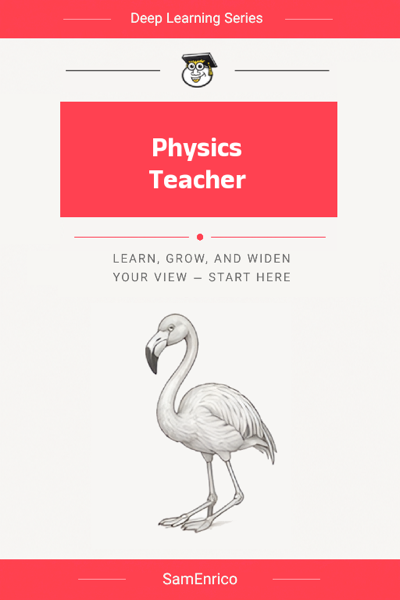
Non-FictionInformativeEducational
Physics Teacher eBook
A Coursebook on Physics Teacher
A Coursebook on Physics Teacher
Formats
Free sample
Chapter 1: The Hidden Curriculum...--–- The first time Maria walked into her physics classroom, she had fourteen perfect Power Point presentations, a pacing guide highlighted in four colors, and absolutely no idea that her students had already decided whether they would fail before she said a single word.She had done everything right, by the standards of her teacher credentialing program. She had written measurable learning objectives. She had aligned her assessments to state standards. She had even memorized the district’s mandated “student-centered language” script. On her first day, she stood at the front of the room, clicked through her beautifully formatted slides, and explained Newton’s three laws with clarity that would have made her methods professor proud.Six weeks later, her students took their first unit test.
The average was a 58 percent.Maria did what any rational new teacher would do: she re-taught the unit. She explained the same concepts more slowly, with more examples, with color-coded diagrams, with a mnemonic device she invented herself. She stayed after school for extra help sessions that three students attended. She made Quizlet flashcards and Kahoot! games and encouraged her students to use them.
She was working sixty hours a week, and she was certain that her effort would translate into their understanding.The retake average was 61 percent.Maria sat in her empty classroom on a Friday evening, staring at the stack of exams, and thought: Maybe I’m not cut out for this.Here is what Maria did not know, because no one had told her: her students had not failed because she explained physics badly. They had failed because they had learned, long before they entered her classroom, that physics was a subject for memorizing formulas, that getting the right answer meant finding the right equation to plug numbers into, and that anyone who had to ask questions in physics class probably didn’t belong there. These beliefs were not written anywhere in her curriculum. They were not in the state standards or the textbook or the pacing guide. They were the hidden curriculum — the invisible set of attitudes, expectations, and beliefs that students absorb from culture, from previous science classes, from movies, from parents, from each other — and they were more powerful than any Power Point Maria could create.This chapter is about that hidden curriculum.
It is about why students believe what they believe about physics, how those beliefs shape every moment of your classroom, and what you can do — starting tomorrow, in five minutes — to begin reshaping them. By the end of this chapter, you will understand the single most important distinction in physics teaching: the difference between how experts think about physics and how novices think about physics. And you will have a concrete plan for starting your next class period not with content, but with a conversation that might change everything.The Expert-Novice Divide: Why Your Students Are Not Small Physicists Let us begin with a thought experiment. I am going to give you two sets of physics problems. In Set A, I give you problems about blocks on inclined planes, projectiles launched at angles, and circuits with resistors in parallel.
In Set B, I give you problems about a child going down a slide, a basketball player shooting a free throw, and the wiring in a string of holiday lights. Which set is harder?Most physics teachers would say Set A is harder. But here is the truth: Set A and Set B are the same problems. The child on the slide is a block on an inclined plane. The basketball free throw is projectile motion.
The holiday lights are resistors in parallel. The only difference is the surface features — the concrete, real-world details that cloak the underlying physics principles.Here is the key insight: Experts see Set A and Set B as identical. Novices see them as completely different.This is not an opinion. It is one of the most replicated findings in the cognitive science of physics education. In a classic study from the 1980s, researchers asked expert physicists and novice physics students to sort a set of problems into categories based on similarity.
The novices sorted problems by surface features: “these have pulleys,” “these have ramps,” “these have springs.” The experts sorted problems by deep structure: “these use conservation of energy,” “these use Newton’s second law,” “these use the work-energy theorem.”What does this mean for your classroom? It means that when you teach a student how to solve a “block on a ramp” problem, you think you are teaching them Newton’s second law. But they think you are teaching them how to solve ramp problems. When you later give them a “child on a slide” problem — which is physically identical — they will say, “We never learned how to do slides. We only learned ramps.”This is not because your students are lazy or stupid.
It is because they have not yet built the mental structures that allow experts to see past surface features. They are doing exactly what their brains have evolved to do: they are noticing concrete, specific details because concrete, specific details are what kept our ancestors alive. “That rustle in the bushes is a saber-toothed tiger” is a surface-feature classification. “That rustle in the bushes is an instance of the general category ‘large predatory mammal approaching’” is a deep-structure classification. Your students are running ancient, highly adaptive cognitive software.
It just happens to be terrible for learning physics.The Three Beliefs That Destroy Physics Learning (Before You Even Start)The expert-novice divide is not just about cognition. It is also about beliefs — about what students think physics is, who can do physics, and what it means to understand something. Over two decades of research on student attitudes in physics, summarized most accessibly in the Colorado Learning Attitudes about Science Survey (CLASS) and the Maryland Physics Expectations Survey (MPEX), three beliefs consistently predict failure. They are not wrong answers. They are worldviews.
And they are almost certainly present in your classroom right now.Belief #1: Physics is a collection of formulas This is the most common and most destructive belief. Students who hold this belief see physics as a box of tools: each problem presents a set of numbers, and the student’s job is to select the correct formula from the box, plug in the numbers, and produce an answer. When they fail, they say things like, “I knew all the formulas, but I didn’t know which one to use” — which is like a carpenter saying, “I have a hammer, a saw, and a screwdriver, but I didn’t know which one to use to build a house.” The problem is not a lack of tools. It is a lack of understanding about what the tools do.Students with this belief study by memorizing equations. They make flashcards of F=ma F = ma F=ma, v=v0+atv = v_0 + atv=v0+at, E=mc2E = mc^2E=mc2, and they believe that memorization is understanding.
When they encounter a problem that requires reasoning — a conceptual question with no numbers, a real-world scenario where the variables are not given — they freeze.…
This is the end of the free sample. Get the eBook to keep going. Buy now
About this book
Details
- Author
- Holguin Debora
- Publisher
- SamEnrico
- Language
- English
- Genre
- Non-Fiction, Informative, Educational
- Released
- 2026-06-03
- Pages (approx.)
- 160
- Available as
- eBook, Audiobook

Read better in the ZLOADR app
Your eBooks on your phone or tablet. Sign in with your SamEnrico account and start reading.
More by Holguin Debora
 Children As EyewitnessesHolguin Debora$11.99
 The Handshake Decoder HandbookHolguin Debora$11.99
 Placental Abruption Loss HandbookHolguin Debora$11.99
 Metta for DepressionHolguin Debora$11.99
 Insurance ESG ComparisonsHolguin Debora$11.99
 The Jade Dragon’s Last Roar: Shanghai’s Forgotten UndergroundHolguin Debora$11.99
 10 Ways to Use Digestive Biscuit (Recipe Book)Holguin Debora$11.99
 Business Credit Fast Build GuideHolguin Debora$12.99
 Warm Introductions Through ConnectionsHolguin Debora$12.99
 Understanding Scalp–ear–nipple SyndromeHolguin Debora$17.99
You may also like
 Hong Kong Handover 1997Dunn Johnnie$11.99
 Zumba For Postnatal Recovery CourseNeal Christian$11.99
 Zumba for BeginnersLadner Nikia$11.99
 YouTube Comment Mining GuideHumes Pandora$12.99
 Worry Box MeditationCarlin Rudy$11.99
 Workplace Stress MeditationNguyen Lynn$11.99
 Workplace Stress and Sleep RepairHawley Ivory$11.99
 Workplace Perfectionism CureDelaney Jeffry$11.99
 Workplace Injustice Anger GuideWallen Isabelle$11.99
 Work Addiction and Burnout LinkGreenwood Ester$11.99
 Women in Yoga and WellnessBeattie Galina$11.99
 Women in Stand Up ComedyChun Evangeline$11.99