
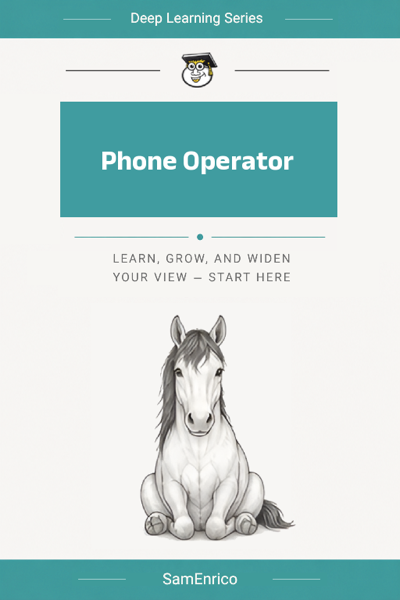
Non-FictionInformativeEducational
Phone Operator eBook
A Coursebook on Phone Operator
by Strain Kris
A Coursebook on Phone Operator
Formats
Free sample
Chapter 1: The Obituary Was Premature--–- In March 2018, a Fortune 500 company fired its entire phone support team of forty-seven people and replaced them with an automated chatbot powered by IBM Watson. The press release called it "the future of customer service." The company saved $2.1 million in the first year. The CEO gave a triumphant interview about efficiency and innovation.Eighteen months later, that same company quietly rehired thirty-two phone operators. They didn't issue a press release. They didn't announce the reversal.
They just posted job listings, held interviews, and brought back human voices to answer human calls. The chatbot hadn't failed technically—it could answer basic questions just fine. But something else happened that the spreadsheets hadn't predicted: customers started leaving. Not with a bang, but with a whisper. They didn't cancel angrily.
They just didn't come back. They called once, got the bot, hung up, and took their business elsewhere.The company learned a painful lesson that every phone operator should tattoo on the inside of their eyelids: speed is not the same as service, and automation is not the same as care.This book exists because that lesson is being forgotten and rediscovered in real time, every single day, in every industry. And at the center of that rediscovery is you—the person who picks up the phone.The Great Disappearing Act Let me tell you a story about a lie that almost came true.For the past decade, we have been told that the phone operator is a dying breed. "Talk to a representative" has been buried under layers of automated menus, AI chat windows, and "helpful" FAQs. Business publications have published thousands of articles with headlines like "The End of Call Centers" and "Why Phone Support Is Obsolete." Silicon Valley has poured billions into replacing human voices with synthetic ones.And on the surface, they made a compelling case.Why pay a human fifteen dollars an hour when a chatbot costs pennies per conversation?
Why deal with sick days, bathroom breaks, and bad moods when an algorithm never gets tired? Why tolerate the variability of human performance when a machine delivers the same answer every single time?The logic seemed airtight. The math was undeniable. And for a while, the obituary for the phone operator appeared to be writing itself.But then something strange happened. Something the spreadsheets didn't capture.
Something the algorithms couldn't compute.The customers noticed.They noticed when they needed to cancel a service and couldn't find a human. They noticed when a billing error took three days to resolve instead of three minutes. They noticed when they were angry, confused, or scared—and the voice on the other end was not a voice at all, but a recording.And they started leaving.The Data That Changed Everything In 2022, a major research firm conducted a study of 25,000 consumers across twelve industries. The question was simple: "When you have a complex problem with a company, what channel do you prefer?"The results shocked everyone who had been writing the obituaries.Seventy-three percent of respondents said they preferred speaking to a human on the phone for complex issues. Not chat.
Not email. Not self-service portals. The phone. A real person. A real voice.Even among respondents aged eighteen to twenty-five—the so-called "digital natives"—the preference for phone support over chat was nearly two to one.Why?
Because young people grew up with screens. They are exhausted by screens. They spend their days typing, tapping, and swiping. When something goes wrong, they don't want another screen. They want a human.
They want proof that a company actually cares enough to employ people who can listen.The researchers called this "the paradox of automation"—the more companies automate, the more customers crave human connection.This is not nostalgia. This is not Luddism. This is a rational response to a fundamental truth that technology cannot erase: complex human problems require complex human solutions. And no algorithm, no matter how sophisticated, can replace the emotional intelligence of a skilled phone operator.The Five Dimensions of Telephone Service Before we go any further, we need a framework. This entire book is built on one central idea: that excellence in phone operation can be measured, taught, and mastered.
That idea rests on five pillars. I call them the Five Dimensions of Telephone Service, and they will appear in every chapter that follows.Let me introduce them to you now.Dimension One: Speed Speed is the most obvious dimension. It is also the most misunderstood.When most people think about phone service, they think about how fast someone answers the phone. But speed is much bigger than that. Speed means:How quickly you answer the call (average speed to answer, or ASA)How efficiently you move through the call without rushing How promptly you follow up on promises How fast you recognize a problem and move to a solution The trap that many operators fall into is equating speed with rushing.
They are not the same thing. A fast call can feel rushed and disrespectful. A slower call can feel efficient if the operator is confident and focused. Speed without control is just chaos.Here is the rule that separates great operators from mediocre ones: Speed is measured in outcomes, not seconds. A two-minute call that requires a callback is slower than a five-minute call that resolves everything.
The faster outcome is the one that ends the problem permanently.Dimension Two: Accuracy Accuracy is the dimension that operators forget until it fails.Accuracy means:Capturing information correctly the first time Following procedures without error Transferring calls to the right person Documenting issues completely Making promises you can keep The cost of inaccuracy is enormous. Every wrong piece of information, every misrouted call, every forgotten promise creates a second call—sometimes a third, a fourth, a tenth. The most expensive call center in the world is the one that solves problems slowly and inaccurately, because every "almost resolved" issue comes back again and again.I have watched operators make the same mistake a hundred times: they rush through the information-gathering phase, miss a critical detail, and spend the next twenty minutes untangling a mess that could have been avoided with thirty seconds of careful listening.Accuracy is not about being slow. It is about being thorough in the right moments. The best operators know exactly where to slow down—at the beginning, during security verification, and at the end, during confirmation.
Everything else can flow naturally.Dimension Three: Tone Tone is the dimension that machines cannot replicate.Tone means:The warmth in your voice The pace of your speech The volume and inflection The presence or absence of a smile The emotional register you choose Here is a secret that most phone operators never learn: Your tone matters more than your words. A caller can forgive an agent who doesn't know an answer if the agent sounds caring and competent. A caller cannot forgive an agent who has all the answers but sounds cold, rushed, or dismissive.I have analyzed thousands of recorded calls. I have seen agents succeed with imperfect information because their tone built trust. I have seen agents fail with perfect information because…
This is the end of the free sample. Get the eBook to keep going. Buy now
About this book
Details
- Author
- Strain Kris
- Publisher
- SamEnrico
- Language
- English
- Genre
- Non-Fiction, Informative, Educational
- Released
- 2026-06-02
- Pages (approx.)
- 134
- Available as
- eBook, Audiobook

Read better in the ZLOADR app
Your eBooks on your phone or tablet. Sign in with your SamEnrico account and start reading.
More by Strain Kris
 The Greta Thunberg AwakeningStrain Kris$11.99
 Gym Small Talk WorkbookStrain Kris$11.99
 Japanese Nobel LaureatesStrain Kris$11.99
 Fading Food Cues TechniqueStrain Kris$11.99
 Forest Path Mindfulness TrainingStrain Kris$11.99
 The Silk Road's Shadow: How a 13th-Century Merchant Empire Shaped Global TradeStrain Kris$11.99
 The Bone Counters: The Prehistoric Quest for Prime NumbersStrain Kris$11.99
 Understanding Goldblatt–viljoen SyndromeStrain Kris$17.99
 How to Start a Printing Ink Manufacturing BusinessStrain Kris$11.99
 One Page A B Testing PrimerStrain Kris$12.99
 Grant Writing for StartupsStrain Kris$12.99
You may also like
 Hong Kong Handover 1997Dunn Johnnie$11.99
 Zumba For Postnatal Recovery CourseNeal Christian$11.99
 Zumba for BeginnersLadner Nikia$11.99
 YouTube Comment Mining GuideHumes Pandora$12.99
 Worry Box MeditationCarlin Rudy$11.99
 Workplace Stress MeditationNguyen Lynn$11.99
 Workplace Stress and Sleep RepairHawley Ivory$11.99
 Workplace Perfectionism CureDelaney Jeffry$11.99
 Workplace Injustice Anger GuideWallen Isabelle$11.99
 Work Addiction and Burnout LinkGreenwood Ester$11.99
 Women in Yoga and WellnessBeattie Galina$11.99
 Women in Stand Up ComedyChun Evangeline$11.99