
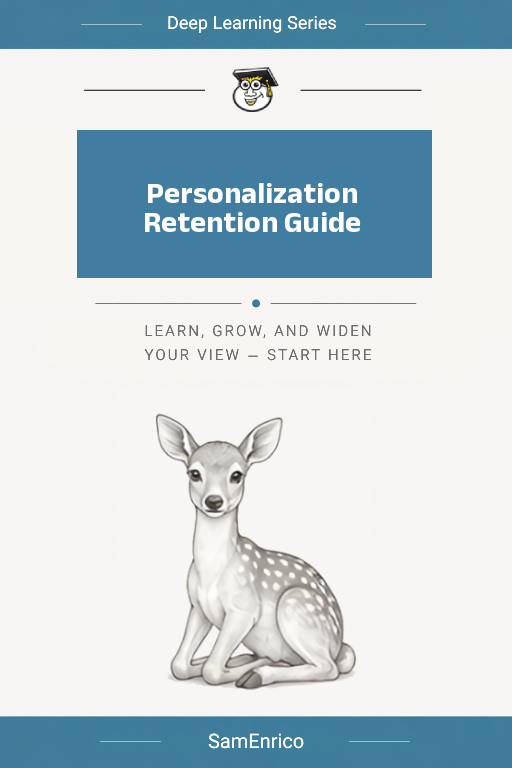
Non-FictionStrategic AtlasPersonalization
Personalization Retention Guide eBook
Reveals how top performers use personalization for
Reveals how top performers use personalization for retention including product recommendations, content curation, and tailored offers.
Formats
Free sample
Chapter 1: The Two-Trillion Lie--The average company spends nine dollars to acquire a customer and less than one dollar to keep them. Then they wonder why growth feels like running up a down escalator.Let me say that again, because the math is so absurd it sounds like a typo: nine dollars in, one dollar out. For every nine units of energy, money, and strategic attention poured into bringing people through the door, less than one unit is allocated to making sure they don’t immediately walk out the back. This is not a rounding error. This is not a temporary imbalance.
This is the single most expensive operational blind spot in modern business, and it has a name: the acquisition trap.The acquisition trap is the seductive belief that growth equals new customers. It is reinforced by every metric that boards worship—monthly active users, new signups, download volume, trial starts. These numbers go up when you spend money. They create beautiful hockey-stick charts for investor decks. They feel like progress.
But they are hiding a slower, more insidious truth: the faster you acquire, the faster you leak, unless you build the systems that make people want to stay.This chapter is called The Two-Trillion Lie not because two trillion dollars is a precise figure—though by most estimates, that is the annual value lost to churn across global e-commerce and subscription markets. It is called a lie because the marketing industry has convinced itself that acquisition is the hard part and retention is the easy cleanup crew. That is backwards. Acquisition is expensive, competitive, and increasingly inefficient. Retention, when done right, is compoundingly profitable.
And personalization is the only scalable bridge between the two.The Profit That Hides in Plain Sight Let us start with a number that should be tattooed on every founder’s forearm: increasing customer retention by just five percent can boost profits by twenty-five to ninety-five percent. This is not startup folklore. It comes from Frederick Reichheld’s seminal research at Bain & Company, replicated across thousands of companies over three decades. The range exists because different industries have different margin structures, but the direction is never in doubt. Retention is profit leverage.To understand why, imagine two companies.
Company A spends aggressively on acquisition, growing its customer base by ten percent every month. But it loses fifteen percent of its existing customers each month due to neglect, generic messaging, and zero personalization. Net growth? Negative five percent. Company B grows its customer base by only five percent per month through acquisition, but loses just two percent of existing customers because it has built personalization into every retention touchpoint.
Net growth? Three percent. Company B grows slower on paper but compounds faster over time because each customer stays longer and buys more.This is the math that nobody puts in their pitch deck. Acquisition gets the glory. Retention builds the fortune.The leaky bucket fallacy—the idea that you can just pour more water into a bucket with holes—has been debunked for decades, yet it persists.
Why? Because acquisition spending produces immediate, measurable results. Run a Facebook ad campaign today, see new users tomorrow. Retention spending produces results that are delayed, diffuse, and harder to attribute. Fix your onboarding personalization this quarter, and you will see lower churn in six months.
That lag makes retention an easy budget cut when times get tight. It is precisely the wrong move, but it is the predictable one.The Personalization Bridge Here is the core argument of this book, stated as simply as possible: generic retention efforts fail. Personalized retention efforts succeed. And the gap between the two is widening every day.Consider the standard retention toolkit. An abandoned cart email that says “You left something behind.” A win-back campaign that says “We miss you.” A birthday discount that says “Here is ten percent off anything.” These are not retention strategies.
They are spam with better grammar. They treat every customer identically, which means they treat no customer appropriately.Personalization changes the equation. Instead of “You left something behind,” imagine: “Your favorite running shoes are down to the last pair in your size.” Instead of “We miss you,” imagine: “It has been three weeks since your last workout—here is a recovery plan tailored to your history.” Instead of a birthday discount on anything, imagine: “We noticed you have been eyeing the ceramic coffee dripper. Happy birthday—here is fifteen percent off exactly that.”The difference is not semantic. It is structural.
Generic messages ask the customer to do work—to remember what they wanted, to search for it, to decide. Personalized messages do the work for them. They reduce cognitive load. They demonstrate attention. They transform a broadcast into a conversation.This book argues that personalization is not a feature you add to your retention stack.
It is the stack. Without it, you are guessing. With it, every post-purchase interaction becomes a signal that feeds the next action. The customer who buys a winter coat in November is telling you they might need gloves in December. The customer who reads three articles about productivity is telling you they might want a webinar on time management.
The customer who pauses a show during the opening credits is telling you they are distracted—and maybe, just maybe, that they need a different kind of recommendation entirely.The $2 Trillion Math Let me be precise about the two trillion figure, because it will come up throughout this book. According to a multi-year study by the Boston Consulting Group analyzing over 1,500 companies across retail, media, and subscription services, the global annual value lost to preventable churn exceeds $2 trillion. Preventable churn means customers who left not because they went bankrupt, moved away, or died, but because the business failed to give them a reason to stay.Break that down. A streaming service with ten million subscribers losing two percent per month is losing two hundred thousand customers every thirty days. At an average customer lifetime value of 500,thatis500, that is 500,thatis100 million in future revenue evaporating each month.
Not revenue they never had. Revenue they had, then lost.Most executives can tell you their customer acquisition cost to the penny. Few can tell you their churn rate by segment, their retention ROI, or the lift from their last personalization initiative. This asymmetry reveals the lie: we measure what we spend on, not what we lose. Acquisition gets a line item.
Retention gets a prayer.Top performers flip this script. They treat retention as a profit center, not a cost center. They know that reducing churn by one percent is mathematically equivalent to increasing acquisition by five to ten percent, but at a fraction of the cost. They use personalization to shorten time-to-value (getting a new customer to their first “aha” moment faster), reduce early churn (the first ninety days, where most attrition happens), and increase lifetime value by three to five times.The Case That Opened My Eyes Several years ago, I consulted for a direct-to-consumer supplement company. They were growing fast—thirty percent month over month—but burning cash on Facebook ads at a rate that made their CFO visibly uncomfortable.
Their retention numbers were abysmal. Of every hundred new subscribers, sixty were gone within three months.Their retention “strategy” consisted of…
This is the end of the free sample. Get the eBook to keep going. Buy now
About this book
Details
- Author
- Herron Shanika
- Publisher
- SamEnrico
- Language
- English
- Genre
- Non-Fiction, Strategic Atlas, Personalization
- Released
- 2026-05-29
- Pages (approx.)
- 144
- Available as
- eBook, Audiobook

Read better in the ZLOADR app
Your eBooks on your phone or tablet. Sign in with your SamEnrico account and start reading.
More by Herron Shanika
 HIIT Breathing Technique GuideHerron Shanika$11.99
 Empathy Vs Sympathy GuideHerron Shanika$11.99
 Trumpet Call of a Lead PlayerHerron Shanika$11.99
 Step One Admission ManualHerron Shanika$11.99
 The OCD Relationship GuideHerron Shanika$11.99
 Montcalm: The Lion of Quebec and the Fall of New FranceHerron Shanika$11.99
 Head of New Business and DevelopmentHerron Shanika$11.99
 CRM Free to Paid ConversionHerron Shanika$12.99
 The Breeder's Guide to Icelandic ChickensHerron Shanika$11.99
 How to Become a Oyster FloaterHerron Shanika$11.99
You may also like
 Hong Kong Handover 1997Dunn Johnnie$11.99
 Zumba For Postnatal Recovery CourseNeal Christian$11.99
 Zumba for BeginnersLadner Nikia$11.99
 YouTube Comment Mining GuideHumes Pandora$12.99
 Worry Box MeditationCarlin Rudy$11.99
 Workplace Stress MeditationNguyen Lynn$11.99
 Workplace Stress and Sleep RepairHawley Ivory$11.99
 Workplace Perfectionism CureDelaney Jeffry$11.99
 Workplace Injustice Anger GuideWallen Isabelle$11.99
 Work Addiction and Burnout LinkGreenwood Ester$11.99
 Women in Yoga and WellnessBeattie Galina$11.99
 Women in Stand Up ComedyChun Evangeline$11.99