
Non-FictionSelf-Help / Personalization
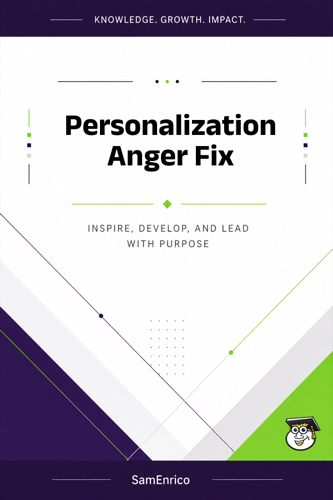
Personalization Anger Fix eBook
Stops taking everything personally when it's not a
Stops taking everything personally when it's not about you.
Formats
Free sample
Chapter 1: The 90-Second Reset--– You are standing in your kitchen. Your partner just walked in from work, glanced at the sink full of dishes, and sighed. Not a dramatic sigh. Just a small exhale. But something inside you ignites.
Within two seconds, your brain has already completed the following sequence: They’re angry at me. They think I’m lazy. I should have done the dishes. I’m always failing. They’re going to bring this up later.
I feel attacked. Your chest tightens. Your jaw clenches. You open your mouth to say something defensive—“I was going to do them, you know”—or maybe you say nothing and instead feel a hot wave of resentment wash over you for the next three hours.This is personalization anger. And it just cost you your evening.Before we talk about childhood templates, cognitive reframes, or boundary scripts, you need one thing above all else: a tool that works in the moment.
Not after the fight. Not when you’re journaling at midnight. Not next week after you’ve read six more chapters. Right now. In the kitchen.
In the three seconds between their sigh and your explosion.This chapter is that tool.Why Your Body Betrays You Here is something most self-help books won’t tell you: you cannot think your way out of personalization anger in real time. Not because you’re weak or undisciplined, but because your nervous system is faster than your prefrontal cortex. Way faster.Let me explain.The human brain processes threat through two parallel pathways. The first is the low road—a direct, lightning-fast connection from your sensory thalamus to your amygdala, the brain’s threat detection center. This pathway takes approximately 30 to 50 milliseconds.
That is not a typo. Milliseconds. By the time you are consciously aware that someone sighed, your amygdala has already decided whether you are under attack.The second pathway is the high road—a slower route from the thalamus to the sensory cortex to the prefrontal cortex (your logic and reasoning center) and then to the amygdala. This pathway takes about 500 to 600 milliseconds. In the world of neuroscience, that is an eternity.Here is what this means for you: by the time your rational brain gets a vote, your amygdala has already sounded the alarm, flooded your body with cortisol and adrenaline, increased your heart rate, tensed your muscles, and prepared you to fight, flee, or freeze.
You are not choosing to feel angry. Your body has already chosen for you.This is called an amygdala hijack, a term coined by psychologist Daniel Goleman. It is the neurobiological equivalent of a fire alarm going off because someone burned toast. The response is wildly disproportionate to the trigger, but the system doesn’t care about proportion. It cares about survival.
And here is the cruel irony: your brain treats social rejection—a sigh, a canceled plan, an unreturned text—with the same urgency as a physical threat. Evolution did not update the software. A grunt from a tribesman 100,000 years ago could mean exile or death. A sigh from your partner today feels the same way to your amygdala, even though you are not going to be left alone in the savanna to die.So no, you are not “too sensitive.” You are not “crazy.” You are operating with a brain that was designed for a world that no longer exists, responding to ambiguous social cues with the full force of a survival mechanism.But here is the good news: while you cannot prevent the amygdala from sounding the alarm, you can learn to interrupt the cascade before it becomes a full-blown personalization spiral. And the window for that interruption is very specific.The 90-Second Wave Neuroscientist Jill Bolte Taylor, in her book My Stroke of Insight, popularized a finding that has since been supported by affective neuroscience research: the physiological life span of an emotion—the raw, chemical, body-based experience—is approximately 90 seconds.
From the moment the amygdala triggers the cascade to the moment the chemicals are flushed out of your bloodstream, about 90 seconds pass.Let me repeat that because it is the single most important fact in this chapter. The feeling of anger—the heat in your chest, the tension in your jaw, the urge to lash out—lasts about 90 seconds if you do not feed it. What keeps anger alive for hours or days is not the emotion itself. It is the story you add. The rumination.
The replaying. The mental argument you have with the person who isn’t even in the room. The second dart, as we will explore in the next chapter.Your task, then, is simple to understand but difficult to execute in the beginning: you must learn to ride the 90-second wave without adding the story. You must feel the anger without becoming it. You must let the physiological surge pass through you like a wave through water, leaving no trace.This chapter gives you a four-part protocol to do exactly that.
I call it the 90-Second Reset.Part One: The Breath Anchor (Seconds 0–30)The moment you feel the first twinge of personalization anger—a colleague’s tone, a friend’s silence, a partner’s sigh—you have a choice. Not a choice about whether you feel angry. That choice is already gone. But a choice about whether you feed the anger or ride it.The first 30 seconds belong to your breath.Here is what you do: turn your attention to your exhale. Not your inhale.
Your exhale. Extend it. Breathe in for a count of four. Breathe out for a count of eight. In for four, out for eight.
Do this three times. That takes approximately 30 seconds.Why does this work? The vagus nerve—the longest cranial nerve in your body—runs from your brainstem to your abdomen, touching your heart, lungs, and digestive system along the way. It is the primary conduit of the parasympathetic nervous system, which is responsible for “rest and digest” functions. When you extend your exhale, you stimulate the vagus nerve.
When you stimulate the vagus nerve, you activate the parasympathetic response. When you activate the parasympathetic response, your heart rate slows, your blood pressure drops, and your amygdala receives a chemical signal that says, in effect: Stand down. We are not under attack.This is not meditation woo-woo. This is physiology. Elite military units use box breathing (a variation of extended exhale) to regulate themselves in combat.
Trauma therapists teach it to patients with PTSD. It works because it exploits a direct neural pathway from your lungs to your threat detection center.But here is what most people get wrong: they wait until they are already enraged to try the breath. By then, the window is closing. The 90-second reset works best when you apply it at the very first sign of activation. That raised eyebrow.
That silence that feels heavy. That text message with a period at the end. The moment you notice anything that could become personalization anger, you start the breath. Do not wait to see if you get angrier. Do not wait to see if they say something else.
Start now.Part Two: The Temperature Shift (Seconds 30–60)At the 30-second mark, you transition from breath to temperature.Here is what you…
This is the end of the free sample. Get the eBook to keep going. Buy now
About this book
Details
- Author
- Paulson Queen
- Publisher
- SamEnrico
- Language
- English
- Genre
- Non-Fiction, Self-Help / Personalization
- Released
- 2026-06-07
- Pages (approx.)
- 114
- Available as
- eBook, Audiobook

Read better in the ZLOADR app
Your eBooks on your phone or tablet. Sign in with your SamEnrico account and start reading.
More by Paulson Queen
 Fecal Transplant BrainPaulson Queen$11.99
 The Charles Eastman BiographyPaulson Queen$11.99
 Morning Tech Stack GuidePaulson Queen$11.99
 Mechanical Creativity GuidePaulson Queen$11.99
 Self Talk For GratitudePaulson Queen$11.99
 Loma Linda Adventists GuidePaulson Queen$11.99
 Nicoya PeninsulaPaulson Queen$11.99
 The Wrong Man: The Great Melbourne Jewel Heist and the Innocent ConvictedPaulson Queen$11.99
 The Iron Crown and the Black Eagle: The Rise of the Holy Roman EmpirePaulson Queen$11.99
 How to Produce Extruded PolystyrenePaulson Queen$11.99
 A Collector's Handbook to the Alfa Romeo 1750 BerlinaPaulson Queen$11.99
 B2B Sales for Events IndustryPaulson Queen$12.99
You may also like
 Hong Kong Handover 1997Dunn Johnnie$11.99
 Zumba For Postnatal Recovery CourseNeal Christian$11.99
 Zumba for BeginnersLadner Nikia$11.99
 YouTube Comment Mining GuideHumes Pandora$12.99
 Worry Box MeditationCarlin Rudy$11.99
 Workplace Stress MeditationNguyen Lynn$11.99
 Workplace Stress and Sleep RepairHawley Ivory$11.99
 Workplace Perfectionism CureDelaney Jeffry$11.99
 Workplace Injustice Anger GuideWallen Isabelle$11.99
 Work Addiction and Burnout LinkGreenwood Ester$11.99
 Women in Yoga and WellnessBeattie Galina$11.99
 Women in Stand Up ComedyChun Evangeline$11.99