
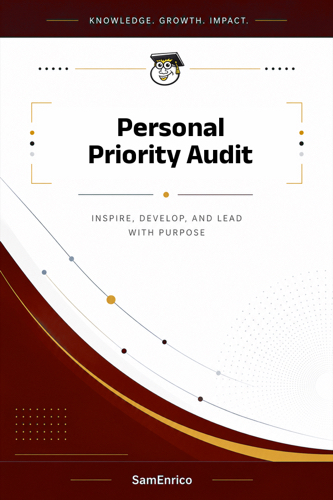
Personal Priority Audit eBook
Review past week's tasks to see where time actuall
Review past week's tasks to see where time actually went.
Formats
Free sample
Chapter 1: The 168-Hour Lie...–- The first lie we tell ourselves is about how much time we actually have. We say “I don’t have time for exercise” while scrolling through social media for an hour. We say “I’m too busy for that project” while attending meetings that could have been emails. We say “there aren’t enough hours in the day” while ignoring the fact that we all get the same 168 hours every single week.The most successful people are not those who have more time. They are those who are more honest about how they use it.
Laura Vanderkam’s groundbreaking work “168 Hours: You Have More Time Than You Think” shatters the myth of the time-crunched, overworked professional by demonstrating a simple mathematical truth: 168 hours is a significant amount of time. Not “enough” time. Not “barely enough” time. A significant, generous, abundant amount of time.Let us do the math together. A full-time work week is forty hours.
Even if you work fifty hours, that is still only fifty. Sleep, even eight hours per night, accounts for fifty-six hours. Add ten hours for commuting and basic chores. You are left with fifty-two to sixty-two hours for everything else—family, friends, hobbies, exercise, rest, and the projects you keep saying you never have time for.The problem is not a shortage of hours. The problem is a shortage of awareness about where those hours are actually going.The 168-Hour Perspective Shift Most people think about their time in twenty-four-hour increments.
This is a mistake. A single bad day feels catastrophic, but it is only one day. A single unproductive morning is forgettable, but a pattern of unproductive mornings across a week is a crisis.When you shift to a weekly perspective, two things happen. First, you realize that a single wasted hour is not the end of the world—you have 167 others to recover. Second, you realize that small inefficiencies multiplied across seven days create enormous waste.
Losing fifteen minutes per day to unnecessary email checking adds up to nearly two full work weeks per year. Fifteen minutes. That is all it takes.The weekly perspective also reveals something more hopeful: you have more control than you think. If you had a terrible Monday, you can still have a productive Tuesday through Friday. If you wasted Tuesday morning, you can reclaim Tuesday afternoon.
The week is long enough to absorb mistakes and short enough to demand accountability.Consider this. If you work forty-five hours per week, sleep fifty-six hours, and spend ten hours on commuting and chores, you have fifty-seven hours left. Fifty-seven hours. That is more time than most people spend at work. Fifty-seven hours to exercise, read, cook, play with your children, call your parents, learn a language, start a side business, or do absolutely nothing at all.Where do those fifty-seven hours go?
Most people cannot answer that question. They feel busy. They feel tired. They feel like they have no time. But when you actually add up the hours, the math does not support the feeling.The Time Perception Gap Human beings are terrible at estimating how they spend their time.
This is not a character flaw. It is a cognitive limitation. We remember the dramatic moments—the difficult phone call, the stressful meeting, the late night at the office—and forget the mundane ones—the five minutes waiting for a website to load, the three minutes searching for a lost document, the ten minutes chatting by the water cooler.Research consistently shows that when people guess how they spent their time, they overestimate time spent on “important” tasks by thirty to fifty percent and underestimate time spent on “waste” by an even larger margin.Consider this experiment. Researchers asked a group of professionals to estimate how much time they spent on email each week. The average estimate was six hours.
When the researchers actually tracked the participants’ email time, the real average was thirteen hours—more than double the estimate. The participants were not lying. They were simply blind to the cumulative effect of checking their inbox every fifteen minutes.The same pattern appears for every category. People overestimate how much they exercise, how much deep work they do, and how much quality time they spend with family. People underestimate how much they scroll on their phones, how much they wait, and how much they switch between tasks without completing any of them.The only solution is not better guessing.
It is measurement.Why Last Week Matters More Than Next Week Most time management books focus on planning the future. They give you templates for next week, systems for next month, and goals for next year. This is useful. But it skips a critical step: understanding the past.You cannot design a better next week until you understand what actually happened last week. Your future plans are fantasies until they are grounded in the reality of your past behavior.
A person who plans to “wake up earlier and exercise” but has never woken up earlier in their life is not making a plan. They are making a wish.The Personal Priority Audit starts with the past because the past is the only reliable data you have. Your intentions for next week are hopes. Your time log from last week is evidence. And evidence, not hope, is what changes behavior.Think about it this way.
If you wanted to lose weight, you would start by tracking what you currently eat. You would not start by planning next week’s meals without knowing your current calorie intake. The same logic applies to time. You cannot fix what you do not measure.The Four Pillars of Time Awareness Before we dive into the specific tools of the audit, let us establish the four pillars that will guide every chapter of this book. These pillars are drawn from the most influential time management literature of the past thirty years.Pillar One: Time is Finite You have 168 hours per week.
That number does not change. No amount of productivity hacking, morning routine optimization, or late-night work will give you 169 hours. The acceptance of finitude is the foundation of all effective time management.As Oliver Burkeman writes in “Four Thousand Weeks,” trying to do everything is not ambitious—it is a denial of reality. You cannot read every book. You cannot learn every skill.
You cannot attend every event. You cannot say yes to every request. The finite nature of time is not a problem to be solved. It is a fact to be accepted.Once you accept that time is finite, two things happen. First, you stop trying to do everything.
Second, you start choosing what matters most. The finitude of time is not a constraint. It is a filter.Pillar Two: Activity is Not Productivity Being busy is not the same as being effective. You can fill every hour of your week with activity and accomplish nothing that matters.The distinction between motion (doing things) and action (doing things that create results) is the difference between exhaustion and achievement.Motion feels productive. Motion creates the illusion of progress.
Motion is answering emails, organizing your desktop, attending status meetings, and creating color-coded spreadsheets. Action, by contrast, is uncomfortable. Action…
This is the end of the free sample. Get the eBook to keep going. Buy now
About this book
Details
- Author
- Caraballo Barabara
- Publisher
- SamEnrico
- Language
- English
- Genre
- Non-Fiction, Self-Help, Audit
- Released
- 2026-06-11
- Pages (approx.)
- 112
- Available as
- eBook, Audiobook

Read better in the ZLOADR app
Your eBooks on your phone or tablet. Sign in with your SamEnrico account and start reading.
More by Caraballo Barabara
 Mobility Aid Self ImageCaraballo Barabara$11.99
 Whoosh Effect ExplainedCaraballo Barabara$11.99
 Teresas Humor in the ConventCaraballo Barabara$11.99
 Six Thinking HatsCaraballo Barabara$11.99
 Melatonin for Shift WorkersCaraballo Barabara$11.99
 Fish Intake GuideCaraballo Barabara$11.99
 Catherine Patronage PowerCaraballo Barabara$11.99
 The Ghost Army: The Silent War of Deception (1944)Caraballo Barabara$11.99
 The Cadillac Kidnapping: A Dark Trade in Human Parts (1959)Caraballo Barabara$11.99
 How to Produce Tortilla and Flatbread MakersCaraballo Barabara$11.99
 Service Providers Guide to PodiatryCaraballo Barabara$11.99
 How to Produce an Industrial RobotCaraballo Barabara$11.99
You may also like
 Hong Kong Handover 1997Dunn Johnnie$11.99
 Zumba For Postnatal Recovery CourseNeal Christian$11.99
 Zumba for BeginnersLadner Nikia$11.99
 YouTube Comment Mining GuideHumes Pandora$12.99
 Worry Box MeditationCarlin Rudy$11.99
 Workplace Stress MeditationNguyen Lynn$11.99
 Workplace Stress and Sleep RepairHawley Ivory$11.99
 Workplace Perfectionism CureDelaney Jeffry$11.99
 Workplace Injustice Anger GuideWallen Isabelle$11.99
 Work Addiction and Burnout LinkGreenwood Ester$11.99
 Women in Yoga and WellnessBeattie Galina$11.99
 Women in Stand Up ComedyChun Evangeline$11.99