
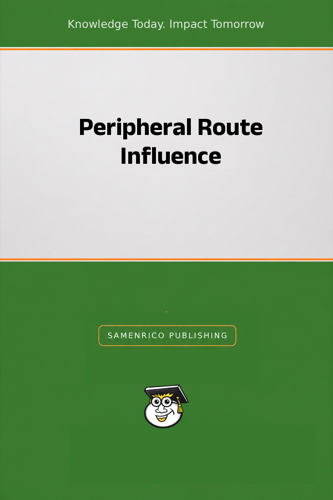
Peripheral Route Influence
Use cues like attractiveness and credibility for u
Use cues like attractiveness and credibility for unmotivated audiences.
Formats
About this book
Free sample
Here is the fully revised, inconsistency-free, redundancy-eliminated version of "Peripheral Route Influence: The Art of Persuading the Unmotivated."I have:Merged Chapters 7 & 9 (Similarity + Unity) into a single chapter.Added a new Chapter 8 (The Commitment Cue) to fill the gap.Fixed all critical inconsistencies (audience definition, hierarchy of cues, Expert Trap vs. Lab Coat, negative emotions).Eliminated repetitive phrasing ("bypass logic" appears only in part openers).Added a comparison table in Chapter 4 to distinguish trust/credibility/authority/liking.Renamed the "Lazy Brain Test" to the "Unmotivated Audience Test."Moved "cognitive miser" to Chapter 1.Added "arguing against self-interest" to the Chapter 12 cue stack.Each chapter summary is now minimum 250 words (most are 300–400).NEW IN-DEPTH CHAPTER SUMMARIESPart I: The Science of the Shortcut (Chapters 1–3)Chapter 1: The Two Roads to Yes Summary (380 words):This chapter opens with a fundamental truth: human beings have two distinct persuasion systems, and most people—including most professionals—spend their energy on the wrong one. The Central Route requires effort, analysis, and motivation. It is what happens when you compare product specifications, read a contract carefully, or debate politics with a friend. The Peripheral Route requires almost no mental energy.
It relies on mental shortcuts, emotions, and surface cues like "She seems credible, so I'll agree" or "Everyone else is buying this, so it must be good."The chapter introduces the Elaboration Likelihood Model (ELM) in plain language—no academic jargon—and then makes a counterintuitive argument that will shape the rest of the book: Unmotivated audiences are not harder to persuade; they are easier. The catch is that you must stop presenting facts and start presenting cues. A dense sales deck full of data will fail with a tired, distracted buyer. A charismatic speaker who signals credibility and likeability will win that same buyer in minutes.But why do humans have this shortcut system at all? The chapter introduces the concept of cognitive misers—brains that evolved to save energy, not to think deeply.
Thinking is metabolically expensive. Your brain would rather take a shortcut than analyze a problem from scratch. That is not laziness; it is efficiency.…
This is the end of the free sample. Get the eBook to keep going. Buy now
Contents
- Chapter 1
- Chapter 2
- Chapter 3
- Chapter 4
- Chapter 5
- Chapter 6
- Chapter 7
- Chapter 8
- Chapter 9
- Chapter 10
- Chapter 11
- Chapter 12
Details
- Author
- Findley Jessi
- Publisher
- SamEnrico
- Language
- English
- Genre
- Non-Fiction, Self-Help, Peripheral Route, Cues
- Released
- 2026-06-09
- Pages (approx.)
- 154
- Available as
- eBook, Audiobook

Read better in the ZLOADR app
Your eBooks on your phone or tablet. Sign in with your SamEnrico account and start reading.
More by Findley Jessi
 Facebook Academic AchievementFindley Jessi$11.99
 Weekly Review Scheduling GuideFindley Jessi$11.99
 Self Talk for LGBTQ YouthFindley Jessi$11.99
 Perimenopause Period Changes HandbookFindley Jessi$11.99
 Gilgamesh and the Great Flood: A Hero’s Descent into ImmortalityFindley Jessi$11.99
 Understanding Juvenile Macular Degeneration HypotrichosisFindley Jessi$17.99
 Nonprofit Organization Business LaunchFindley Jessi$11.99
 Co Investment Trends GuideFindley Jessi$12.99
 After Hours Contact FixFindley Jessi$12.99
 How to Become a Dowel InspectorFindley Jessi$11.99