
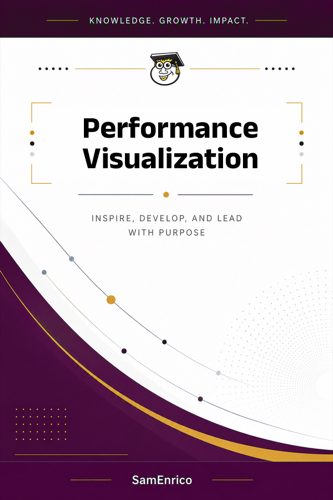
Performance Visualization eBook
See yourself executing flawlessly before an athlet
See yourself executing flawlessly before an athletic or artistic performance.
Formats
Free sample
Chapter 1: The Neural Blueprint...-- What if everything you believed about practice was wrong? What if the difference between choking and executing flawlessly had nothing to do with how many hours you logged, and everything to do with what happened inside your skull when you closed your eyes?Imagine two athletes. They are identical in talent, training, and conditioning. They have the same coach, the same diet, the same sleep schedule. They have run the same drills, lifted the same weights, and studied the same film.
By every external measure, they are equals.And yet, on competition day, one of them rises to the occasion while the other collapses.The first athlete moves with fluid, almost automatic precision. Her body seems to know exactly what to do without her conscious mind getting in the way. She is present, focused, and utterly unshakeable. The second athlete, by contrast, hesitates. His muscles feel tight.
His mind races with instructions and corrections. He is trying so hard to get it right that he gets it wrong. Afterward, he cannot explain what happened. "I practiced perfectly," he says. "I don't know why I choked."Here is the secret that the first athlete understands and the second does not: she practiced not only with her body but also with her brain.
Long before she stepped onto the field or stage, she had already performed her routine hundreds of times in the most powerful rehearsal space in existence—her own mind.This book is about teaching you to become that first athlete. It is about transforming the way you prepare so that your best performance is not a rare accident but a reliable outcome. And it begins with a single, almost unbelievable truth: your brain cannot reliably distinguish between a vividly imagined action and a physically executed one.The Neural Marriage: How Your Brain Confuses Imagination with Reality Let us begin with a simple experiment. Close your eyes for ten seconds and imagine, as vividly as you can, biting into a bright yellow lemon. See the texture of the rind.
Hear the sound of your teeth breaking through the skin. Feel the sudden rush of sour juice flooding your mouth. Now open your eyes.If you did this exercise honestly, you probably noticed something strange: your mouth watered. Your salivary glands activated in response to an event that never actually happened. There was no lemon.
There was no biting. There was only a thought—a vivid, multisensory mental image—and yet your body reacted as if the lemon were real.This is not a parlor trick. It is a window into the most important performance-enhancing mechanism you have never been taught.The phenomenon has a formal name: psychoneuromuscular theory. First proposed by the psychologist Edmund Jacobson in the 1930s and later refined by decades of sports science research, the theory holds that vividly imagining a physical action produces subtle but measurable electrical activity in the same muscles used during the actual movement. When you imagine throwing a dart, the small muscles in your fingers and forearm fire in a pattern nearly identical to the pattern produced during an actual throw.
When you imagine singing a high C, your laryngeal muscles activate. When you imagine sprinting, the motor cortex of your brain lights up on functional MRI scans as if you were actually running.The neuroscientist Dr. Stephen Kosslyn, former chair of Harvard's psychology department, described it this way: "Mental imagery is not a pale, weak substitute for perception. It is a form of perception that occurs in the absence of external input. The same neural machinery is involved, often with the same intensity."Consider what this means for performance.
Every time you visualize executing a skill, you are strengthening the neural pathways that control that skill. You are, in a very real sense, practicing. The brain does not care whether the sensory input comes from your eyes and ears in the present moment or from your memory and imagination. It only cares about the pattern of activation. If the pattern is strong and clear, the brain treats it as real experience and updates its neural architecture accordingly.This is why elite performers across every domain—athletics, music, dance, acting, surgery, public speaking—have quietly relied on visualization for decades.
They may not have known the neuroscience behind it, but they knew it worked. Olympic gold medalists, concert pianists, Cirque du Soleil acrobats, and neurosurgeons all report spending significant portions of their preparation time not moving at all, but seeing themselves move. They have discovered what science has now confirmed: the line between imagination and execution is not a wall. It is a door.The 80/20 Rule and Its Exception: Understanding How Much to Visualize Before we go further, a necessary clarification. You may have heard stories about elite athletes who spend more time visualizing than training physically.
Some sources claim that top performers devote 60 to 75 percent of their practice time to mental rehearsal. Is this true? And if so, does it apply to you?The answer requires a distinction between three different training phases: normal skill development, injury recovery, and the taper period before a major competition.During normal training—the daily, week-in-and-week-out work of building and refining skills—the evidence overwhelmingly supports an 80/20 ratio. That is, 80 percent of your practice time should be physical, and 20 percent should be mental. In a one-hour practice session, this translates to roughly forty-eight minutes of physical repetition and twelve minutes of visualization, distributed as four minutes before, four minutes during breaks, and four minutes after.
This ratio maximizes the synergistic effect of mental and physical rehearsal without causing mental fatigue or replacing the irreplaceable value of actual movement.During injury recovery, however, the equation changes dramatically. When an athlete or artist is physically unable to train—whether due to a torn ligament, a broken bone, or a vocal nodule requiring rest—visualization becomes the primary mode of practice. In this context, elite performers may spend 60 to 75 percent of their scheduled "practice time" in mental rehearsal. Research on immobilized limbs has shown that daily visualization can maintain up to 50 percent of muscle strength and significantly accelerate return-to-play timelines. The brain, it turns out, does not need the body to move in order to keep neural pathways strong.During the taper week—the seven to ten days before a major competition when athletes deliberately reduce physical load to avoid fatigue—visualization may increase to 50 or 60 percent of practice time.
This is not because visualization is superior to physical practice but because physical volume must decrease to allow the body to recover and super-compensate. Visualization fills the gap, maintaining neural activation while the muscles rest.Throughout this book, unless otherwise specified, we will be operating under the 80/20 rule for normal training. If you are currently healthy and in a skill-building phase, your daily visualization sessions should be relatively short—three to five minutes per skill, not hours. The goal is consistency and quality, not duration. A five-minute session of vivid, focused process visualization is infinitely more valuable than an hour of vague, wandering daydreaming.The Case for Mental Rehearsal: What the Research Actually Says The scientific literature on visualization is vast and remarkably consistent.…
This is the end of the free sample. Get the eBook to keep going. Buy now
About this book
Details
- Author
- Patrick Grant
- Publisher
- SamEnrico
- Language
- English
- Genre
- Non-Fiction, Self-Help, Sports Psychology
- Released
- 2026-06-10
- Pages (approx.)
- 150
- Available as
- eBook, Audiobook

Read better in the ZLOADR app
Your eBooks on your phone or tablet. Sign in with your SamEnrico account and start reading.
More by Patrick Grant
 Public Defender Burnout PreventionPatrick Grant$11.99
 Internalized Criticism ImposterPatrick Grant$11.99
 Constipation Research ReviewPatrick Grant$11.99
 The Schmalkaldic WarPatrick Grant$11.99
 Texting Listening EquivalentsPatrick Grant$11.99
 Evening Routine for ParentsPatrick Grant$11.99
 Bolivar LiberatorPatrick Grant$11.99
 Indigenous Spiritual Direction CoursePatrick Grant$11.99
 The Thunder of the Great Wall: How Chinese Cannonry Defied the MongolsPatrick Grant$11.99
 Echoes from the Void: The Lost Signals of Pioneer 10Patrick Grant$11.99
 The Silk Spinners of Lyon: Weaving the Industrial RevolutionPatrick Grant$11.99
 How to Start a Hobby in Collecting Bottle capsPatrick Grant$11.99
You may also like
 The Athlete Body ScanSteel Cayla$11.99
 Self Hypnosis For Sports Performance GuideGoad Deedra$11.99
 Self Doubt Athletic Performance GuideHargrove Elodia$11.99
 Imposter Syndrome in Sports PsychologyBoudreau Foster$11.99
 Athletic Flow TrainingKessler Christa$11.99
 Athletic Failure Resilience GuidePepper Sybil$11.99
 Athlete Affirmation GuideBelt Mitch$11.99
 TM Athlete PerformanceVidal Mika$11.99
 Teen Athletic Self EsteemNolan Hoyt$11.99
 Mindfulness Meditation for Athletes GuideHawley Ara$11.99
 Mindfulness for Beginner AthletesReese Patti$11.99
 Dream Incubation for AthletesBetts Raphael$11.99