
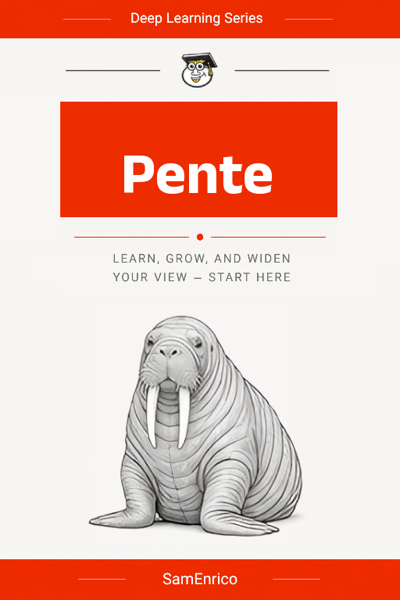
Non-FictionInformativeEducational
Pente Audiobook
A Coursebook on Pente
by Mcfadden Ok
A Coursebook on Pente
Formats
Free sample
Chapter 1: The Tube on the Shelf--–- In the autumn of 1978, a man named Gary Gabrel sat alone in a small workshop in Seattle, Washington, hand-filling plastic tubes with glass stones. He had no publisher, no distributor, no marketing budget, and no reason to believe that his creation would outlive the holiday season. He had a board, two colors of stones, and a single sheet of mimeographed instructions. That was all. Forty years later, that tube would sit on the shelves of collectors, competitive players, and casual gamers across thirty countries.
The game would outlast Parker Brothers, survive the collapse of the mainstream board game industry in the 1990s, and find new life on the internet. It would inspire world championships, computational analysis, and a small but ferociously dedicated community of players who insist that Pente is the most underrated abstract strategy game ever devised. But in 1978, it was just a tube on a shelf, waiting for someone to open it.This chapter is not a rulebook. It is not a strategy guide. It is an origin story and a map.
Before you can win at Pente, you must understand what Pente actually is—not as a set of mechanisms, but as a game with a history, a personality, and a unique place in the pantheon of abstract strategy. You will learn why Pente is neither Go nor Gomoku, why the center of the board matters more than anywhere else, why the edges are not the dead zones that earlier literature claimed, and why the unwritten rules of competitive etiquette matter as much as the written ones. By the end of this chapter, you will see the grid not as a blank slate but as a living geography of opportunity, threat, and human psychology.The Invention of an Accident Gary Gabrel did not set out to invent a classic. He was a graphic designer and a game enthusiast who enjoyed the elegant simplicity of Go but found its learning curve too steep for casual play. He admired Gomoku—the ancient game of five-in-a-row—but found it too linear, too predictable, too easily solved by defensive play.
In his workshop, he began experimenting. What if you added capture? What if you changed the win condition from one to three? What if you kept the board small enough to fit on a coffee table but large enough to reward spatial thinking? The…
This is the end of the free sample. Get the Audiobook to keep going. Buy now
About this book
Details
- Author
- Mcfadden Ok
- Publisher
- SamEnrico
- Language
- English
- Genre
- Non-Fiction, Informative, Educational
- Released
- 2026-06-02
- Pages (approx.)
- 148
- Available as
- eBook, Audiobook

Listen in the VoxFlicks app
Audiobooks and audio dramas wherever you go. Sign in with your SamEnrico account and press play.
More by Mcfadden Ok
 The Social Media and Sleep GuideMcfadden Ok$11.99
 WFH Cable Management GuideMcfadden Ok$11.99
 The South Africa Vendor GuideMcfadden Ok$11.99
 Financial Stress Foreclosure PreventionMcfadden Ok$11.99
 The Lion and the Fox: Scipio Africanus and the Art of DeceptionMcfadden Ok$11.99
 How to Start a Biscuits Business (Beginners Guide)Mcfadden Ok$11.99
 Learn to Play the ViolottaMcfadden Ok$11.99
 Board Meeting Etiquette GuideMcfadden Ok$12.99
You may also like
 Hong Kong Handover 1997Dunn Johnnie$11.99
 Zumba For Postnatal Recovery CourseNeal Christian$11.99
 Zumba for BeginnersLadner Nikia$11.99
 YouTube Comment Mining GuideHumes Pandora$12.99
 Worry Box MeditationCarlin Rudy$11.99
 Workplace Stress MeditationNguyen Lynn$11.99
 Workplace Stress and Sleep RepairHawley Ivory$11.99
 Workplace Perfectionism CureDelaney Jeffry$11.99
 Workplace Injustice Anger GuideWallen Isabelle$11.99
 Work Addiction and Burnout LinkGreenwood Ester$11.99
 Women in Yoga and WellnessBeattie Galina$11.99
 Women in Stand Up ComedyChun Evangeline$11.99