
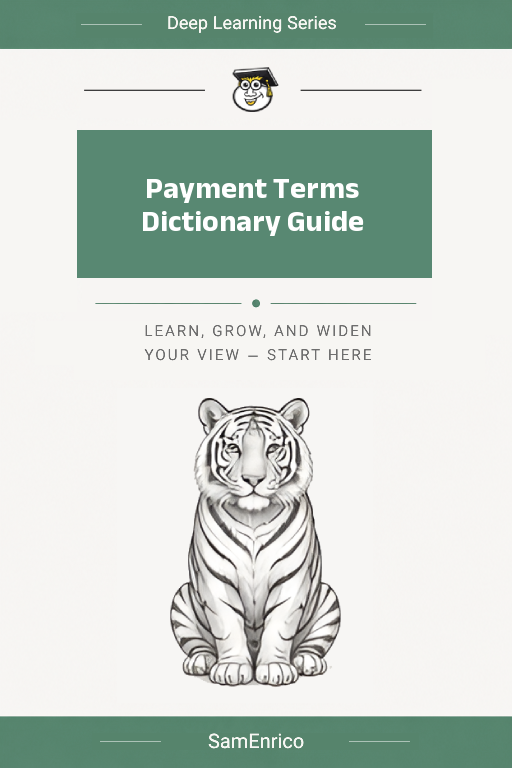
Payment Terms Dictionary Guide eBook
Understand common cross border payment terms like
Understand common cross border payment terms like CAD COD and open account so African exporters choose the right terms for each buyer.
Formats
Free sample
Chapter 1: The Cashew Trap...--–- The container left Bissau on a Tuesday. Twenty metric tons of raw cashew nuts, destined for a buyer in Lisbon. The exporter, a third-generation trader named Amílcar, had done everything right. The nuts were graded, dried to spec, and inspected by a local cooperative. The buyer had provided a glowing reference from a previous supplier in India.
The contract was signed. The Bill of Lading was clean.For sixty-three days, Amílcar checked the tracking portal every morning. The vessel crossed the Atlantic, rounded the Strait of Gibraltar, and docked at the Port of Lisbon. The container was offloaded. And then—silence.On day sixty-five, the email arrived.
The buyer claimed the cashews were "moldy and unfit for human consumption." Attached were three blurry photos taken under fluorescent lights, showing what appeared to be discoloration on a small handful of nuts. The buyer demanded a 40 percent discount. The alternative, they wrote, was to ship the entire container back to Guinea-Bissau at the exporter's expense.Amílcar requested an independent inspection. The buyer refused, citing "time sensitivity." He offered to fly to Lisbon himself. The buyer said they were "too busy for visits." He consulted a lawyer in Portugal, who quoted a retainer of eight thousand euros—just to open a file.
The goods were perishable. Every day in the humid Lisbon warehouse, they became slightly more likely to develop actual mold.On day seventy-eight, Amílcar accepted the 40 percent discount. He lost twelve thousand dollars on a single shipment. The buyer resold the nuts within a week at full market price.This is not a story about bad luck. It is a story about payment terms.Amílcar sold on Open Account.
He shipped the goods, invoiced the buyer, and agreed to be paid ninety days after delivery. In the language of international trade, he became an unsecured lender. He had no collateral, no bank guarantee, and no leverage. The buyer had his goods, his documents, and a two-thousand-dollar legal budget to draft threatening emails.If Amílcar had demanded Cash in Advance, the buyer would have laughed and moved on. If he had insisted on a Confirmed Letter of Credit, the buyer would have complained about paperwork but might have agreed.
If he had used the 30/70 Hybrid Model taught later in this book, he would have collected thirty percent upfront—enough to cover his costs—and held the Bill of Lading hostage until the remaining seventy percent was paid.Instead, he shipped naked. And he paid the price.The Single Most Dangerous Moment in Exporting Every African exporter fears the wrong things. They fear customs delays, port strikes, currency fluctuations, and shipping line surcharges. These are real risks, but they are manageable. You can insure against them.
You can build them into your pricing. You can hire a freight forwarder to navigate the bureaucracy.The single most dangerous moment in exporting is not when the container is loaded. It is not when it clears customs. It is not even when it arrives at the buyer's port.The most dangerous moment is the sixty-day void after the container leaves your warehouse and before the money hits your account.During those sixty days, you own nothing—or rather, you own a promise. The buyer holds your goods.
Your bank holds your documents. The law holds your fate in a jurisdiction that is not your own. You are not a seller anymore. You are a supplicant.This chapter will teach you three things:Why Open Account is the most common term requested by buyers and the most dangerous term for African exporters.How to calculate your real risk exposure using the Pre-Shipment Risk Calculator.The psychological trap that causes smart exporters to accept bad terms—and how to escape it.By the end of this chapter, you will never look at a buyer's email the same way again.Part One: The Bank of Exporter Let us define the term that destroyed Amílcar's profit margin.Open Account (O/A): A payment arrangement where the exporter ships the goods and sends an invoice to the buyer, who agrees to pay within a specified number of days (typically 30, 60, 90, or 120) after the invoice date or after the Bill of Lading date.In plain language: You give. They pay later.
Maybe.Here is what Open Account actually means in financial terms. When you ship goods on Open Account, you are extending trade credit to your buyer. You are lending them the value of your goods—plus the cost of freight, insurance, and port handling—for the duration of the payment term. You are acting as a bank. An unsecured bank.
A bank with no collateral, no credit check, and no ability to garnish wages.Banks charge interest when they lend money. Banks require collateral. Banks run credit checks. Banks have legal departments and repossession teams.You have a Bill of Lading and hope.This is not to say that Open Account is always wrong. Chapter 7 of this book will show you how to use Open Account safely with blue-chip buyers who have passed credit checks and when you have purchased Export Credit Insurance.
But for a first-time buyer, a regional buyer in a currency-volatile country, or any buyer who refuses to share bank references—Open Account is a trap disguised as a convenience.The Time Gap Trap The danger of Open Account is not theoretical. It is mathematical.Consider a shipment from Mombasa to Rotterdam. The vessel sails for twenty-five days. Customs clearance takes another five. The buyer takes ten days to inspect the goods (or to claim they are inspecting them).
The payment term is sixty days after Bill of Lading.From the moment you hand the container to the shipping line, you are looking at ninety to one hundred days before cash hits your account. During those one hundred days, the following can happen:The buyer can go bankrupt.The buyer can claim a quality defect.The buyer's country can impose currency controls.The buyer's bank can freeze assets.The buyer can simply disappear.Each of these events has a different probability, but they share a common feature: once the container is on the water, your leverage evaporates.The Asymmetry of Leverage Before shipment, you hold the goods. You have all the power. You can demand a deposit, a Letter of Credit, or even full prepayment. The buyer cannot access your products without your cooperation.After shipment, the buyer holds the goods (or will, upon arrival).
You hold a document—the Bill of Lading—that controls access to the goods. This sounds like power, but it is a fragile kind of power. The Bill of Lading is only valuable if the buyer wants the goods and cannot obtain them elsewhere and is willing to follow the legal process to get them.If the buyer finds cheaper cashews from Vietnam while your shipment is at sea, your Bill of Lading becomes a piece of paper. If the buyer decides to manufacture a quality dispute, your Bill of Lading becomes evidence in a court case you cannot afford. If the buyer simply stops answering emails, your Bill of Lading becomes a claim…
This is the end of the free sample. Get the eBook to keep going. Buy now
About this book
Details
- Author
- Perron Lyndon
- Publisher
- SamEnrico
- Language
- English
- Genre
- Non-Fiction, Business Brief, Trade Terms, Glossary Guide
- Released
- 2026-05-29
- Pages (approx.)
- 147
- Available as
- eBook, Audiobook

Read better in the ZLOADR app
Your eBooks on your phone or tablet. Sign in with your SamEnrico account and start reading.
More by Perron Lyndon
 Herbal Cigarette Substitution GuidePerron Lyndon$11.99
 Microbiome Clinical TestingPerron Lyndon$11.99
 The Parent Death Addiction LossPerron Lyndon$11.99
 Road Rage Consequence AwarenessPerron Lyndon$11.99
 Catherine the Great Smallpox Inoculation CampaignPerron Lyndon$11.99
 The Seventh Floor: The Haunting of the OverlookPerron Lyndon$11.99
 The Celestial Cartographer: How a Japanese Astronomer Charted the HeavensPerron Lyndon$11.99
 Manager of Product ManagementPerron Lyndon$11.99
 How to Start a Containers Made of Wood (commission Agent) Business (Beginners Guide)Perron Lyndon$11.99
 Chart of Accounts OptimizationPerron Lyndon$12.99
 Understanding Bencze SyndromePerron Lyndon$17.99