
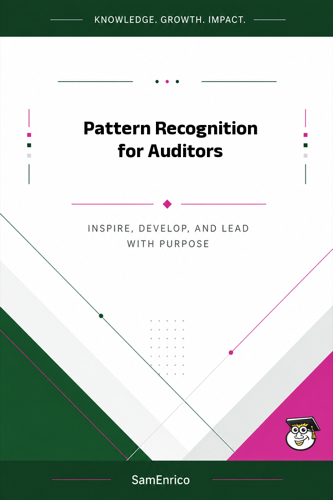
Non-FictionSelf-HelpAuditingFraud
Pattern Recognition for Auditors eBook
Identify financial irregularities and fraud patter
by Osburn Vince
Identify financial irregularities and fraud patterns in accounts.
Formats
Free sample
Chapter 1: The Expectation Gap--–- The first time Maria Chen ran a Benford test on a vendor ledger, she almost quit auditing.She was three years into her job as a senior internal auditor at a mid-sized logistics company, and she had just spent six weeks on a routine expense review. Six weeks of sampling fifty invoices per quarter, ticking boxes, and signing off on controls that everyone knew were more theatrical than functional. Her manager called it "industry standard." Her colleagues called it "job security." Maria called it something else: a lottery.Every quarter, she pulled fifty transactions out of tens of thousands. Fifty. If a fraudster was smart enough to keep their fake invoices below the sampling threshold, they could steal forever.
And Maria suspected that many of them were that smart.So she taught herself Excel tricks during lunch breaks. She read obscure white papers from forensic accounting journals. She learned about a strange statistical law she had never encountered in her audit training: Benford's Law. The idea was simple but almost unsettling: in naturally occurring numbers, the digit 1 appears as the first digit about thirty percent of the time. The digit 9 appears less than five percent of the time.
Fraudsters, unaware of this pattern, spread their fabricated numbers evenly across digits, creating a distribution that is statistically impossible in nature.Maria ran the test on her company's vendor payments. She expected a few deviations. What she got was a disaster.Forty-seven percent of the flagged transactions were false positives. Her algorithm—a simple Benford test she had built in an afternoon—screamed fraud at legitimate weekend deliveries, valid promotional discounts, and perfectly innocent rush orders. Her manager laughed at her.
Her colleagues called it "the boy who cried wolf." One operations manager accused her of accusing his team of theft.She almost quit.But then she did something that changed everything. Instead of abandoning pattern recognition, she asked a different question: What if the algorithm wasn't wrong—what if the definition of "normal" was wrong?She segmented the data. She removed promotional periods. She excluded weekends for certain vendors. She built an iterative loop that refined the model every month.
Within six months, the false positive rate dropped from forty-seven percent to three percent. And in the second month of that refined process, she found a real fraud: a shipping clerk who had stolen seventy-one million dollars over seven years, starting with five hundred dollars and rising slowly, never triggering a single traditional audit sample.Maria didn't quit. She became the head of data analytics for a Fortune 500 internal audit department. And she learned the single most important lesson in pattern recognition for auditors:Before you can spot a lie, you must mathematically define the truth.This chapter is about that definition. It is about the critical pre-analytics phase that most auditors skip, the phase that separates useful pattern recognition from algorithmic noise.
It is about data cleaning, segmentation, and the concept that will appear in every subsequent chapter of this book: the Expectation Gap.The Expectation Gap: Defining the Core Concept Let us start with a definition that will anchor every technique in this book.The Expectation Gap is the difference between what the ledger shows and what economic reality suggests. It is not a fraud indicator by itself—it is a measure of surprise. A wide Expectation Gap means that the numbers in front of you are not what you would expect to see if the business were operating normally. That gap might be caused by fraud. It might be caused by an accounting error.
It might be caused by a legitimate business event that you failed to account for. But whatever the cause, the gap is where you must look.Here is why the Expectation Gap matters more than any individual fraud pattern: patterns are infinite. Fraudsters invent new schemes every day. But the Expectation Gap is finite. It is the distance between two distributions: the distribution of numbers you have, and the distribution of numbers you would expect if the world were honest.To calculate the Expectation Gap, you need three things:A mathematical definition of normal – a statistical baseline for what the data should look like in the absence of fraud, error, or exceptional events.Clean, segmented data – raw information that has been stripped of duplicates, nulls, and legitimate noise, then split into meaningful groups.A tolerance threshold – a decision rule for how large the gap must be before you investigate.Most auditors skip the first two steps entirely.
They run tests on uncleaned, unsegmented data. Then they wonder why false positives drown out true signals.This chapter is about the first two steps. Subsequent chapters will teach you how to measure the gap using Benford's Law, time-series analysis, ratio analysis, clustering, and supervised learning. But if you skip the foundation, the rest of the book will fail you.Step One: Data Cleaning – The Unsexy Prerequisite Before you run a single test, you must clean your data. This is the least glamorous part of pattern recognition, and it is where most automated fraud detection systems die.Data cleaning means removing or correcting:Duplicate records – Identical transactions entered twice, often by accident, sometimes by design (invoice splitting, which we will cover in Chapter 3).Null or missing values – Blank fields that break formulas and skew distributions.Formatting inconsistencies – Dates stored as text, amounts with commas or dollar signs, vendor names with typos ("ACME Corp" vs.
"Acme Corporation").Obvious data entry errors – Negative amounts where positive is expected, improbable values (a $10,000 coffee purchase), or transactions dated before the company was founded.The One-Hour Rule: Spend at least one hour cleaning data for every hour you spend analyzing it. If you skip this rule, your false positive rate will be at least thirty percent higher. This is not a guess. It is a mathematical certainty, because dirty data introduces artificial variance that your model cannot distinguish from fraud.Practical Example – The Duplicate Nightmare:A retail auditor ran a duplicate payment test on the accounts payable ledger. The test found three hundred identical amounts from the same vendor on the same date.
The auditor flagged all three hundred as potential fraud. It took two weeks to investigate.The result? Zero fraud. The vendor was a cloud service provider that billed monthly recurring fees of exactly $499.00 per store. The chain had three hundred stores.
The duplicates were legitimate.The mistake? The auditor failed to clean the data by excluding recurring subscription vendors from the duplicate test. The fix took five minutes: add a filter for "vendor category != subscription."Checklist for Data Cleaning (Do This Before Every Test):Step Action Typical Time1Remove exact duplicate rows5 minutes2Fill or remove nulls in key fields (amount, date, vendor)15 minutes3Standardize date formats to YYYY-MM-DD5 minutes4Convert all amounts to numeric (remove $ and commas)5 minutes5Create a "legitimate exceptions" flag for known recurring patterns15 minutes6Document every cleaning step so the audit is repeatable15 minutes Total: 60 minutes minimum.Step Two: Segmentation – The Most Overlooked Step Data cleaning is necessary but not sufficient. The most common failure mode in pattern recognition is not dirty data—it is unsegmented data.Segmentation means splitting your data into meaningful groups before running…
This is the end of the free sample. Get the eBook to keep going. Buy now
About this book
Details
- Author
- Osburn Vince
- Publisher
- SamEnrico
- Language
- English
- Genre
- Non-Fiction, Self-Help, Auditing, Fraud
- Released
- 2026-06-09
- Pages (approx.)
- 142
- Available as
- eBook, Audiobook

Read better in the ZLOADR app
Your eBooks on your phone or tablet. Sign in with your SamEnrico account and start reading.
More by Osburn Vince
 Vatican Religious Art DealerOsburn Vince$11.99
 Middle Manager Burnout RescueOsburn Vince$11.99
 Shania Twain Come On OverOsburn Vince$11.99
 The LLC Bank Account Setup GuideOsburn Vince$11.99
 The Imperial Crown of Charlemagne: Forge of a European LegacyOsburn Vince$11.99
 RummikubOsburn Vince$11.99
 How to Become a Light-bulb AssemblerOsburn Vince$11.99
 Shea Butter Buyer EuropeOsburn Vince$12.99
 Waseda University Scholarship GuideOsburn Vince$12.99
 Understanding Seres–santamaria–arimany–muniz SyndromeOsburn Vince$17.99
You may also like
 Hong Kong Handover 1997Dunn Johnnie$11.99
 Zumba For Postnatal Recovery CourseNeal Christian$11.99
 Zumba for BeginnersLadner Nikia$11.99
 YouTube Comment Mining GuideHumes Pandora$12.99
 Worry Box MeditationCarlin Rudy$11.99
 Workplace Stress MeditationNguyen Lynn$11.99
 Workplace Stress and Sleep RepairHawley Ivory$11.99
 Workplace Perfectionism CureDelaney Jeffry$11.99
 Workplace Injustice Anger GuideWallen Isabelle$11.99
 Work Addiction and Burnout LinkGreenwood Ester$11.99
 Women in Yoga and WellnessBeattie Galina$11.99
 Women in Stand Up ComedyChun Evangeline$11.99