
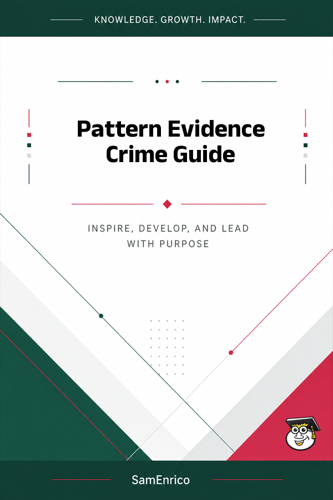
Pattern Evidence Crime Guide eBook
Analyze blood, glass fracture, tool mark, and impr
Analyze blood, glass fracture, tool mark, and impression patterns to reconstruct events.
Formats
Free sample
Chapter 1: The Silent Witness--–- The call came in at 3:47 on a Tuesday morning. A woman’s voice, high and fractured, told the dispatcher her husband had fallen down the basement stairs. She’d heard a crash, she said, then nothing. When she went down to check, he was lying at the bottom, blood pooling around his head. An accident.
A tragedy. The responding officers saw what she wanted them to see: an old house, steep wooden steps, a man in his sixties who’d had two beers with dinner. They wrote it up as an accidental fall and called for the medical examiner.But the crime scene analyst who arrived four hours later saw something different.Her name was Elena Vasquez, and she had been examining pattern evidence for seventeen years. She didn’t work for the police. She worked for the state forensic lab, and her job was not to solve crimes but to read the physical story left behind by violence.
She carried a camera, a tripod, an L-shaped scale, and a notebook full of trigonometric tables. She did not carry a weapon. Her only defense against error was method.The basement was cramped, poorly lit, and smelled of mildew and old wood. The victim lay face up, which was already strange—most people who fall backward down stairs land face down or twisted. But Vasquez ignored the body at first.
She had been trained to ignore the body. The body was the story’s end. The blood was its sentences.She knelt beside a large elliptical stain on the concrete floor, two feet from the victim’s head. It was roughly the size of her palm, elongated, with a distinct tail pointing southwest. She pulled out her scale, placed it beside the stain, and photographed it with her tripod at exactly 90 degrees.
No flash. No distortion. Then she measured the width and length with digital calipers: 2.1 centimeters wide, 4.2 centimeters long. She did the math in her head. Width divided by length was 0.5.
The arcsine of 0.5 was 30 degrees. This bloodstain had struck the floor at a 30-degree angle, traveling from the northeast to the southwest. That meant the person who shed this blood—the victim, presumably—had been moving. The blood had not dripped straight down from a stationary body. It had been flung.She looked up.
The wall above the stain showed a pattern of smaller, rounder droplets. Those were closer to 90 degrees, meaning they had fallen more or less straight down. That suggested two different events: an impact that produced the angled spatter, followed by stationary dripping. She stood and scanned the basement walls. Near the bottom of the stairs, she saw a void—a clean, blood-free area shaped roughly like a human shoulder in the middle of an otherwise continuous spatter pattern.
Something had been standing there when the blood flew. Someone had blocked the spray.Vasquez called the lead detective over. “Your victim didn’t fall down the stairs,” she said. “He was beaten. Then he was moved.
And someone else was in this basement when it happened.”The detective stared at her. “The wife says she never came down here until after she found him.”“The blood says otherwise.”That case, which went to trial eighteen months later, ended in a conviction for second-degree murder. The wife had struck her husband with a fireplace poker during an argument, then staged the fall to cover it up. Vasquez’s bloodstain pattern analysis placed her in the basement at the moment of impact using the void pattern. The angled spatter proved the victim was standing—not falling—when he was first struck.
The wife’s story collapsed.This is what pattern evidence does. It does not confess. It does not lie. It does not forget. It simply sits where it landed, frozen in time, waiting for someone who knows how to read it.Why Pattern Evidence Matters – And Why It Is Under Attack The term “pattern evidence” covers four distinct but related disciplines: bloodstain pattern analysis (BPA), glass fracture analysis, toolmark examination, and impression evidence (shoeprints and tire tracks).
Each discipline uses the physical marks left by force to reconstruct the sequence, direction, and nature of violent events. Unlike DNA or toxicology, which identify substances or biological sources, pattern evidence answers dynamic questions: Where was the victim standing? Which shot came first? Did the suspect walk or run? Was the window broken from inside or outside?
These are not peripheral questions. In many violent crimes—especially those without witnesses, confessions, or video footage—pattern evidence is the only thing that separates a self-defense claim from a murder conviction.But pattern evidence is also under sustained attack. The 2009 National Research Council report, Strengthening Forensic Science in the United States, delivered a devastating assessment. The report found that most pattern evidence disciplines lack standardized error rates, validated methodologies, and mandatory certification. It noted that cognitive bias—the unconscious tendency to see what you expect to see—contaminates many pattern evidence conclusions.
It criticized the lack of blind verification, the overstatement of conclusions in court, and the absence of peer-reviewed research establishing the fundamental validity of some pattern evidence methods.The report was not a death sentence. It was a warning. And in the fifteen years since its publication, the pattern evidence community has begun to respond. BPA now has published error rate studies (typically 1–5% for experienced examiners). Glass fracture analysis is grounded in decades of materials science research.
Toolmark examination has adopted statistical models and blind verification protocols. Shoeprint and tire tread databases have grown exponentially, and gait analysis has moved from anecdotal observation to biomechanical measurement.But the gap between what pattern evidence can do and what pattern evidence is often claimed to do in court remains dangerously wide. This chapter—and this book—exists to close that gap by teaching you what pattern evidence actually is: a powerful, limited, probabilistic tool for reconstructing events, not a magical mirror that reveals the past with certainty.The Daubert Standard: What Makes Evidence Admissible Before any pattern evidence reaches a jury, it must survive the Daubert Standard. Named after the 1993 Supreme Court case Daubert v. Merrell Dow Pharmaceuticals, this standard requires trial judges to act as gatekeepers, excluding expert testimony that is not both relevant and reliable.
The Court listed five factors that judges should consider:Testability: Has the theory or technique been tested? Can it be falsified?Peer review: Has the method been published in and scrutinized by peer-reviewed journals?Error rate: What is the known or potential rate of error? Are there standards controlling the technique’s operation?General acceptance: Is the method widely accepted within the relevant scientific community?Standards: Are there established protocols and quality control measures?For pattern evidence, Daubert has been both a blessing and a curse. It has forced the field to become more rigorous. But it has also excluded testimony that was probably correct but could not meet the new standards.
A bloodstain pattern analyst who cannot state an error rate—and many cannot—may find their testimony limited or barred. A toolmark examiner who relies on “training and experience” without peer-reviewed validation may not be allowed to say “match.” The…
This is the end of the free sample. Get the eBook to keep going. Buy now
About this book
Details
- Author
- Applegate Ula
- Publisher
- SamEnrico
- Language
- English
- Genre
- Non-Fiction, True Crime
- Released
- 2026-06-11
- Pages (approx.)
- 152
- Available as
- eBook, Audiobook

Read better in the ZLOADR app
Your eBooks on your phone or tablet. Sign in with your SamEnrico account and start reading.
More by Applegate Ula
 Imposter Thoughts StoppingApplegate Ula$11.99
 Green Energy Talent MovementApplegate Ula$11.99
 Recording Your Own VoiceApplegate Ula$11.99
 Founder Financial MistakesApplegate Ula$11.99
 Stay Home Parent ScheduleApplegate Ula$11.99
 Deep Work For MarketersApplegate Ula$11.99
 Bullet Journal Time BlockingApplegate Ula$11.99
 The Dragonheart’s Bride: A Ballad of Fire and FateApplegate Ula$11.99
 Blood on the Tracks: The 1920s Vampire Murders of New OrleansApplegate Ula$11.99
 Exploring Spanish Painting: El Greco, Velázquez & GoyaApplegate Ula$11.99
 How to Produce Drafting SuppliesApplegate Ula$11.99
 Cassava: Manioc Root HarvestingApplegate Ula$11.99
You may also like
 Hong Kong Handover 1997Dunn Johnnie$11.99
 Zumba For Postnatal Recovery CourseNeal Christian$11.99
 Zumba for BeginnersLadner Nikia$11.99
 YouTube Comment Mining GuideHumes Pandora$12.99
 Worry Box MeditationCarlin Rudy$11.99
 Workplace Stress MeditationNguyen Lynn$11.99
 Workplace Stress and Sleep RepairHawley Ivory$11.99
 Workplace Perfectionism CureDelaney Jeffry$11.99
 Workplace Injustice Anger GuideWallen Isabelle$11.99
 Work Addiction and Burnout LinkGreenwood Ester$11.99
 Women in Yoga and WellnessBeattie Galina$11.99
 Women in Stand Up ComedyChun Evangeline$11.99