
Non-FictionSelf-HelpCodependency
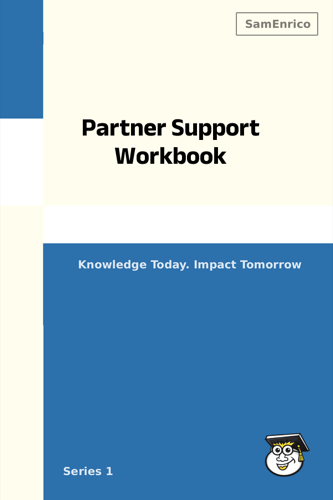
Partner Support Workbook eBook
For loved ones of addicts: boundaries, self care,
For loved ones of addicts: boundaries, self care, and informed choices.
Formats
Free sample
Chapter 1: The Three Lies--–- You are reading this because someone you love is disappearing. Not all at once, and not in a way that anyone outside your home would notice. They are still eating breakfast. Still scrolling on their phone. Still sleeping beside you, sometimes.
But the person who made promises to you, who laughed with you, who dreamed about a future with you—that person is being slowly replaced by a chemical. And you have been trying to stop it.You have tried logic. You have tried pleading. You have tried threatening. You have tried hiding their substances, monitoring their bank accounts, tracking their location, calling their friends, crying in the shower, lying to your family, and apologizing for things you did not do.
You have tried loving them harder, then loving them colder, then leaving them, then coming back, then pretending everything is fine, then exploding, then collapsing into silence. None of it has worked. And here is the truth that this entire workbook is built upon: None of it will ever work. Not because you are not trying hard enough. Not because you do not love them enough.
Not because you are weak, or stupid, or naive. It will never work because you are trying to solve the wrong problem.The problem is not that they do not understand how much they are hurting you. The problem is not that they have not yet found the right motivation to stop. The problem is not that you have failed to explain it clearly enough. The problem is that addiction is a neurological disease that has hijacked their brain's ability to choose.
And you cannot logic your way through a hijacking.This chapter will teach you the single most important concept in the entire workbook: the Three C's. You did not cause it. You cannot control it. You cannot cure it. These three sentences will save your life if you let them.
But first, you have to stop fighting them.The First Lie: "If I Just Explain It Better, They Will Understand"Let us start with what you have already tried. Make a mental list of every conversation you have had with the addict about their using. The late-night talks where you cried and they nodded. The early-morning confrontations where you listed every way they had failed you. The calm, rational discussions where you laid out evidence, consequences, and solutions like a Power Point presentation.
The letters you wrote. The texts you sent. The therapists you dragged them to. The interventions you planned.None of it worked. And here is why: the part of the brain that processes logic, understands consequences, and makes long-term plans—the prefrontal cortex—is the exact part of the brain that addiction damages most severely.
When a person is actively using, their prefrontal cortex is offline. When they are in withdrawal, it is flooded with distress signals that override everything else. When they are craving, it is being screamed at by the limbic system, which cares about nothing except getting the next dose. You are trying to have a rational conversation with a brain that has lost the ability to be rational.This is not a metaphor. This is neuroscience.
Addiction changes the brain's structure and function. It floods the reward pathway with dopamine, teaching the brain that the substance is the most important thing in any environment. It weakens the prefrontal cortex's ability to say "no." It strengthens the amygdala's fear response, so withdrawal feels like a life-or-death emergency. By the time a person has a moderate to severe substance use disorder, their brain has been physically remodeled. They are not choosing to use because they are weak or selfish.
They are using because their brain has been reprogrammed to prioritize the substance above food, water, sex, sleep, and love.This does not excuse their behavior. It does not mean you should tolerate abuse, lies, or neglect. But it does mean that you can stop exhausting yourself trying to find the magic combination of words that will finally make them see. There is no magic combination. You cannot explain your way into their sobriety because the part of their brain that would hear you is not currently accepting calls.The Second Lie: "If I Could Just Control the Environment, They Would Stop"You have probably tried this too.
You have hidden their substances. You have flushed them down the toilet. You have poured alcohol down the sink. You have taken their car keys. You have monitored their phone.
You have cut off their access to money. You have called their dealer. You have shown up at their meetings. You have searched their room, their pockets, their car, their computer. You have tried to build a cage around their addiction, thinking that if you could just remove all the opportunities, they would have no choice but to stop.Here is what happens next.
They find new hiding places. They find new dealers. They find new ways to get money. They lie more creatively. They sneak more carefully.
They resent you more deeply. And you become a full-time prison guard with no days off, no backup, and no appreciation.The illusion of control is the most seductive trap for partners of addicts. It feels like you are doing something. It feels like you are fighting the disease instead of just watching it win. But here is the truth that will set you free: You were never in control.
Not of their using, not of their recovery, not of their choices. You were only ever in control of your own responses. And you have been exhausting yourself trying to control something that was never yours to control.Think of it this way. If your partner had cancer, you would not try to control their tumor. You would not hide their chemotherapy pills to make sure they took them at the right time.
You would not search their body for new lumps every night. You would not blame yourself when the cancer progressed. You would support them, love them, and drive them to appointments. But you would not believe that you could control the cancer. Addiction is a disease, just like cancer.
The difference is that the symptoms of addiction—lying, stealing, manipulating, neglecting—look like moral failures. So you treat them like moral failures. And then you believe that if you could just be a better person, a more persuasive person, a more vigilant person, you could control the disease.You cannot. And the moment you surrender that illusion is the moment you stop drowning.The Third Lie: "If I Love Them Enough, They Will Heal"This is the most painful lie, because it feels like the truth. Love is powerful.
Love has inspired people to do extraordinary things. Love has pulled people back from the edge of suicide, has motivated people to change careers, has transformed angry people into gentle people. So surely love can cure addiction.No. Love cannot cure addiction. If love could cure addiction, no one would be addicted.
Every addict is loved by someone. Most are loved by many people. Parents love their addicted children. Partners love their addicted spouses.…
This is the end of the free sample. Get the eBook to keep going. Buy now
About this book
Details
- Author
- Blanchard Zada
- Publisher
- SamEnrico
- Language
- English
- Genre
- Non-Fiction, Self-Help, Codependency
- Released
- 2026-06-09
- Pages (approx.)
- 124
- Available as
- eBook, Audiobook

Read better in the ZLOADR app
Your eBooks on your phone or tablet. Sign in with your SamEnrico account and start reading.
More by Blanchard Zada
 Parental Anger And Child TraumaBlanchard Zada$11.99
 Self Hypnosis Time Distortion GuideBlanchard Zada$11.99
 Perfect Prioritization HabitsBlanchard Zada$11.99
 Franchising Your Local Brand Across Borders Earn Out StructuresBlanchard Zada$11.99
 Understanding Davenport–donlan SyndromeBlanchard Zada$17.99
 The Last Broadcast: How a Radio Station Defied the Berlin WallBlanchard Zada$11.99
 How to Start a Hobby in Making DioramasBlanchard Zada$11.99
 Schedule A Filings GuideBlanchard Zada$12.99
 Discord Monetization GuideBlanchard Zada$12.99
 Energy ManagerBlanchard Zada$11.99
 The Deep-Sea Alchemists: Uncovering the Indian Ocean's Hidden TreasuresBlanchard Zada$11.99
You may also like
 Hong Kong Handover 1997Dunn Johnnie$11.99
 Zumba For Postnatal Recovery CourseNeal Christian$11.99
 Zumba for BeginnersLadner Nikia$11.99
 YouTube Comment Mining GuideHumes Pandora$12.99
 Worry Box MeditationCarlin Rudy$11.99
 Workplace Stress MeditationNguyen Lynn$11.99
 Workplace Stress and Sleep RepairHawley Ivory$11.99
 Workplace Perfectionism CureDelaney Jeffry$11.99
 Workplace Injustice Anger GuideWallen Isabelle$11.99
 Work Addiction and Burnout LinkGreenwood Ester$11.99
 Women in Yoga and WellnessBeattie Galina$11.99
 Women in Stand Up ComedyChun Evangeline$11.99