
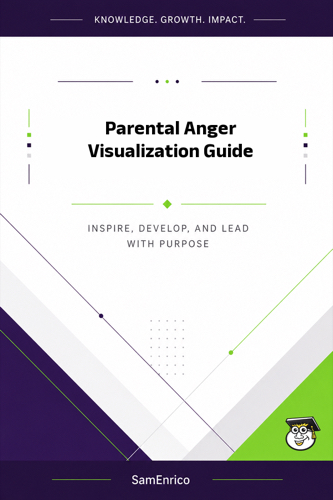
Parental Anger Visualization Guide eBook
Use mental rehearsal and imagery to practice calm
Use mental rehearsal and imagery to practice calm responses before real situations.
Formats
Free sample
Chapter 1: The Seven Seconds...--–- You have exactly seven seconds. That is not a metaphor, not a motivational slogan, and not an exaggeration pulled from a self-help book to make you feel like you are running out of time. It is a physiological fact. From the moment your child’s behavior triggers the first spark of irritation—a whine that pierces your skull, a cup of milk knocked over for the third time, a direct refusal to put on shoes when you are already late—your body requires approximately seven seconds to complete the full neurochemical cascade we call anger. In those seven seconds, your adrenal glands release epinephrine, your cortisol levels spike, your heart rate accelerates by twenty to thirty beats per minute, and your prefrontal cortex—the part of your brain responsible for reasoning, impulse control, and perspective-taking—begins to dim like a light on a dimmer switch.
After those seven seconds, if no intervention has occurred, you are no longer parenting. You are reacting. And there is a difference between those two states as vast as the difference between steering a car and being thrown from it.This chapter exists to give you those seven seconds back.Most anger management advice fails parents not because it is wrong but because it arrives too late. "Take a deep breath" is excellent advice for someone who notices their anger rising at second two. But most parents do not notice until second six or seven, when the breath would need to be the size of a yoga ball to make any difference.
"Count to ten" assumes you have ten seconds before the explosion, but the explosion is already scheduled for seven. By the time you reach eight, you are counting from inside the wreckage. These techniques are not flawed. They are mistimed.This book introduces a different approach: visualization-based mental rehearsal that trains your brain to recognize anger earlier, pause more reliably, and choose a response instead of being consumed by a reaction. The method is grounded in neurocognitive equivalence—the proven principle that the brain activates identical neural regions whether you perform an action or vividly imagine performing it.
When you mentally rehearse a calm response to a triggering situation, you are not daydreaming. You are building a neural pathway that will be available to you in the real moment, often without conscious effort, like a path through a forest that becomes easier to walk each time you take it.By the end of this chapter, you will understand the physiology of your anger well enough to stop blaming yourself for having it. You will learn the single most important distinction in this entire book: the difference between a micro-pause and a macro-pause, and when to use each. You will practice your first visualization script—The Stoplight—and you will learn what to do if visualization makes you feel worse instead of better. You will also receive the first layer of the Daily Anchor Practice, a ninety-second ritual that will become the spine of your work with this book.Let us begin with the body.
Because anger does not begin in your character. It begins in your nervous system.The Neurochemistry of Parental Anger Anger is not a sin. It is not a moral failing. It is not evidence that you are secretly a monster who should not have had children. Anger is a survival program written into the mammalian brain over sixty million years of evolution.
Its job is to detect threats to resources, status, or safety and mobilize the body for defense. When your child refuses to listen, your brain interprets that as a threat to your authority—a resource. When your child screams in a grocery store, your brain interprets the stares of strangers as a threat to your social standing—status. When your child runs toward the street, your brain interprets that as a threat to their physical survival—safety. In each case, anger is not malfunctioning.
It is working exactly as designed. The problem is that the design is forty million years older than parenting.Here is what happens inside your body during the seven-second window.Second one: A trigger occurs. Your child says "no" in a particular tone, or throws food, or ignores you for the fifth time. Your sensory systems send this information to the thalamus, which routes it to the amygdala—your brain's smoke detector. The amygdala does not analyze.
It does not consider context. It does not ask whether your child is tired, hungry, or developmentally incapable of impulse control. The amygdala asks one question: threat or not? And it answers that question in less than fifty milliseconds.Second two: If the amygdala detects a threat, it activates the hypothalamic-pituitary-adrenal (HPA) axis. This is a chain reaction that begins in your brain and ends in your adrenal glands, which sit on top of your kidneys.
The message travels at nearly two hundred miles per hour. You do not decide to send it. It sends itself.Second three: Your adrenal glands release epinephrine (adrenaline) into your bloodstream. Your heart rate begins to climb. Your blood pressure rises.
Your breathing becomes shallower and faster. Blood vessels in your hands and feet constrict—this is why angry people often report feeling "cold" or "tingling" in their extremities. Your pupils dilate. Your digestive system slows or stops. None of these changes are under your conscious control.Second four: Your body releases cortisol, the primary stress hormone.
Cortisol increases glucose availability in your bloodstream—energy for the coming confrontation. It also suppresses non-essential systems: immune response, growth, reproduction, digestion. Your body is preparing for a physical fight, even though the conflict with your child is verbal. The body does not know the difference.Second five: Your prefrontal cortex—the seat of executive function, impulse control, and long-term planning—begins to be suppressed. This is not damage; it is prioritization.
In a true life-threatening emergency, you do not need to reflect on the nuance of your childhood trauma. You need to run, fight, or freeze. The brain suppresses the prefrontal cortex to allow faster, more primitive circuits to take over. The problem is that parenting rarely involves life-threatening emergencies, but your body cannot tell the difference between a toddler running toward a street and a toddler refusing to put on pajamas.Second six: Your sympathetic nervous system (the "fight or flight" branch) has now fully activated. Your heart rate may be twice its resting rate.
Your breathing is rapid and shallow. Your field of vision narrows—this is called "tunnel vision," and it is designed to help you focus on a threat, but it also means you stop seeing your child's facial expressions, body language, and emotional cues. You are now visually blind to the very information that would help you de-escalate.Second seven: If no intervention has occurred, your brain releases the final wave of catecholamines (neurotransmitters that amplify arousal). You are now in a state of full physiological anger. Your prefrontal cortex is suppressed to the point where you cannot access your usual parenting strategies.
You cannot remember what the book said about gentle discipline. You cannot recall the breathing exercise you practiced. You are…
This is the end of the free sample. Get the eBook to keep going. Buy now
About this book
Details
- Author
- Kaiser Nereida
- Publisher
- SamEnrico
- Language
- English
- Genre
- Non-Fiction, Self-Help, Visualization
- Released
- 2026-06-09
- Pages (approx.)
- 149
- Available as
- eBook, Audiobook

Read better in the ZLOADR app
Your eBooks on your phone or tablet. Sign in with your SamEnrico account and start reading.
More by Kaiser Nereida
 Recovery Lifestyle ManualKaiser Nereida$11.99
 Bullet Journal Priority SetupKaiser Nereida$11.99
 Cronometer Advanced GuideKaiser Nereida$11.99
 Presidential Libraries GuideKaiser Nereida$11.99
 Silk Road: The Dark Web’s Billion-Dollar ExperimentKaiser Nereida$11.99
 Einstein’s Shadow: The Antarctic Relativity Expedition That Defied DeathKaiser Nereida$11.99
 Ultimate Handbook Guide to Stepanakert : (Nagorno-Karabakh Republic) Travel GuideKaiser Nereida$11.99
 Expectation-Maximization Algorithm OperatorKaiser Nereida$11.99
 Schedule L Transactions GuideKaiser Nereida$12.99
 Discord Server StructureKaiser Nereida$12.99
 Understanding Deaf Blind HypopigmentationKaiser Nereida$17.99
You may also like
 White Room InductionHostetler Vasiliki$11.99
 The Gambling Free Identity VisualizationFinn Clement$11.99
 Spending Visualization ExerciseCantwell Michaele$11.99
 Guided Imagery for RestGuillen Stevie$11.99
 Financial Visualization PracticeIsbell Gerri$11.99
 Emotional Regulation VisualizationFelix Lanell$11.99
 Anger Visualization TechniquesYounger Verona$11.99
 Visualization Sleep MeditationStull Dodie$11.99
 Visualization for ConfidenceMilliken Bok$11.99
 Road Rage Visualization GuideStratton Latrina$11.99
 The Affirmation Visualization ComboHopper Nyla$11.99
 Teen Visualization Self EsteemClick Jere$11.99