
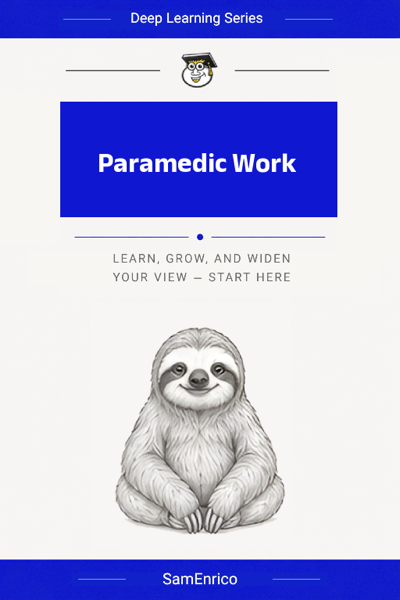
Non-FictionInformativeEducational
Paramedic Work eBook
A Coursebook on Paramedic Work
by Nixon Elsy
A Coursebook on Paramedic Work
Formats
Free sample
Chapter 1: Beyond Lights and Sirens--–– The ambulance screamed through the intersection, lights flashing, siren wailing, its three-ton frame hurtling toward a reported cardiac arrest. Inside, a paramedic ran through her mental checklist: airway equipment, cardiac monitor, medications, backup. She had done this hundreds of times before. But this call was different. The patient was her neighbor.
And the cardiac arrest was not a heart attack at all. It was a panic attack triggered by a utility shut-off notice that the patient could not afford to pay. The paramedic recognized the signs: the patient was hyperventilating, anxious, and frightened, but her pulse was strong, her lungs were clear, and her electrocardiogram showed nothing more than sinus tachycardia. There was no heart attack. There was no emergency.
There was, however, a person in crisis—a person whose medical problem was not a disease but a social circumstance. The paramedic sat down on the floor next to her neighbor, held her hand, and listened. She did not start an IV. She did not administer a medication. She made a phone call to a social worker, found a food bank that could help, and arranged for a follow-up visit from a community paramedic.
The "emergency" ended without a single medical intervention. This is the modern reality of paramedicine. The paramedic's role has expanded far beyond the lights and sirens of emergency response. Today's paramedic must be equally prepared for cardiac arrest and existential crisis, for trauma and social work, for critical care and compassionate listening. This chapter establishes the foundational understanding that paramedicine has evolved from a transportation service into a sophisticated healthcare profession.
The paramedic is no longer defined by the ambulance. The paramedic is defined by clinical judgment, interprofessional collaboration, and the ability to care for the whole patient—not just the presenting complaint.From Hearse to Healthcare Provider The origins of paramedicine are humble and, by modern standards, disturbing. Before the 1960s, ambulance transportation in the United States was largely provided by funeral homes. Hearses doubled as ambulances. The attendants were morticians who had little or no medical training.
Their job was to transport the sick or injured to the hospital as quickly as possible—not to treat them. Patients were often loaded into the back of a vehicle and left unattended during transport. There was no such thing as prehospital care. There was only prehospital transport.Two documents changed everything. The first was the 1966 white paper "Accidental Death and Disability: The Neglected Disease of Modern Society," published by the National Academy of Sciences.
The report was a scathing indictment of the state of emergency medical services in America. It noted that a soldier wounded in Vietnam had a better chance of survival than a civilian injured in a car crash on an American highway. The battlefield had helicopters, trained medics, and field hospitals. The highway had hearses. The white paper catalyzed federal action, leading to the Highway Safety Act of 1966 and the creation of the National Highway Traffic Safety Administration, which began funding EMS systems across the country.The second document was a television show.
"Emergency!" aired from 1972 to 1977 and followed the lives of two paramedics working for the Los Angeles County Fire Department. The show was fictional, but its impact was real. Millions of Americans watched paramedics intubate patients, defibrillate hearts, and administer medications. The show inspired a generation of men and women to enter the profession. It also educated the public about what paramedics could do, creating demand for advanced prehospital care.The training programs that emerged in the 1970s were heavily influenced by military medicine.
Medics returning from Vietnam brought battlefield experience in hemorrhage control, airway management, and triage. The curriculum that became the national standard—the U.S. Department of Transportation National EMS Education Standards—drew directly from military protocols. The paramedic was conceived as a civilian combat medic, ready to handle the worst that trauma and cardiac arrest could offer. That conception, however, was incomplete.
It prepared paramedics for the dramatic call. It did not prepare them for the neighbor with the panic attack.The Paramedic Within the Healthcare Continuum The paramedic of the twenty-first century operates at the intersection of multiple healthcare domains: emergency medicine, primary care, public health, and social services. Understanding this intersection is essential because the paramedic's role cannot be reduced to any single domain. The paramedic is neither a physician extender nor a social worker nor a public health nurse. The paramedic is something unique—a clinician who practices in the patient's environment, with limited resources, under conditions of uncertainty, and without the safety net of a hospital.Emergency Medicine Domain.
The paramedic's emergency medicine role is the most familiar. Paramedics respond to cardiac arrests, strokes, trauma, respiratory failure, and other time-sensitive emergencies. They initiate treatments that can mean the difference between life and death. They perform endotracheal intubation, administer thrombolytics for stroke, interpret electrocardiograms, and manage critically unstable patients during transport. In this domain, the paramedic functions as an extension of the emergency physician, operating under standing orders or online medical direction.Primary Care Domain.
But not every 9-1-1 call is an emergency. Studies consistently show that between 30 and 50 percent of ambulance transports are for conditions that do not require emergency department care. Patients call for help with medication refills, minor injuries, chronic pain, dental problems, and anxiety. In many communities, the ambulance has become the default healthcare provider for the uninsured and the underserved. The paramedic who cannot distinguish a true emergency from a primary care problem will either over-treat (subjecting patients to unnecessary emergency department visits) or under-treat (missing serious conditions).
The primary care domain requires knowledge of chronic disease management, medication reconciliation, and the capabilities of alternative care destinations.Public Health Domain. Paramedics are often the first healthcare providers to encounter emerging public health threats. A cluster of opioid overdoses may signal a contaminated drug supply. An unusual respiratory illness may be the first sign of an outbreak. The paramedic who recognizes these patterns can activate surveillance systems and prevent wider harm.
Public health also includes injury prevention: fall prevention education for older adults, car seat distribution and education, naloxone leave-behind programs for overdose survivors, and safe storage counseling for firearms and medications. These interventions happen not in an emergency department but in the patient's home, at the moment of vulnerability.Social Services Domain. The patient with the utility shut-off notice is not atypical. Many 9-1-1 calls are driven by social determinants of health: lack of food, unstable housing, social isolation, inability to afford medications, lack of transportation to medical appointments. The paramedic who recognizes these social drivers can connect patients to community resources—food banks, housing assistance, social workers, area agencies on aging.
These connections may do more for the patient's health than any medication the paramedic could administer. The paramedic who ignores the social domain will treat the same patient repeatedly for the same preventable problems.The paramedic who masters all four domains delivers patient-centered care. The paramedic who masters only the emergency medicine domain delivers episodic, reactive, and often ineffective care. The distinction is the difference between a technician and a clinician.Interprofessional Collaboration: No One Practices Alone Modern paramedicine requires seamless integration…
This is the end of the free sample. Get the eBook to keep going. Buy now
About this book
Details
- Author
- Nixon Elsy
- Publisher
- SamEnrico
- Language
- English
- Genre
- Non-Fiction, Informative, Educational
- Released
- 2026-05-11
- Pages (approx.)
- 126
- Available as
- eBook, Audiobook

Read better in the ZLOADR app
Your eBooks on your phone or tablet. Sign in with your SamEnrico account and start reading.
More by Nixon Elsy
 The Bizarre Disappearance Of Thelma PaulineNixon Elsy$11.99
 Sahara Explorer Sand Dune CollapseNixon Elsy$11.99
 LSE Online Student ExperienceNixon Elsy$11.99
 Emotion Regulation Sex AddictsNixon Elsy$11.99
 The Lobbyist Who Sold the Moon: How One Man Shaped Space PolicyNixon Elsy$11.99
 Ragnarok’s Shadow: How Loki Tricked the Gods of OlympusNixon Elsy$11.99
 Understanding Horner's SyndromeNixon Elsy$17.99
 Bug Bounty Vulnerability Disclosure OutlookNixon Elsy$12.99
 Search Console Query ManualNixon Elsy$12.99
 A Beginners Guide to Beach Volleyball (Volume 1)Nixon Elsy$11.99
You may also like
 Hong Kong Handover 1997Dunn Johnnie$11.99
 Zumba For Postnatal Recovery CourseNeal Christian$11.99
 Zumba for BeginnersLadner Nikia$11.99
 YouTube Comment Mining GuideHumes Pandora$12.99
 Worry Box MeditationCarlin Rudy$11.99
 Workplace Stress MeditationNguyen Lynn$11.99
 Workplace Stress and Sleep RepairHawley Ivory$11.99
 Workplace Perfectionism CureDelaney Jeffry$11.99
 Workplace Injustice Anger GuideWallen Isabelle$11.99
 Work Addiction and Burnout LinkGreenwood Ester$11.99
 Women in Yoga and WellnessBeattie Galina$11.99
 Women in Stand Up ComedyChun Evangeline$11.99