
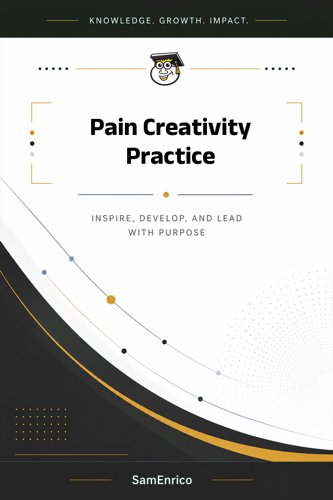
Non-FictionSelf-HelpCreativity
Pain Creativity Practice eBook
Express pain experiences through art, music, or wr
by Craven Clair
Express pain experiences through art, music, or writing as therapy.
Formats
Free sample
Chapter 1: The Shared Wound--You have been told, probably your entire life, that physical pain and emotional pain are different things. A broken bone is real. A broken heart is a metaphor. One sends you to the emergency room. The other sends you to a bar, or a bed, or a long silent walk.
But here is the first and most important truth this book will offer you: your brain does not know the difference. Not really. Not where it matters most.This is not a poetic sentiment. It is a neurological fact, confirmed by decades of functional magnetic resonance imaging studies that have watched people’s brains light up in real time as they experienced physical pain, social rejection, heartbreak, and grief. The same regions activate.
The same neural alarm system rings. The same chemical cascade floods your bloodstream. When your lover leaves you and when you break your leg, your brain’s anterior cingulate cortex—a small, ancient structure buried deep between the hemispheres—sends out the same distress signal. Pain is pain is pain.If you are holding this book, you likely know this truth already, even if no doctor or therapist ever told you. You know because you have felt a panic attack land like a heart attack.
You have felt grief settle into your chest like a stone. You have felt the exhaustion of chronic pain drain your ability to hope. You have felt, perhaps, that your suffering is not neatly categorized into “physical” and “emotional” boxes. It just is. It lives in you.
And no one has given you a map for what to do with it.This book is that map. And this first chapter is where we draw the first line. We are going to dismantle the false wall between body and mind, understand exactly what pain is and is not, and learn the single most important distinction you will ever make: the difference between pain and suffering. Then, because this is a practice book and not a lecture, you will end this chapter with your first creative act.The Architecture of Alarm Let us start with the brain. Specifically, let us start with the anterior cingulate cortex, or ACC.
The ACC sits roughly in the middle of your brain, just behind your forehead, straddling the two hemispheres like a bridge. For decades, neuroscientists thought its primary job was attention and error detection. But in the late 1990s and early 2000s, a series of clever experiments changed that understanding.Researchers placed volunteers inside f MRI scanners and asked them to experience pain—typically a hot probe against the skin. The ACC lit up. Then, the same volunteers were subjected to social pain: they were excluded from a virtual ball-tossing game, or they looked at photos of an ex-partner after a breakup.
The ACC lit up again. The same region. The same intensity. The same distress signal. In one particularly elegant study, participants who took acetaminophen (Tylenol) reported not only less physical pain but also less social pain.
The same drug worked on both. Because the brain does not differentiate.Let me say that again: your brain does not have separate “physical pain” and “emotional pain” circuits. It has one alarm system. The alarm rings whether you are being burned, rejected, abandoned, or humiliated. The ring is the ring.
The interpretation comes later.This has profound implications. If you have been telling yourself that your emotional suffering is “less real” than a broken bone, you can stop. It is not less real. It is processed by the same neural tissue, using the same neurotransmitters, demanding the same attention. And if you have been told that your chronic physical pain is “all in your head” as a way of dismissing it, you now have a rebuttal.
Of course it is in your head. That is where all pain lives. The head is not a less valid place to suffer than the knee or the back. The head is the only place any of us suffer.The ACC is not working alone. It is part of a larger network called the “pain matrix,” which includes the insula (which maps the internal state of your body), the somatosensory cortex (which locates the pain in space), and the prefrontal cortex (which tries to make meaning of it all).
When you are in pain, your entire brain reorganizes itself around that signal. Attention narrows. Memory becomes selective. The future shrinks. This is adaptive in the short term—a predator does not want you distracted by tomorrow’s meal plan when your leg is broken.
But in the long term, chronic pain—whether from a back injury or a childhood trauma—rewires the brain to expect pain constantly. The alarm gets stuck in the on position.That stuck alarm is what brings most people to a book like this. You are not imagining that your pain has become a permanent background hum. It has. And the first step to turning down the volume is understanding how the alarm works.The Opioid Theory of Music Here is where this chapter turns from neuroscience to something that might feel like magic, except it is also neuroscience.
When you listen to music that your brain predicts as rewarding—a song you love, a piece that moves you, even a sad melody that makes you cry—your brain releases endogenous opioids. Endorphins. The same natural painkillers that allow a runner to keep going after twenty miles. The same chemicals that make a hug feel warm and a laugh feel cleansing.This is not metaphorical. Researchers have administered naloxone, a drug that blocks opioid receptors, to listeners of their favorite music.
Under naloxone, the music stopped feeling pleasurable. The chills stopped. The emotional resonance faded. The opioids were not a side effect of the music. They were the music.
Or at least, they were the reason the music moved you.But here is the counterintuitive finding that matters most for this book’s purpose. Sad music—the kind that makes you cry, the kind you listen to when you are already grieving—triggers a different hormonal cascade. In addition to endorphins, sad music releases prolactin, a hormone associated with lactation and, crucially, with consolation. Prolactin is the body’s way of saying, “You are safe. Rest now.” It is the chemical opposite of the stress hormone cortisol.
When you listen to a mournful song and feel comfort rather than deeper despair, you are experiencing prolactin at work.This explains a paradox that has puzzled psychologists for decades. Why do people choose to listen to sad music when they are already sad? Why does it not make them feel worse? The answer is that sad music does not amplify sadness. It counter-regulates it.
The brain, detecting a mismatch between the internal state (grief) and the external stimulus (a sad song that is not actually threatening), releases prolactin to soothe. The song becomes a container for the grief. The grief is held. And for a few minutes, you are not alone in it.Let me pause here to address something important. If you have ever listened to a sad song on repeat for hours, crying, unable to stop…
This is the end of the free sample. Get the eBook to keep going. Buy now
About this book
Details
- Author
- Craven Clair
- Publisher
- SamEnrico
- Language
- English
- Genre
- Non-Fiction, Self-Help, Creativity
- Released
- 2026-06-09
- Pages (approx.)
- 131
- Available as
- eBook, Audiobook

Read better in the ZLOADR app
Your eBooks on your phone or tablet. Sign in with your SamEnrico account and start reading.
More by Craven Clair
 The Chemotherapy Body ScanCraven Clair$11.99
 Cape Town Founder Mental Health GuideCraven Clair$11.99
 Klinefelter Syndrome TestosteroneCraven Clair$11.99
 Managing Stress as a New ManagerCraven Clair$11.99
 Rum & Revolution: The Smugglers' Code of the CaribbeanCraven Clair$11.99
 The Outback's Hidden Cure: Howard Florey and the Fight Against InfectionCraven Clair$11.99
 Understanding Charcot–Marie–tooth Disease Type 4aCraven Clair$17.99
 Execution Discipline in Online BusinessesCraven Clair$11.99
 Australian Education System GuideCraven Clair$12.99
 Proposal Writing Checklist GuideCraven Clair$12.99Proposal Writing Checklist GuideCraven Clair$12.99
You may also like
 Hong Kong Handover 1997Dunn Johnnie$11.99
 Zumba For Postnatal Recovery CourseNeal Christian$11.99
 Zumba for BeginnersLadner Nikia$11.99
 YouTube Comment Mining GuideHumes Pandora$12.99
 Worry Box MeditationCarlin Rudy$11.99
 Workplace Stress MeditationNguyen Lynn$11.99
 Workplace Stress and Sleep RepairHawley Ivory$11.99
 Workplace Perfectionism CureDelaney Jeffry$11.99
 Workplace Injustice Anger GuideWallen Isabelle$11.99
 Work Addiction and Burnout LinkGreenwood Ester$11.99
 Women in Yoga and WellnessBeattie Galina$11.99
 Women in Stand Up ComedyChun Evangeline$11.99