
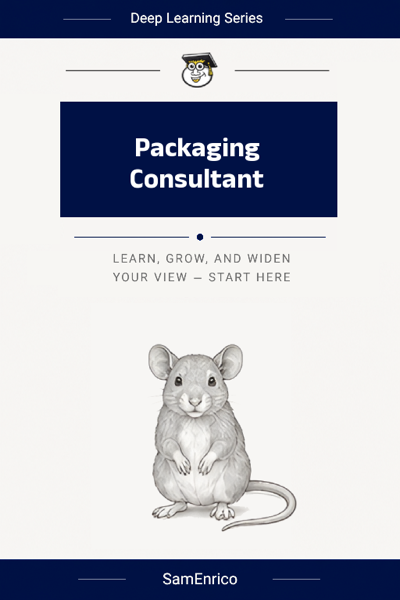
Non-FictionInformativeEducational
Packaging Consultant eBook
A Coursebook on Packaging Consultant
by Bolduc Tisa
A Coursebook on Packaging Consultant
Formats
Free sample
Chapter 1: Seeing Through Cardboard...--Most people look at a package and see a box. They see a bottle, a pouch, a clamshell, a tube. Something to hold a product, protect it during shipping, and maybe catch a shopper's eye for a second or two before ending up in the recycling bin or the landfill.You cannot afford to be most people.The difference between a packaging consultant who charges two hundred dollars an hour and one who charges two thousand dollars an hour has nothing to do with how many years they have spent in a lab or on a factory floor. It has everything to do with what they see when they look at a package. The rookie sees a container.
The expert sees a complex system of trade-offs, failure points, hidden costs, and missed opportunities. The expert sees what the client cannot see, even though it has been sitting on their warehouse shelf for years.This chapter is about training your eyes to see what others miss. It introduces the foundational framework of this entire book: the Three-Lens Diagnostic. Master this framework, and you will never look at packaging the same way again. More importantly, your clients will never look at you the same way again.
You will become the person they call when they are stuck, when the internal teams have spent months arguing in circles, when the easy solutions have failed and the expensive solutions look terrifying.Let us begin by understanding why most packaging professionals are blind in two eyes.The Curse of Specialization The packaging industry has a dirty secret that no one likes to talk about. It has been deliberately, systematically siloed for over a century. The people who formulate the materials rarely speak to the people who design the graphics. The people who design the structures rarely stand next to the filling lines where their creations will run. The people who negotiate supplier contracts have never watched a customer struggle to open a package on their kitchen counter.This is not because these professionals are lazy or stupid.
It is because the industry has evolved into deep, narrow specialties that reward depth over breadth. A material scientist gets promoted for knowing more and more about less and less. A structural designer gets awards for innovative shapes without ever calculating how those shapes affect pallet density. A procurement manager gets bonuses for driving down unit prices without ever measuring the downstream costs of damage, returns, and customer frustration.The result is a landscape of brilliant experts who are accidentally sabotaging each other's work. The designer creates a beautiful curved bottle that jams the filling line.
The engineer specifies a thinner film that saves material cost but doubles breakage rates. The sustainability team mandates compostable packaging that spoils the product three months before it reaches the customer.Each of these professionals made the best decision they could with the information they had. Each of them was acting in good faith. Each of them was blind to the consequences of their decision outside their narrow domain.This is where you come in.The Three Lenses Defined The Three-Lens Diagnostic is a simple but brutal framework. You will apply it to every client problem, every package you evaluate, and every recommendation you make for the rest of your career.
It consists of three distinct ways of seeing a package, each corresponding to a different professional domain. Master all three, and you will see what literally everyone else misses.Lens One: The Chemist The chemist asks one fundamental question: Does this package keep the product safe, stable, and fresh for its intended shelf life?This lens is about protection and preservation. It is about the invisible battles that happen at the molecular level. Moisture trying to get in. Oxygen trying to get in.
Light trying to degrade sensitive compounds. The product trying to interact chemically with its container. The seal trying to hold.When you look through the chemist's lens, you are looking for failure modes that the client has probably never considered. That beautiful glass jar? It is inert, which is good, but it is also heavy and breakable, which is bad.
That thin plastic film? It provides an excellent moisture barrier, but it might also allow oxygen transmission at a rate that spoils the product. That recycled paperboard? It is sustainable and compostable, but recycled fibers are shorter and weaker than virgin fibers, which means the box may crush under less weight.The chemist also thinks about chemical migration. Will the ink on the label leach through the film and into the food?
Will the adhesive on the closure react with the product and create an off taste or, worse, a health hazard? Will the recycled content introduce contaminants that the client has not tested for? Major recalls have happened for exactly these reasons. Brands have been destroyed. Lawsuits have been lost.You do not need to be able to calculate the moisture vapor transmission rate of a polyethylene terephthalate film from memory.
But you need to know that the question exists. You need to know which accredited laboratory to call to get the data. You need to know how to interpret the results when they come back. Most importantly, you need to be able to translate those results into plain English for a marketing vice president or a chief financial officer who has never heard of moisture vapor transmission rate and does not care to learn.Lens Two: The Artist The artist asks one fundamental question: Does this package compel someone to pick it up, turn it over, and put it in their cart?This lens is about communication, desire, and emotion. Before the customer has tasted the product, smelled the fragrance, or experienced the service, they have judged the package.
That judgment happens in less than three seconds on a retail shelf. On an e-commerce site, it happens in the time it takes to scroll past a thumbnail image. The package is the brand at the moment of purchase. It is the handshake, the flirtation, the promise.When you look through the artist's lens, you are looking for failures of communication. Is the typography legible at arm's length, or does it dissolve into an unreadable mess?
Are the colors accurate and appealing, or have they shifted during the printing process into something muddy and unappetizing? Does the structural design feel premium and intentional, or does it feel cheap and accidental?The artist also thinks about the physical constraints of printing and decoration. Can the client's converter print that fine level of detail on that rough, absorbent substrate? Will the hot foil stamping crack and flake when the flexible film is bent repeatedly during shipping and handling? Is that beautiful window placement going to actually line up with the product inside, or will the customer see empty space and assume they have been shortchanged?And then there is the question of the retail environment.
Is this package going to sit on a crowded shelf next to aggressive competitors, where it needs to scream for attention from three feet away? Or is it going to arrive in a brown box on someone's porch, where it…
This is the end of the free sample. Get the eBook to keep going. Buy now
About this book
Details
- Author
- Bolduc Tisa
- Publisher
- SamEnrico
- Language
- English
- Genre
- Non-Fiction, Informative, Educational
- Released
- 2026-05-11
- Pages (approx.)
- 131
- Available as
- eBook, Audiobook

Read better in the ZLOADR app
Your eBooks on your phone or tablet. Sign in with your SamEnrico account and start reading.
More by Bolduc Tisa
 Remote Work Noise CancellationBolduc Tisa$11.99
 Substitution Effect AnalysisBolduc Tisa$11.99
 The Posting Perfectionism GuideBolduc Tisa$11.99
 The Senolytics Anti Aging GuideBolduc Tisa$11.99
 Wellington's Gambit: The Bloodied Fields of Salamanca (1812)Bolduc Tisa$11.99
 Learn to Play the UkuleleBolduc Tisa$11.99
 How to Become a Mains-and-service SupervisorBolduc Tisa$11.99
 Negotiating with Event VendorsBolduc Tisa$12.99
You may also like
 Hong Kong Handover 1997Dunn Johnnie$11.99
 Zumba For Postnatal Recovery CourseNeal Christian$11.99
 Zumba for BeginnersLadner Nikia$11.99
 YouTube Comment Mining GuideHumes Pandora$12.99
 Worry Box MeditationCarlin Rudy$11.99
 Workplace Stress MeditationNguyen Lynn$11.99
 Workplace Stress and Sleep RepairHawley Ivory$11.99
 Workplace Perfectionism CureDelaney Jeffry$11.99
 Workplace Injustice Anger GuideWallen Isabelle$11.99
 Work Addiction and Burnout LinkGreenwood Ester$11.99
 Women in Yoga and WellnessBeattie Galina$11.99
 Women in Stand Up ComedyChun Evangeline$11.99