
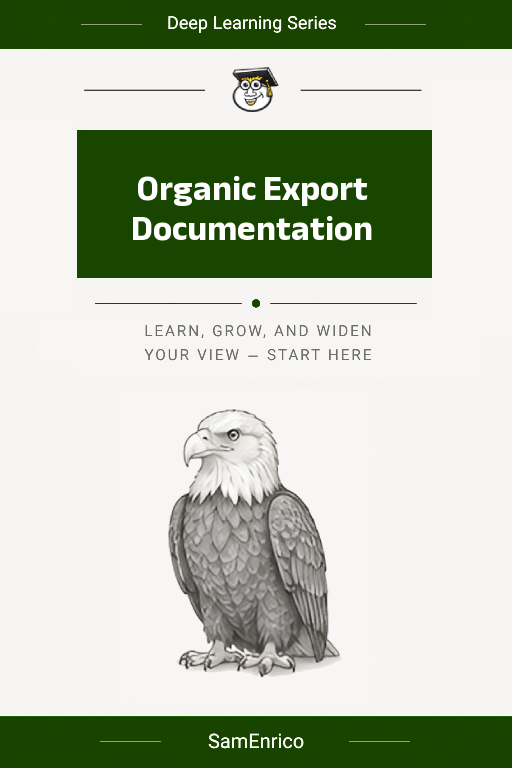
Organic Export Documentation eBook
Meet EU and USDA organic requirements with traceab
Meet EU and USDA organic requirements with traceability logs, buffer zone inspections, and accredited certifier selection for your products.
Formats
Free sample
Chapter 1: The $2 Million Mistake--–- The letter arrived on a Tuesday, three weeks before Christmas. Maria Vasquez, owner of Almond Groves Organic in California's Central Valley, had just approved a $2.1 million shipment of certified organic almonds to a buyer in Hamburg, Germany. The container was already on the water, scheduled to arrive at the Port of Rotterdam in eleven days. Her buyer had paid a 40% deposit. Her staff had worked double shifts to meet the production deadline.The letter, from the European Union's Directorate-General for Health and Food Safety, was titled "Notice of Import Refusal – Non-Compliance with EU Organic Regulation 2018/848."Maria read it three times before the words stopped blurring.
Her USDA Organic seal – the one she had paid for, audited for, and built her entire brand around – meant nothing at the German border. The EU did not recognize her certification as equivalent for processed almonds. She needed dual certification, a distinction no one had explained when she signed up with her certifier four years ago.The container was rejected. The almonds were either going to be sold as conventional at a 60% loss, shipped back at her expense, or destroyed. Her buyer demanded their deposit returned.
Her certifier shrugged and said, "We told you we were USDA-accredited, not EU-accredited." Maria lost $1.4 million on that shipment. She closed her export division six months later.This chapter exists to ensure that never happens to you.The Most Dangerous Assumption in Organic Exporting The USDA Organic seal is one of the most recognized food certifications in the world. Consumers from Tokyo to London to Dubai recognize the green-and-white circle as a promise of integrity, environmental stewardship, and premium quality. It is a powerful marketing tool. It is also, when crossing international borders, a potential liability.The assumption that a USDA Organic seal guarantees automatic acceptance in foreign markets has destroyed more organic export businesses than any other single mistake.
It is not true. It has never been true. And in the current regulatory environment, the gap between what the USDA certifies and what the EU, UK, Japan, Switzerland, and Canada require is widening, not narrowing.This chapter dismantles that assumption. You will learn the critical distinction between Equivalence and Identical regulations, understand why the 2012 EU-US Organic Equivalence Arrangement is not the safety net you think it is, and discover exactly when you need dual certification versus when a single certification will suffice. By the end of this chapter, you will have a decision matrix that tells you, in under ten minutes, which markets require which certifications for your specific product.Equivalence vs.
Identity: The Core Distinction That Changes Everything Let us start with the foundation. When two countries or trading blocs have an equivalence arrangement, they agree that their respective organic standards achieve the same goals – protecting consumer trust, ensuring environmental integrity, and preventing fraud – even if the specific rules are different. Equivalence says, "Your system is different from ours, but it is good enough."An identical or harmonized standard, by contrast, means both parties follow exactly the same rules. This is rare. The United States and Canada had a harmonized standard for a period, but even that arrangement had exceptions for specific crops.The EU-US Organic Equivalence Arrangement, signed in 2012 after seven years of negotiation, is an equivalence agreement – not an identity agreement.
This means that an organic product certified in the US under the USDA National Organic Program (NOP) can be sold as organic in the EU without additional certification, provided it meets certain conditions. Those conditions are where the complexity – and the risk – lies.Here is what the equivalence arrangement does not cover:Processed foods containing EU-restricted additives Wine (separate rules apply)Products grown hydroponically (legal in the US, illegal in the EU)Products with GMO contamination above 0.9% (EU threshold is a hard line)Products from land converted to organic for less than two years (EU requires 24 months for annuals, 36 months for perennials)If your product falls into any of these categories, equivalence is not enough. You need dual certification – or you need to stay home.The History of the EU-US Equivalence Arrangement: What They Didn't Tell You To understand why the equivalence arrangement is both a blessing and a trap, you need to know its history. Negotiations began in 2005, when the EU's organic regulation (EC 834/2007) was still being drafted. The US Department of Agriculture (USDA) and the European Commission disagreed on fundamental issues: hydroponics, GMO thresholds, antibiotic use in livestock, and the role of certifiers.The arrangement that finally emerged in 2012 was a compromise.
The EU agreed to accept USDA NOP certification for most crop and livestock products. The US agreed to accept EU certification for most products. But both sides kept their own rules. A product certified under one system could be sold in the other jurisdiction, but the certification itself was not transferable. If an EU exporter wanted to sell in the US, they still needed US NOP certification.
If a US exporter wanted to sell in the EU, they still needed to comply with EU rules.The arrangement also included a "safeguard clause" that allowed either party to suspend equivalence for specific products, regions, or certifiers. This clause has been used repeatedly. In 2017, the EU suspended equivalence for Turkish organic figs due to widespread fraud. In 2019, the US suspended equivalence for several Indian organic certifiers. In 2022, the EU threatened to suspend equivalence for all US organic grain due to concerns about parallel production.The arrangement is not permanent.
It is reviewed annually. And every review creates an opportunity for the rules to change. Exporters who assume that what worked last year will work this year are playing a dangerous game.The Cost of Double Certification: When It's Necessary and When It's Wasteful Dual certification – maintaining both USDA NOP and EU 2018/848 certification for the same product – is expensive. The costs include:Cost Category USDA NOP (Annual)EU 2018/848 (Annual)Certification fee1,500–1,500–1,500–5,000€1,500–€4,000Inspection travel500–500–500–2,000€500–€2,000 (if EU-based inspector)Administrative overhead1,000–1,000–1,000–3,000€1,000–€3,000Separate OSP maintenance500–500–500–1,500€500–€1,500Total annual3,500–3,500–3,500–11,500€3,500–€10,500For a small-to-medium exporter, dual certification can cost $15,000 or more per year. That is a significant line item.
The question is not whether dual certification is expensive – it is whether it is necessary.When Dual Certification Is Required You need both USDA and EU certification if:Your product contains any substance prohibited by EU 2018/848 but allowed by USDA. The most common example is certain sanitizers (hydrogen peroxide at concentrations above EU limits) and processing aids. If your organic apple cider uses a filtration aid that is USDA-approved but EU-restricted, your product cannot enter the EU under equivalence.Your product is grown hydroponically or aquaponically. The EU explicitly excludes hydroponics from organic certification. The USDA allows it.
If you market hydroponic lettuce as organic in the US, you cannot sell it as organic in the EU under any arrangement – you need EU certification for soil-grown product, which is impossible if your operation is hydroponic.Your product is a processed food containing EU-restricted additives. The EU maintains a "positive list" of allowed additives (EU 2018/848 Annex V). If your organic energy bar contains a natural flavor that is not on that list, equivalence is void.Your product is wine. Wine has its own separate organic rules under both…
This is the end of the free sample. Get the eBook to keep going. Buy now
About this book
Details
- Author
- Royster Charity
- Publisher
- SamEnrico
- Language
- English
- Genre
- Non-Fiction, Business Brief, Organic Compliance, Export Operations
- Released
- 2026-06-01
- Pages (approx.)
- 144
- Available as
- eBook, Audiobook

Read better in the ZLOADR app
Your eBooks on your phone or tablet. Sign in with your SamEnrico account and start reading.
More by Royster Charity
 Napping for Insomnia SufferersRoyster Charity$11.99
 Microbiome Diabetes RiskRoyster Charity$11.99
 Remote Team Crisis LeadershipRoyster Charity$11.99
 The 5 Day Quit PlanRoyster Charity$11.99
 Small Talk at Work Made SimpleRoyster Charity$11.99
 Remote Productivity ResearchRoyster Charity$11.99
 Amazon Seller Central DashboardRoyster Charity$11.99
 Thyroid BooksRoyster Charity$11.99
 Boundary Workbook For WomenRoyster Charity$11.99
 The Last Voyages of the *Kaiwo Maru*: Japan's Forgotten Arctic ExplorerRoyster Charity$11.99
 The Bloodhound and the Billionaire: How a Dog Solved the Case of the Missing FortuneRoyster Charity$11.99
 The Algorithm and the Artist: How AI Stole a GrammyRoyster Charity$11.99