
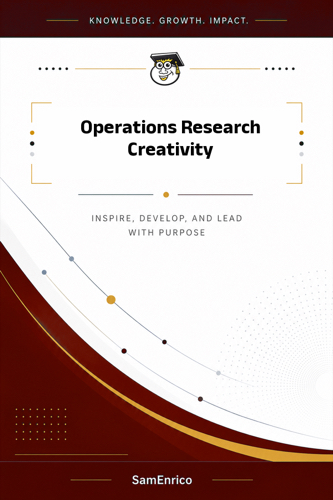
Operations Research Creativity eBook
Apply optimization algorithms to generate novel sc
Apply optimization algorithms to generate novel scheduling and logistics solutions.
Formats
Free sample
Chapter 1: The Unasked Question--–- The conference room smelled of stale coffee and desperation. Around a long walnut table, twelve logistics managers stared at a spreadsheet projected onto a white wall. The numbers were colored red—deep crimson, the color of losses. For six months, they had been trying to optimize their delivery schedules using the most sophisticated mixed-integer programming solver their budget could buy. The software returned solutions that were mathematically optimal.
And every single day, drivers ignored them.“The algorithm says this route saves 11.3 percent on fuel,” the operations director said, pointing at a perfectly efficient serpentine path through the city. “But driver Rodriguez refuses to follow it. He says it takes him through a school zone during dismissal. He’s not wrong.”Someone muttered, “Then change the cost function.” Someone else sighed. They had changed the cost function seventeen times.
They had added constraints for left turns, bridge tolls, driver lunch preferences, and even the locations of public restrooms. Each new constraint made the model more accurate and simultaneously more fragile. The algorithm found optimal solutions that no human would ever execute.This is the central paradox of operations research: we build mathematically perfect models, and then reality refuses to cooperate. The problem is not with optimization. The problem is with the question we ask.
For decades, operations researchers have been trained to ask, “What is the optimal schedule?” or “What is the most efficient route?” These are technical questions, and they yield technical answers. But they are almost always the wrong questions.The right question is simpler and far more radical: What problem are we really trying to solve?This chapter is about the first and most creative act in operations research: reframing. Before you write a single constraint, before you choose an algorithm, before you run a single iteration, you must ask whether you have defined the problem correctly. Most scheduling and logistics failures do not occur because the optimization failed. They occur because the optimization solved the wrong problem perfectly.The Anatomy of a Wrong Problem Consider a typical logistics scenario.
A company operates a fleet of delivery vehicles. Customers place orders throughout the day. The dispatcher’s job is to assign each order to a vehicle and sequence the stops to minimize total driving distance while meeting delivery windows. This is the Vehicle Routing Problem with Time Windows (VRPTW). It has been studied for decades.
There are excellent solvers. And yet, in practice, dispatchers override the solver’s recommendations constantly.Why? Because the solver optimizes distance. The dispatcher optimizes something else: driver sanity, customer relationships, the probability that a traffic jam will cascade into missed windows, or the simple fact that driver Rodriguez knows that the third stop on the algorithm’s route has a loading dock that is unusable between 2 and 3 PM—a constraint that exists nowhere in the model.The problem is not that the model lacks fidelity. The problem is that the problem statement lacks imagination.
When you ask “What is the optimal route?” you are implicitly accepting a frame: that the objective is distance minimization, that constraints are fixed and enumerable, that the problem is one of assignment and sequencing. But what if the real objective is not distance but customer retention? What if the real constraint is not time windows but driver turnover? What if the problem is not a routing problem at all, but a relationship management problem dressed in routing clothes?Reframing is the act of stepping back from the mathematical formulation and asking: Why does this problem exist? Who cares about the solution?
What would success look like from multiple perspectives? These are not soft, qualitative questions. They are the most strategically important questions in operations research. Getting them wrong means optimizing your way to a beautifully efficient disaster.The Four Reframing Techniques Over years of studying creative operations research—and analyzing why top practitioners consistently outperform their peers—we have identified four powerful techniques for reframing scheduling and logistics problems. Each technique challenges a different hidden assumption.
Each has produced breakthrough solutions in real-world settings.Technique 1: Problem Decomposition (But Not the Way You Think)Decomposition is a standard OR technique: break a large problem into smaller subproblems. But creative reframing uses decomposition differently. Instead of decomposing the mathematical structure, decompose the narrative structure. Ask: Whose problem is this? The dispatcher’s problem is different from the driver’s problem, which is different from the customer’s problem, which is different from the CFO’s problem.
Each stakeholder experiences a different constraint, values a different outcome, and would define success differently.A hospital logistics team once spent three months optimizing the schedule for moving patients between units. Their model minimized travel time for porters. The solution was mathematically elegant. Nurses hated it. Why?
Because the porters’ travel time was not the real problem. The real problem was bed availability. When a porter arrived at a unit to move a patient, the receiving unit was often unprepared, forcing the patient to wait on a gurney in a hallway. The porter’s travel time was a symptom. The real constraint was inter-unit communication and bed turnover.By decomposing the problem into stakeholder narratives—porter, sending nurse, receiving nurse, bed manager—the team realized they were solving the wrong equation.
They stopped optimizing porter routes and started redesigning the bed-release notification system. Patient wait times fell by 40 percent. Porter travel time increased slightly. No one cared.How to apply it: Write down every role that touches your logistics system. For each role, write one sentence describing their primary frustration and one sentence describing what success looks like to them.
Look for patterns. The pattern that appears across multiple roles is usually the real problem. The role-specific frustrations are usually symptoms.Technique 2: Assumption Reversal Every logistics problem rests on a bedrock of assumptions so obvious that no one thinks to question them. Trucks have capacity limits. Drivers have shift durations.
Deliveries happen in a sequence. Warehouses have fixed locations. These are not laws of physics; they are choices made by someone, somewhere, often decades ago. Assumption reversal is the practice of systematically flipping each assumption to its opposite and asking: What would the world look like if this assumption were false?Consider the assumption that deliveries happen in a sequence. A major parcel carrier flipped this assumption.
What if deliveries happen in parallel? That led to the concept of dynamic load consolidation: a truck does not follow a fixed route but acts as a mobile depot, with smaller vehicles (bikes, drones, or even walking couriers) meeting the truck at temporary hubs. The truck’s route is not a sequence of deliveries but a sequence of rendezvous points. The entire problem reframes from “order the stops” to “schedule the handoffs.”The same carrier reduced last-mile delivery costs by 18 percent. They did not invent new vehicles or hire more drivers.
They reversed an assumption so basic that no one had thought to question it.A partial list of assumptions worth reversing:“The schedule must be deterministic.” → What if it adapts in real time?“Each vehicle returns to the depot at day’s end.” → What if vehicles sleep on the road?“Customers specify delivery windows.”…
This is the end of the free sample. Get the eBook to keep going. Buy now
About this book
Details
- Author
- Tibbetts Hedwig
- Publisher
- SamEnrico
- Language
- English
- Genre
- research, Self-Help, Operations Research
- Released
- 2026-06-08
- Pages (approx.)
- 154
- Available as
- eBook, Audiobook

Read better in the ZLOADR app
Your eBooks on your phone or tablet. Sign in with your SamEnrico account and start reading.
More by Tibbetts Hedwig
 Back Pain Body ScanTibbetts Hedwig$11.99
 The Nemonte Nenquimo StoryTibbetts Hedwig$11.99
 Cognitive Distancing AngerTibbetts Hedwig$11.99
 Plan de Vida PurposeTibbetts Hedwig$11.99
 Gambling Addiction for TeensTibbetts Hedwig$11.99
 Low FODMAP Brain BenefitsTibbetts Hedwig$11.99
 Entrepreneur ProcrastinationTibbetts Hedwig$11.99
 The Manchester Martyr: A Mother's Last StandTibbetts Hedwig$11.99
 Nefertiti’s Veil: The Lost Excalibur of EgyptTibbetts Hedwig$11.99
 How to Produce Remote ControlsTibbetts Hedwig$11.99
 How to Produce Eyelets and GrommetsTibbetts Hedwig$11.99
 The Essential Guide to StandardsTibbetts Hedwig$11.99