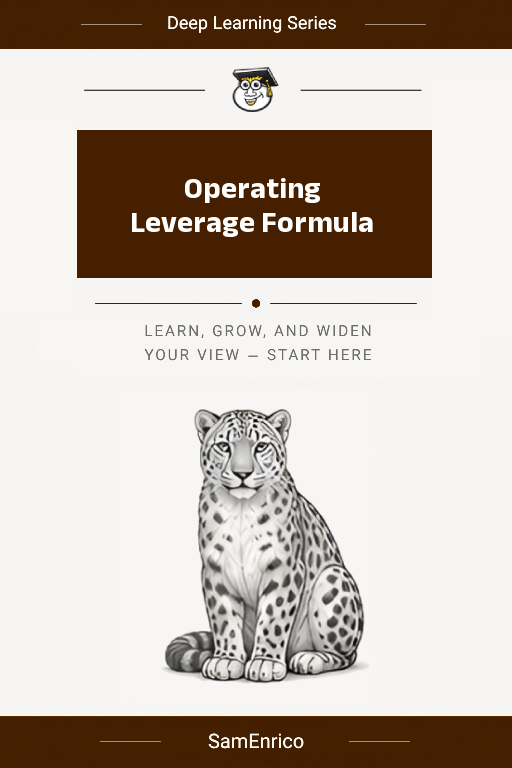
Operating Leverage Formula Audiobook
Measure fixed cost impact using Contribution Margi
Measure fixed cost impact using Contribution Margin divided by Operating Income.
Formats
Free sample
Chapter 1: The Million-Dollar Illusion--–- Every business owner has experienced the moment of triumph: a new contract signed, a major customer order confirmed, or a record-breaking sales month. The revenue number glows green on the dashboard, and instinctively, the manager smiles. More revenue means more profit. That is the fundamental promise of commerce, drilled into every entrepreneur since their first lemonade stand. But what if that promise was built on a lie?
What if a million dollars in new sales could actually make your company poorer? What if another million dollars, structured differently, could generate ten times the profit of the first? This is not a hypothetical puzzle for accountants. It is the most dangerous blind spot in traditional finance—and the single greatest opportunity for strategic advantage. Welcome to the hidden world of operating leverage, where identical revenues produce radically different outcomes, and where understanding the difference separates the companies that scale profitably from those that grow themselves into bankruptcy.The Traditional Income Statement: A Beautiful Deception Walk into almost any small or medium-sized business and ask to see their financial performance.
The manager will likely pull out a Profit and Loss statement—the classic P&L that has been used for centuries. It looks simple, clean, and logical:Revenue – Expenses = Net Income That single equation has guided more business decisions than any other formula in history. On its surface, it seems unassailable. You bring in money. You spend money.
What remains is yours to keep. If you want more of what remains, you either increase revenue or decrease expenses. This is the mental model that drives pricing decisions, hiring choices, marketing budgets, and expansion plans.But this model contains a fatal flaw. It treats every dollar of revenue as identical and every dollar of expense as equivalent. In reality, the relationship between revenue and expenses is not linear, not constant, and not predictable through simple subtraction.
The traditional P&L is like a weather report that tells you yesterday's temperature but gives you no information about whether a hurricane is approaching. By the time you see the damage, it is too late.Consider two companies. Both report exactly 10millioninannualrevenueand10 million in annual revenue and 10millioninannualrevenueand9 million in total expenses. Both show a tidy 1millionprofit.Atraditionalanalysiswoulddeemthemequallyhealthy.Butthesecompaniescouldnotbemoredifferent.Company Ahas1 million profit. A traditional analysis would deem them equally healthy.
But these companies could not be more different. Company A has 1millionprofit.Atraditionalanalysiswoulddeemthemequallyhealthy.Butthesecompaniescouldnotbemoredifferent.Company Ahas8 million in fixed costs (rent, salaried employees…
This is the end of the free sample. Get the Audiobook to keep going. Buy now
About this book
Details
- Author
- Rogers Domingo
- Publisher
- SamEnrico
- Language
- English
- Genre
- Non-Fiction, Student's Shortcut, Leverage
- Released
- 2026-05-30
- Pages (approx.)
- 160
- Available as
- eBook, Audiobook

Listen in the VoxFlicks app
Audiobooks and audio dramas wherever you go. Sign in with your SamEnrico account and press play.
More by Rogers Domingo
 Wholesaling Tax LiensRogers Domingo$11.99
 Chemistry Palace GuideRogers Domingo$11.99
 The Natural ED Remedy GuideRogers Domingo$11.99
 Validation for AddictionRogers Domingo$11.99
 Body Image NightmaresRogers Domingo$11.99
 Assertiveness for New FathersRogers Domingo$11.99
 Freelance During COVID WFHRogers Domingo$11.99
 ED and Alcohol ReductionRogers Domingo$11.99
 The Siege of Nicaea: The Last Byzantine Bulwark (1331 AD)Rogers Domingo$11.99
 The Bloodstained Badge: Australia's First WhistleblowerRogers Domingo$11.99
 Communications Law: Media, Telecom & Free SpeechRogers Domingo$11.99
 A Collector's Handbook to the Alfa Romeo Super SprintRogers Domingo$11.99