
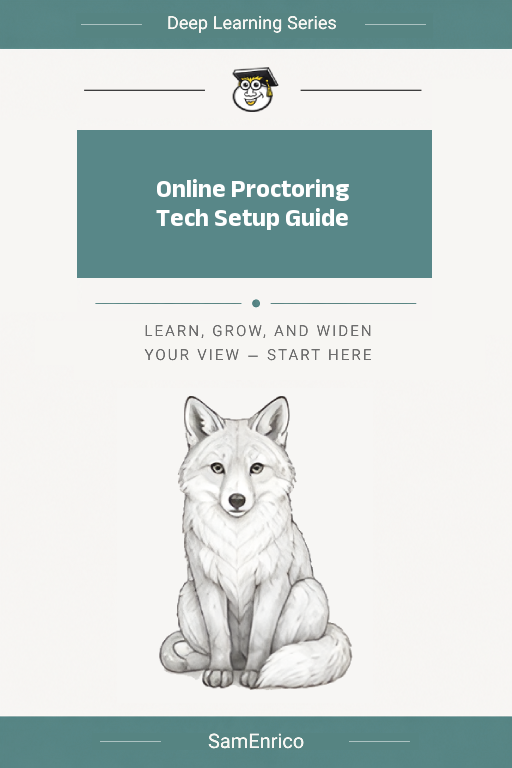
Non-FictionStudent's ShortcutTest-Taking StrategyTech Guide
Online Proctoring Tech Setup Guide eBook
Configure your computer lighting and camera to avo
Configure your computer lighting and camera to avoid common online proctoring flags before your remote exam begins.
Formats
Free sample
Chapter 1: The Algorithm’s Blind Spot--–- You are not paranoid. The camera is watching you. But here is what no proctor will ever tell you: the machine is terrified. It is terrified of missing a real cheater, so it flags everything. It is terrified of being wrong, so it assumes guilt in every shadow, every glance, every nervous scratch of your nose.
And in that terror lies your advantage.This book is not about cheating. It is about understanding a deeply flawed system so you can stop being its victim. Every semester, millions of students sit down for online proctored exams. A significant percentage of them—some studies suggest as many as one in four—will receive a flag. Most of those flags are false.
A glance at a calculator. A stretch of the neck. A cough. A shadow. A fly buzzing past the camera.
These innocent moments trigger the same automated warnings as a student literally holding their phone up to the screen.The system is broken. But you can learn to work within its brokenness.Before we fix your lighting, before we adjust your camera angle, before we walk through the fifteen-minute pre-flight checklist, you need to understand what you are actually facing. This chapter reframes online proctoring from a terrifying surveillance experience into a technical compliance task. The AI is not a judgmental human. It does not watch for intent.
It scans for specific data anomalies: facial landmarks, eye movement vectors, background pixel changes, and audio spikes. Once you understand those four categories, the mystery disappears. The anxiety does not vanish overnight, but it becomes manageable. You stop asking "What if they think I'm cheating?" and start asking "What data points am I sending right now?"That shift in mindset is the difference between a student who panics and a student who passes.The Panopticon in Your Bedroom The philosopher Jeremy Bentham conceived of the Panopticon in the late eighteenth century: a circular prison with a central guard tower. The prisoners could never see the guard, but they knew they might be watched at any moment.
The uncertainty itself enforced obedience. Online proctoring is the digital Panopticon, but with one crucial difference. The guard is not a human being with judgment and mercy. The guard is a pattern-matching algorithm that cannot distinguish between a student looking down at their own lap to think and a student reading answers from a hidden cell phone.This distinction matters more than any technical specification in this book. Human proctors, when they are present at all, typically monitor between twelve and twenty-four students simultaneously.
They are overworked, underpaid, and prone to distraction. The vast majority of flags are generated not by a human decision but by an automated trigger. The algorithm watches your video feed and compares it against a set of rules coded by a software engineer who has never met you, never taken your exam, and never experienced the panic of a false accusation.Understanding this changes everything. You are not being judged. You are being scanned.
And scans can be optimized.The average online proctoring session generates approximately 400 discrete data points per minute. These include the position of your irises relative to your head, the angle of your chin, the distance between your nose and the camera, the presence of any secondary face in the frame, the volume and frequency of ambient noise, and the rate of pixel change in the background behind you. The algorithm assigns a confidence score to each data point. When that confidence score drops below a certain threshold—a threshold set differently by every proctoring company—the system logs an event.Most of these events are never reviewed by a human. They sit in a database, timestamped and categorized, waiting for an instructor to request a report.
If your exam goes smoothly and your score is within expectations, no one will ever look at your flags. But if your instructor receives a report showing twenty-seven "suspicious eye movement" events, they will assume the worst. Your job is to prevent those events from ever being logged.The Four Categories of Detection Every proctoring algorithm on the market—Proctor U, Honorlock, Exam Soft, Respondus, Proctorio, and a dozen smaller competitors—works within the same four categories. Some platforms emphasize one category over others. Some claim to use advanced machine learning.
Some promise "human-reviewed" flags. But the underlying mechanics are identical. Learn these four categories, and you have learned ninety percent of what you need to know.Category One: Facial Landmarks The algorithm places between sixty-eight and one hundred thirty digital pins on your face. These pins track the corners of your eyes, the tip of your nose, the edges of your lips, the curve of your jaw, and the position of your ears. The software expects these pins to remain in a consistent geometric relationship.
When your face moves, the pins move with it. When your face leaves the frame entirely, the pins disappear.The most common facial landmark flag occurs when the pins shift too quickly or too asymmetrically. For example, turning your head to sneeze moves the pins on the left side of your face differently than the pins on the right. The algorithm does not know you are sneezing. It sees a rapid, asymmetric movement and logs a potential "looking off-screen" event.
Similarly, scratching your nose pushes the nose pin upward while the eye pins remain stationary. The algorithm sees a distortion in the expected facial geometry and logs a potential "covering mouth to speak to someone" event.The green circle mentioned throughout this book is the visual representation of facial landmark detection. When the green circle appears steady, the algorithm has successfully placed its pins and is tracking them in real time. When the green circle flickers or turns yellow, the pins are unstable. When it turns red, the pins have been lost entirely.
Your primary goal from camera setup through exam completion is to keep that circle green.Category Two: Eye Movement Vectors This category causes more false flags than any other. The algorithm tracks the direction of your gaze using the position of your irises relative to the whites of your eyes. It does not know what you are looking at. It only knows where your eyes are pointing. Looking up and to the left is typically associated with memory recall.
Looking up and to the right is associated with creative thinking. Looking straight ahead is neutral. Looking down is suspicious because the algorithm assumes you are reading something below the camera's field of view.Here is the critical insight that changes everything. The algorithm does not distinguish between looking down at your own lap and looking down at a cheat sheet taped to your thigh. It cannot see what is below the camera frame.
So it treats all downward gazes as potentially suspicious. This is not a flaw in the software. It is a design constraint. The camera sees only what you point it at. Anything below that frame is invisible, and invisibility equals risk in the algorithm's calculus.Your job is to minimize unnecessary downward gazes.
If you must look down at scratch paper or a calculator, do it deliberately and return your gaze to the…
This is the end of the free sample. Get the eBook to keep going. Buy now
About this book
Details
- Author
- Yamamoto Larue
- Publisher
- SamEnrico
- Language
- English
- Genre
- Non-Fiction, Student's Shortcut, Test-Taking Strategy, Tech Guide
- Released
- 2026-05-28
- Pages (approx.)
- 154
- Available as
- eBook, Audiobook

Read better in the ZLOADR app
Your eBooks on your phone or tablet. Sign in with your SamEnrico account and start reading.
More by Yamamoto Larue
 Varenicline Smoking Cessation CourseYamamoto Larue$11.99
 Lost Diamonds MysteryYamamoto Larue$11.99
 Anger De escalation Complete GuideYamamoto Larue$11.99
 Learning from Adjacent FieldsYamamoto Larue$11.99
 Family Guide to Aging SensesYamamoto Larue$11.99
 The Puppet Master: How a Serial Killer Orchestrated a Nation’s NightmareYamamoto Larue$11.99
 The Grand Illusion: Secrets of the Ritz-Carlton’s Lost HeiressYamamoto Larue$11.99
 How to Start a Curtain Rail, Rollers and Fittings Made of Plastic Business (Beginners Guide)Yamamoto Larue$11.99
 Understanding Cardioauditory Syndrome of Sanchez- CascosYamamoto Larue$17.99
 Islamic Finance B2B SalesYamamoto Larue$12.99
 Track and Field Facility ManagerYamamoto Larue$11.99
You may also like
 Hong Kong Handover 1997Dunn Johnnie$11.99
 Zumba For Postnatal Recovery CourseNeal Christian$11.99
 Zumba for BeginnersLadner Nikia$11.99
 YouTube Comment Mining GuideHumes Pandora$12.99
 Worry Box MeditationCarlin Rudy$11.99
 Workplace Stress MeditationNguyen Lynn$11.99
 Workplace Stress and Sleep RepairHawley Ivory$11.99
 Workplace Perfectionism CureDelaney Jeffry$11.99
 Workplace Injustice Anger GuideWallen Isabelle$11.99
 Work Addiction and Burnout LinkGreenwood Ester$11.99
 Women in Yoga and WellnessBeattie Galina$11.99
 Women in Stand Up ComedyChun Evangeline$11.99