
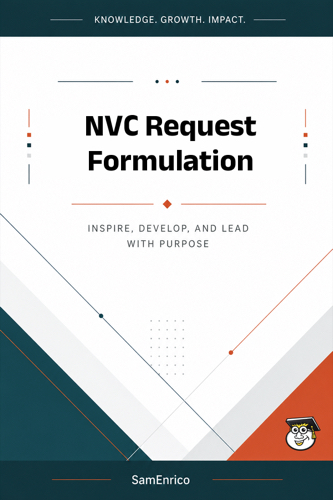
NVC Request Formulation Audiobook
Craft clear, doable, positive requests that invite
Craft clear, doable, positive requests that invite connection rather than demand.
Formats
Free sample
Chapter 1: The Lateness Lie--–- You said “Don’t be late” again. And they were late again. You are standing in the kitchen, arms crossed, watching the clock tick past the agreed-upon time. Your jaw tightens. Your chest feels hot.
When they finally walk through the door, you hear yourself say, “You’re late. Again.” The words hang in the air like a verdict. They sigh. They roll their eyes. They say, “It was only ten minutes.” And now, instead of the evening you wanted, you are in an argument about what “only” means.This scene is so common that most people assume it is inevitable.
It is not. The problem is not that they were late. The problem is not that you were frustrated. The problem is that you used a complaint disguised as a request, and they heard a demand disguised as feedback. And neither of you knew the difference.This chapter dismantles the most common communication habits that masquerade as requests but actually block connection.
You will learn to distinguish three fundamentally different forms of expression: complaints, demands, and genuine requests. You will discover the single most powerful diagnostic tool in Nonviolent Communication—the “No” Test—which you will use for the rest of this book and the rest of your life. And you will begin to separate the stimulus of your feelings from their true cause, a distinction that transforms everything that follows.By the end of this chapter, you will never mistake a complaint for a request again. You will be able to hear your own words differently. And you will have taken the first step toward formulating requests that actually work.The Complaint Trap Most people believe they are making a request when they are actually making a complaint.
The difference is not subtle once you know what to look for, but it is invisible to most of us because we have been complaining our entire lives. Complaints feel like requests because they contain a hidden wish. “You never help with the dishes” sounds like it is asking for help. It is not. It is accusing.A complaint focuses on the past.
It points a finger at something that has already happened. “You were late.” “You forgot the milk.” “You didn’t call.” The grammatical structure of a complaint is almost always past tense, and it almost always contains an implied judgment. The complaint says…
This is the end of the free sample. Get the Audiobook to keep going. Buy now
About this book
Details
- Author
- Langley Mohammed
- Publisher
- SamEnrico
- Language
- English
- Genre
- Non-Fiction, Self-Help, Requests
- Released
- 2026-06-06
- Pages (approx.)
- 141
- Available as
- eBook, Audiobook

Listen in the VoxFlicks app
Audiobooks and audio dramas wherever you go. Sign in with your SamEnrico account and press play.
More by Langley Mohammed
 The 7 Minute Morning WorkoutLangley Mohammed$11.99
 Ayurvedic Digestion GuideLangley Mohammed$11.99
 Road Rage and GesturesLangley Mohammed$11.99
 Immigrant Ecommerce Millionaire ManualLangley Mohammed$11.99
 Cocaine Heart Damage RecoveryLangley Mohammed$11.99
 The Stress Sweating GuideLangley Mohammed$11.99
 Malcolm X By AnyLangley Mohammed$11.99
 Emer and Cú Chulainn: The Warrior’s Forbidden HeartLangley Mohammed$11.99
 The Rendlesham Radio Silence: Britain's UFO Cover-UpLangley Mohammed$11.99
 The Crown & The Contract: How Queen Victoria’s Secret Divorce Scandal Rocked the MonarchyLangley Mohammed$11.99
 The Complete Guide to the Food Swap DietLangley Mohammed$11.99
 High-Engagement Community DesignLangley Mohammed$11.99