
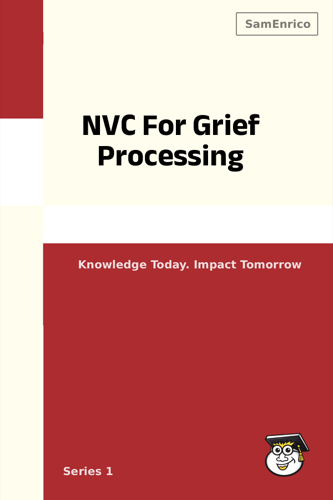
NVC For Grief Processing eBook
Honor loss by connecting to the needs the deceased
by Goss Warner
Honor loss by connecting to the needs the deceased met.
Formats
Free sample
Chapter 1: The Unbearable Beauty--–- The call came at 4:17 on a Tuesday afternoon. I remember the exact minute because I had just taken a sip of lukewarm coffee and thought, I should make a fresh pot. Then my phone vibrated. Then the voice on the other end said three words that split my life into before and after. Three words I had rehearsed a thousand times in my imagination and was still utterly unprepared to hear.
Three words that made the lukewarm coffee irrelevant, the fresh pot irrelevant, the entire ordinary Tuesday irrelevant.I did not fall to my knees dramatically. I did not scream. I sat down on the kitchen floor—slowly, deliberately, as if my body knew something my mind refused to accept—and I became very, very still. The world kept moving outside my window. Cars drove past.
A bird landed on the fence. The refrigerator hummed. Everything was normal, and nothing would ever be normal again.That was twelve years ago. And for the first year after that call, I did everything wrong.I told the story obsessively. I replayed the details like a film I could edit if I just watched it enough times.
The doctor's tone. The word "unexpected." The silence after. I blamed myself, then the hospital, then God, then the weather, then the fact that I had not made that fresh pot of coffee which would have delayed the call by four minutes and maybe, possibly, magically changed the outcome. I attended a grief support group where we all took turns telling our stories, and I left each meeting feeling hollow and strangely competitive—My loss is worse than yours; no, mine is—without ever feeling held. I read seven grief books.
They told me to "move through the stages" and "accept the unacceptable" and "find closure." None of it worked. I remained stuck. Not sad exactly. Stuck. Like a needle that had skipped off a record and was now skating in circles on the paper label, making noise but no music.Then I discovered something that changed everything.
It did not come from a grief expert. It came from a conflict resolution method called Nonviolent Communication, or NVC, developed by a psychologist named Marshall Rosenberg. And what I found, buried inside a framework designed to help enemies speak to each other, was a revolutionary way to understand grief.The insight was this: Grief is not a disorder. It is not a problem to be solved. It is love with nowhere to go.That sentence—which will appear as a refrain throughout this book—stopped me cold when I first heard it.
Not because it was new, but because it was ancient and I had forgotten it. Of course grief is love. What else could it possibly be? You do not grieve people you did not love. You do not collapse in despair over strangers who meant nothing.
The depth of your grief is a direct measure of the depth of your love. And yet every grief book, every therapist, every well-meaning friend had been asking me to do the impossible: to "move on" from love. To "find closure" for something that by its very nature resists closure. To "let go" of the person who taught me how to hold on.This chapter will introduce you to a different path. Not the path of letting go, but the path of holding on differently.
Not the path of closure, but the path of completion. Not the path of forgetting, but the path of honoring what was by connecting to what continues.Let me be clear about what this chapter is not. It is not a collection of platitudes. It is not "everything happens for a reason" or "they are in a better place" or "time heals all wounds." Those statements may comfort some people, but they do not transform grief. They anesthetize it.
They put a bandage on a wound that requires surgery. This chapter—and this book—offers surgery. It will hurt. It will ask you to feel things you have been avoiding. It will ask you to look directly at the pain instead of around it.
And in return, it promises nothing less than the restoration of your capacity to love—not despite your loss, but because of it.The Two Ways of Grieving Before we go any further, I need to introduce a distinction that will serve as the foundation for every practice in this book. There are two fundamentally different ways to grieve. One leads to stuckness, bitterness, and chronic pain. The other leads to healing, integration, and a renewed capacity for joy. I call them life-disconnected grief and life-connected grief.Let me describe the first one carefully, because most of us have been taught that this is grief.
We have been shown no alternative.Life-disconnected grief is characterized by several patterns. The first is blame. When you are stuck in life-disconnected grief, you spend enormous energy asking who is responsible for your loss. You blame yourself: If only I had driven to the hospital sooner. If only I had said I love you one more time.
If only I had been a better partner, parent, child, friend. You blame others: The doctors should have caught it. The driver should have been paying attention. They should have taken better care of themselves. You blame the deceased: How could you leave me?
How could you do this? You promised you would always be here. You may even blame God, fate, the universe, or luck.None of this blame is unreasonable. Loss is often unfair. People do make mistakes.
Bodies do fail unexpectedly. Systems do break. But here is the critical truth that life-disconnected grief cannot see: blame does not heal. Blame protects. It protects you from the much more vulnerable experience of pure, unadorned sadness.
Blame gives you someone to be angry at. Sadness gives you no one to fight—only something to feel.The second characteristic of life-disconnected grief is repetitive narrative storytelling. This is the compulsive retelling of the story of what happened. The phone call. The hospital room.
The last conversation. The moment you found out. The funeral. The days after. You tell it to anyone who will listen.
You replay it in your mind at 3 AM. You add new details each time, searching for the hidden clue that will make the loss make sense. You become, in essence, a detective investigating a crime that has no resolution.Here is what no one tells you about narrative storytelling: it can become a form of addiction. Each time you tell the story, you get a small hit of something—not relief, but activation. Your nervous system fires up.
Your heart rate increases. Your palms sweat. You are, in that moment, back in the trauma. And your brain, which cannot distinguish between remembering and experiencing, treats the memory as if it is happening right now. You are not processing the loss.
You are rehearsing it. And rehearsing a wound does not heal it. It deepens the neural groove until the wound becomes your identity.The third characteristic of life-disconnected grief is judgmental thinking. You judge yourself for not grieving correctly…
This is the end of the free sample. Get the eBook to keep going. Buy now
About this book
Details
- Author
- Goss Warner
- Publisher
- SamEnrico
- Language
- English
- Genre
- Non-Fiction, Self-Help, Grief
- Released
- 2026-06-06
- Pages (approx.)
- 143
- Available as
- eBook, Audiobook

Read better in the ZLOADR app
Your eBooks on your phone or tablet. Sign in with your SamEnrico account and start reading.
More by Goss Warner
 The Supermarket CheckoutGoss Warner$11.99
 Deep Sea Diver Stress GuideGoss Warner$11.99
 Film Director Production StressGoss Warner$11.99
 The Tokyo Ghost Ship: Japan's First Forensic Cold Case BreakthroughGoss Warner$11.99
 How to Produce BinocularsGoss Warner$11.99
 How to Become a Glass-blowing-lathe OperatorGoss Warner$11.99
 A&H Underwriting ManagerGoss Warner$11.99
 Freemium Feature Waterfall DesignGoss Warner$12.99
You may also like
 Hong Kong Handover 1997Dunn Johnnie$11.99
 Zumba For Postnatal Recovery CourseNeal Christian$11.99
 Zumba for BeginnersLadner Nikia$11.99
 YouTube Comment Mining GuideHumes Pandora$12.99
 Worry Box MeditationCarlin Rudy$11.99
 Workplace Stress MeditationNguyen Lynn$11.99
 Workplace Stress and Sleep RepairHawley Ivory$11.99
 Workplace Perfectionism CureDelaney Jeffry$11.99
 Workplace Injustice Anger GuideWallen Isabelle$11.99
 Work Addiction and Burnout LinkGreenwood Ester$11.99
 Women in Yoga and WellnessBeattie Galina$11.99
 Women in Stand Up ComedyChun Evangeline$11.99