
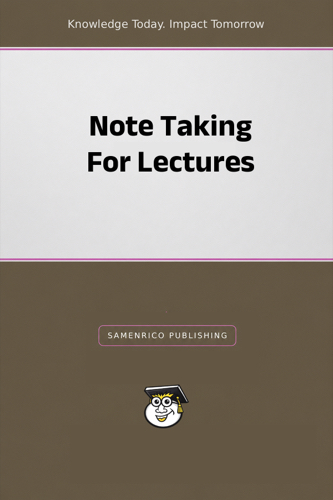
Non-FictionStudent's ShortcutStudy Skills
Note Taking For Lectures Audiobook
Uses Cornell and mind mapping methods.
by Mclain Alysa
Uses Cornell and mind mapping methods.
Formats
Free sample
Chapter 1: The Broken Transcript--–- The first time I saw a student cry over notes, it wasn’t because she hadn’t taken them. It was because she had taken three hundred pages of perfect, word-for-word transcription and still failed the midterm. Her notebook was beautiful. Every sentence was complete. Every slide was copied.
She had done exactly what most professors implicitly demand and no one explicitly teaches. And it had worked against her.This chapter opens with a confession that most study guides avoid: the traditional method of taking notes—the one you were probably taught in middle school—is not merely inefficient. It is actively harmful. The “record-and-forget” cycle has wasted millions of study hours across every university campus in the world. Students walk into lecture halls with good intentions, write down what they hear, close the notebook, and assume that the act of writing created memory.
It did not. Writing is not remembering. Transcription is not learning.The problem is not the student. The problem is the mismatch between how lectures are delivered and how the human brain actually encodes information. Lectures are fast, dense, and linear.
The brain is slow, associative, and pattern-hungry. When you try to transcribe a lecture word-for-word, you are asking your prefrontal cortex—the most energy-hungry, easily fatigued part of your brain—to work at maximum capacity for sixty to ninety minutes straight. That is like asking a sprinter to run a marathon at full speed. By minute twenty, your brain has already started cutting corners. By minute forty, you are writing without processing.
By the end of class, you have a transcript you will never read and a memory that has already begun to decay.This book exists because there is a better way. Not a single method, but a hybrid system that works with your brain’s architecture rather than against it. Based on the foundational work of Walter Pauk (creator of the Cornell system) and Tony Buzan (developer of mind mapping), this chapter introduces the core problem, the neurological explanation for why traditional notes fail, and the meta-framework that will guide everything that follows.The Anatomy of Failure: Why Your Notes Are Useless Let us define the enemy clearly. Passive transcription is the act of writing down what you hear without structural organization, without question generation, and without immediate review. It feels productive because your hand is moving and the page is…
This is the end of the free sample. Get the Audiobook to keep going. Buy now
About this book
Details
- Author
- Mclain Alysa
- Publisher
- SamEnrico
- Language
- English
- Genre
- Non-Fiction, Student's Shortcut, Study Skills
- Released
- 2026-06-05
- Pages (approx.)
- 154
- Available as
- eBook, Audiobook

Listen in the VoxFlicks app
Audiobooks and audio dramas wherever you go. Sign in with your SamEnrico account and press play.
More by Mclain Alysa
 Retail Sales PsychologyMclain Alysa$11.99
 Park Ranger Suspect TheoryMclain Alysa$11.99
 Small Talk That Actually WorksMclain Alysa$11.99
 Police Showup DangersMclain Alysa$11.99
 Inner Child Letter WritingMclain Alysa$11.99
 Overstimulation TriggersMclain Alysa$11.99
 Nightmare Rescripting Audio GuideMclain Alysa$11.99
 The Master Forger of Bruges: How Han van Meegeren Fooled the WorldMclain Alysa$11.99
 The Ballerina of the Andes: The Untold Story of the First Female Chasqui RunnerMclain Alysa$11.99
 How to Produce Sport Safety Lights and ReflectorsMclain Alysa$11.99
 A Collector's Handbook to the Daimler El24Mclain Alysa$11.99
 Freemium User Onboarding GuideMclain Alysa$12.99
You may also like
 Hong Kong Handover 1997Dunn Johnnie$11.99
 Zumba For Postnatal Recovery CourseNeal Christian$11.99
 Zumba for BeginnersLadner Nikia$11.99
 YouTube Comment Mining GuideHumes Pandora$12.99
 Worry Box MeditationCarlin Rudy$11.99
 Workplace Stress MeditationNguyen Lynn$11.99
 Workplace Stress and Sleep RepairHawley Ivory$11.99
 Workplace Perfectionism CureDelaney Jeffry$11.99
 Workplace Injustice Anger GuideWallen Isabelle$11.99
 Work Addiction and Burnout LinkGreenwood Ester$11.99
 Women in Yoga and WellnessBeattie Galina$11.99
 Women in Stand Up ComedyChun Evangeline$11.99