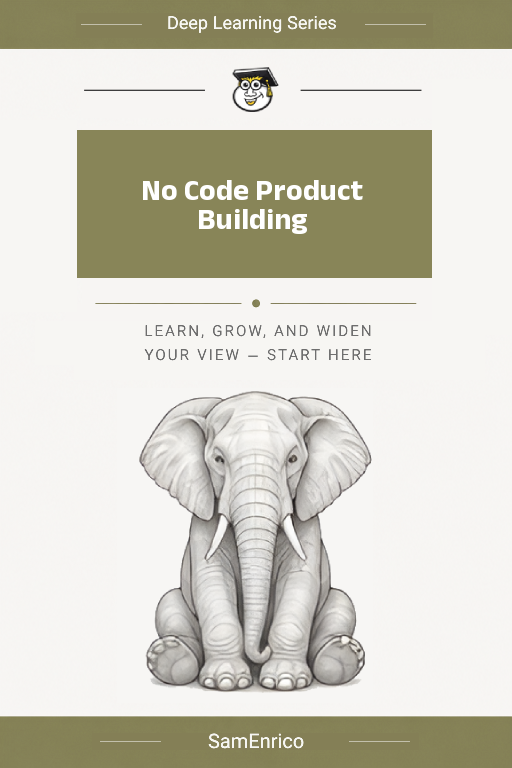
No Code Product Building eBook
Build software products using no code tools to avo
by Goble Melisa
Build software products using no code tools to avoid expensive developer costs.
Formats
Free sample
Chapter 1: The Developer Trap--–- Every year, over 100,000 software ideas die before they see a single user. Not because the ideas were bad. Not because the market wasn't ready. Not because the founder lacked passion. They die because someone said the seven most expensive words in entrepreneurship: "Let me find a developer first."You have probably said these words yourself.
You have a problem you want to solve, a niche you understand better than anyone, and customers who are begging for a solution. But somewhere between the napkin sketch and the working product, you hit a wall. You don't know how to code. So you open Linked In, post a job description, and wait. Weeks turn into months.
Quotes come back at fifty thousand dollars for a "simple MVP." The developer wants equity, then changes their mind, then stops returning emails. Meanwhile, your competitors—or worse, someone with the exact same idea—launches and takes the market.This book exists because that story is obsolete.The $935 Billion Mistake Let us look at the numbers, because numbers do not lie. The global app economy is worth $935 billion. That is not a typo. Nearly a trillion dollars flows through software every year, and the vast majority of that wealth is captured not by Silicon Valley engineers with computer science degrees, but by people who understood a problem better than anyone else and found a fast way to solve it.Here is what the data also tells us: the number one reason startups fail is not running out of money.
It is not bad product-market fit. It is not even competition. According to post-mortems of over 5,000 failed startups, the most common killer is slow execution. They took too long to launch. They waited for the perfect code, the perfect design, the perfect team.
By the time they arrived, the market had moved on or someone else had already claimed it.Speed to market now beats technical elegance. A mediocre product launched today will learn more, earn more, and improve faster than a perfect product launched next year. This is not opinion. This is the pattern of every successful startup from Airbnb to Uber to Canva. They launched with bugs, with ugly interfaces, with features that barely worked.
But they launched. And then they listened, iterated, and won.The Three Tiers of Building Software Before we go any further, we need a common language. Not everyone who picks up this book comes from the same background. Some of you have never built anything digital before. Some of you have built spreadsheets that could pass for databases.
Some of you have hired developers in the past and been burned. The framework below is for all of you.Tier One: Pro-Code This is what most people think of when they imagine "building software." You write lines of code in languages like Python, Java Script, Ruby, or Java. You use frameworks like React, Django, or Rails. You manage servers, databases, authentication, and deployment pipelines. This path gives you maximum control and flexibility.
You can build anything.The trade-off is equally extreme. Pro-code is expensive. A junior developer costs 80,000peryear;aseniordevelopercosts80,000 per year; a senior developer costs 80,000peryear;aseniordevelopercosts150,000 or more. Pro-code is slow. Even a simple MVP takes three to six months when you are learning or hiring.
Pro-code is fragile. One semicolon in the wrong place and the entire application crashes.Pro-code makes sense for three specific situations: you are building novel algorithms that do not exist yet, you need extreme performance (millions of users with sub-second responses), or you have already validated your idea with a no-code prototype and are ready to scale. For everyone else, pro-code is a trap.Tier Two: Low-Code Low-code platforms sit in the middle. They are designed for IT departments inside large companies. Tools like Microsoft Power Apps, SAP Build, and Service Now allow professional developers to build internal tools faster by dragging and dropping components while still writing some custom logic.Low-code is not the focus of this book.
If you work in a Fortune 500 company and need to build an expense approval system that integrates with SAP, low-code is your friend. But if you are an entrepreneur trying to launch a product to paying customers, low-code will feel restrictive, expensive, and slow. You will still need a developer. You will still wait weeks for approvals.Tier Three: No-Code This is where the magic happens. No-code platforms allow you to build fully functional web applications, mobile apps, databases, and automations using visual interfaces.
You drag, drop, click, and configure. You do not write a single line of code.The most powerful no-code platforms—like the ones we will use throughout this book—give you everything you need: a database to store user information, a visual interface builder to design screens, a workflow engine to handle logic, and built-in authentication and payments. All without touching HTML, CSS, Java Script, or SQL.No-code is not a toy. Companies like Bild sold for 50millionafterbeingbuiltentirelyonno−codetools.Glideisvaluedat50 million after being built entirely on no-code tools. Glide is valued at 50millionafterbeingbuiltentirelyonno−codetools.Glideisvaluedat500 million.
Thousands of solo founders are quietly generating six-figure and seven-figure revenues from apps built in weekends. The only difference between them and everyone else is that they stopped waiting for permission and started building.Who This Book Is For (And Who It Is Not For)Let me be direct with you. This book is not for everyone, and pretending otherwise would be dishonest.This book is for you if:You have a business idea but no technical co-founder You have tried hiring developers and been burned by cost, delays, or miscommunication You want to test an idea before spending thousands of dollars You are tired of waiting and ready to build something yourself You believe that understanding the customer is more important than understanding the code This book is NOT for you if:You want to build the next Google search engine from scratch You need to process millions of requests per second You are building novel artificial intelligence models (wrapping existing models is fine—we cover that in Chapter 6)You refuse to learn anything new and expect to build an app by clicking three buttons If you fall into the second group, put this book down and go hire a team of Ph Ds. You will need them. For everyone else, keep reading.The Appreneur Mindset Over the next twelve chapters, you will learn a new identity.
You are not a "no-coder." That term implies a limitation, a lack, a concession. You are not someone who "can't code." You are an Appreneur—a business-first problem-solver who uses visual tools to build software faster than anyone else.The Appreneur mindset rests on four pillars:Pillar One: Problems Over Technologies Most technical founders start with the wrong question. They ask: "What technology should I use?" "Should I learn React or Vue?" "Is Python faster than Ruby?" These questions matter eventually, but they are not the starting point.The Appreneur starts with a different question: "What problem am I solving, and for whom?" You do not care about the stack. You care about the customer who is currently using a spreadsheet, a clipboard, or a sticky…
This is the end of the free sample. Get the eBook to keep going. Buy now
About this book
Details
- Author
- Goble Melisa
- Publisher
- SamEnrico
- Language
- English
- Genre
- Non-Fiction, Business Brief, No Code
- Released
- 2026-05-30
- Pages (approx.)
- 136
- Available as
- eBook, Audiobook

Read better in the ZLOADR app
Your eBooks on your phone or tablet. Sign in with your SamEnrico account and start reading.
More by Goble Melisa
 Creativity for Risk ManagersGoble Melisa$11.99
 Psychomotor Changes in DepressionGoble Melisa$11.99
 Dysthymia Criteria GuideGoble Melisa$11.99
 Unexpected Pet Death GuideGoble Melisa$11.99
 Justin Rose English RoseGoble Melisa$11.99
 Anger Cognitive Restructuring CBTGoble Melisa$11.99
 Overlearning PreventionGoble Melisa$11.99
 Early Warning SignsGoble Melisa$11.99
 The Ghost of the Kremlin: The MI6 Defector and the Russian Spy Ring (2010)Goble Melisa$11.99
 The Bloodied Silk: Healers of the Yuan ConquestGoble Melisa$11.99
 How to Start a Emery Paper Business (Beginners Guide)Goble Melisa$11.99
 How to Produce Tile and Shingle CuttersGoble Melisa$11.99