
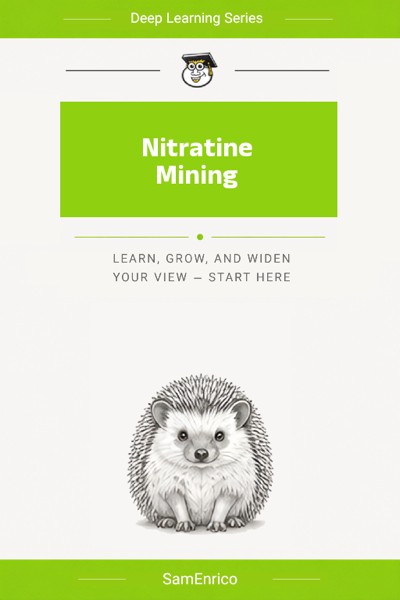
Non-FictionInformativeEducational
Nitratine Mining eBook
A Coursebook on Nitratine Mining
A Coursebook on Nitratine Mining
Formats
Free sample
Chapter 1: The White Gold Rush--–- In the early nineteenth century, the world was running out of fertilizer. Europe’s soils, farmed for centuries without adequate replenishment of nitrogen, were becoming exhausted. The guano deposits of Peru—accumulated over millennia by seabirds on rainless islands—had been a temporary salvation, but those deposits were finite and already being depleted. A new source of fixed nitrogen was desperately needed. It would be found not in a lush coastal ecosystem but in the driest non-polar desert on Earth, in a place where rain had not fallen in recorded history.
The discovery of sodium nitrate—known then as salitre or Chile saltpeter—in the Atacama Desert of northern Chile and southern Peru would transform global agriculture, trigger a war between three nations, and create one of the strangest industrial booms the world has ever seen. For nearly a century, nitrate was as valuable as oil is today. And then, almost overnight, it became nearly worthless.This is the story of that boom and bust. It is a story about the strange geology of one of the most hostile environments on the planet. It is a story about the workers who toiled in that environment, extracting white crystals from the desert floor under a brutal sun.
It is a story about the investors who amassed fortunes, the politicians who fought wars, and the chemists who eventually made the entire industry obsolete. And it is a story that offers enduring lessons for anyone who studies mining, resource economics, or the relationship between geology and geopolitics.The Discovery That Changed Agriculture The nitratine deposits of the Atacama Desert were known to the indigenous peoples of the region long before the arrival of Europeans. The Inca had used the white salt as an oxidizer in their fireworks and ceremonial displays. Local inhabitants recognized that the ground in certain areas would catch fire when exposed to flame—a phenomenon caused by the combustive properties of nitrates, which release oxygen when heated. According to traditional accounts, Spanish conquistadors first identified the deposits when they observed the ground burning beneath their feet.
The alarmed local Indians reportedly took samples to a priest to exorcise what they believed to be an evil spirit. The priest, more knowledgeable, recognized the substance for what it was—a nitrate salt similar to the saltpeter used in European gunpowder.For centuries, exploitation remained small-scale, primarily for local gunpowder production. The deposits were remote, the region was politically unstable, and there was little demand for fertilizer in a world that had not yet discovered the power of industrial agriculture. That changed in the early nineteenth century, as Europe’s population grew and its soils declined. The key moment came in the 1820s, when a Scottish settler living near the port of Iquique noticed that the white soil in his garden made his plants grow with unusual vigor.
He sent samples to Scotland for analysis, and the true nature of the mineral was determined: it was sodium nitrate, a highly soluble, immediately available source of fixed nitrogen.The first nitrate works were established at Iquique in 1826. Production grew slowly at first—just 8,300 tons were exported in 1830. But as European farmers and industrialists learned of the new fertilizer source, demand exploded. By 1850, exports had reached 50,000 tons. By 1870, 200,000 tons.
By 1913, the peak year, exports reached 2.5 million tons. The Atacama Desert, one of the most inhospitable places on Earth, had become one of the richest.Historical Context and Economic Significance To understand the importance of nitratine, one must understand the role of nitrogen in agriculture. All plants require nitrogen to grow. It is a fundamental component of chlorophyll, the molecule that captures sunlight for photosynthesis; of amino acids, the building blocks of proteins; and of nucleic acids, the carriers of genetic information. Most plants cannot absorb nitrogen directly from the atmosphere, even though the air is eighty percent nitrogen gas.
They rely on nitrogen that has been “fixed”—converted from inert N₂ gas into reactive compounds like ammonia or nitrates.Before the development of the Haber-Bosch process in the early twentieth century, the only significant sources of fixed nitrogen were natural deposits. The first of these to be exploited were the guano deposits of Peru, accumulated over millennia by seabirds feeding on the nutrient-rich waters of the Humboldt Current. Guano was an excellent fertilizer, but it was finite. By the 1840s, the best deposits were already being depleted. Nitratine—sodium nitrate from the Atacama—was the next great source.For a world transitioning from subsistence agriculture to industrial-scale food production, control of these nitrogen sources was a matter of national security.
Nitrates were also essential for gunpowder production, giving them a dual military and agricultural significance. The nation that controlled the nitrate fields would control both the world’s food supply and a critical military resource. The nation that lost access to nitrates would be at the mercy of its rivals.This strategic importance had profound geopolitical consequences. The nitrate-rich Atacama Desert lay in a region of disputed sovereignty between Chile, Bolivia, and Peru. The boundaries had never been clearly defined, and the discovery of massive nitrate deposits made the ambiguity intolerable.
The stage was set for conflict.The War of the Pacific (1879–1884)In 1879, tensions boiled over. The War of the Pacific pitted Chile against Bolivia and Peru. The immediate cause was a dispute over taxation and contracts in the Bolivian port of Antofagasta, but the underlying cause was nitrate. All three nations wanted control of the white gold.Chile, with its superior navy and more cohesive military organization, quickly gained the upper hand. Chilean naval forces blockaded Peruvian ports and transported troops northward.
Chilean ground forces occupied the Bolivian port of Antofagasta in February 1879 and the Peruvian port of Iquique in November 1879. By 1880, Chile controlled virtually all of the nitrate-producing regions. Active hostilities effectively ceased in 1881 when Chilean forces occupied Lima, the capital of Peru, but the formal peace treaty took several more years to negotiate.The war ended with the Treaty of Ancon in 1884. Chile acquired permanent control of the Bolivian coast and the Peruvian province of Tarapaca, effectively giving Chile a monopoly over the world’s known nitratine reserves. Bolivia lost its access to the sea—a loss it continues to dispute to this day, with Bolivia still maintaining a claim to a sovereign corridor through Chilean territory.
Peru lost its nitrate-rich territory, though it retained its southern provinces.For Chile, the victory was transformative. The nitrate revenues would fund the modernization of the Chilean state, military, and infrastructure. For the next four decades, Chile would be the world’s sole significant supplier of natural nitrates, and the nitrate tax would account for more than half of Chilean government revenues. Chile used this windfall to build railroads, ports, schools, and hospitals. The Chilean navy became the most powerful in South America.
Santiago, the capital, was transformed from a colonial backwater into a modern metropolis.But the victory also created dependencies. Chile became a mono-economy, reliant on a single resource for the majority of its government revenue. When that resource eventually declined, the Chilean economy would suffer a painful adjustment.The Nitrate Boom Era (1880–1920)The four decades following the War…
This is the end of the free sample. Get the eBook to keep going. Buy now
About this book
Details
- Author
- Newsom Georgie
- Publisher
- SamEnrico
- Language
- English
- Genre
- Non-Fiction, Informative, Educational
- Released
- 2026-06-02
- Pages (approx.)
- 116
- Available as
- eBook, Audiobook

Read better in the ZLOADR app
Your eBooks on your phone or tablet. Sign in with your SamEnrico account and start reading.
More by Newsom Georgie
 Psychotherapy For MDD GuideNewsom Georgie$11.99
 ED WorkbookNewsom Georgie$11.99
 The Reset Parent GuideNewsom Georgie$11.99
 The Rehearsal Strategy GuideNewsom Georgie$11.99
 Twelve Step Retreat PlanningNewsom Georgie$11.99
 Grace and Grandeur: The Pioneers of Black BalletNewsom Georgie$11.99
 How to Become a Log RollerNewsom Georgie$11.99
 PR Success StoriesNewsom Georgie$12.99
 .africa vs .com ComparisonNewsom Georgie$12.99
 The Breeder's Guide to Polish ChickensNewsom Georgie$11.99
You may also like
 Hong Kong Handover 1997Dunn Johnnie$11.99
 Zumba For Postnatal Recovery CourseNeal Christian$11.99
 Zumba for BeginnersLadner Nikia$11.99
 YouTube Comment Mining GuideHumes Pandora$12.99
 Worry Box MeditationCarlin Rudy$11.99
 Workplace Stress MeditationNguyen Lynn$11.99
 Workplace Stress and Sleep RepairHawley Ivory$11.99
 Workplace Perfectionism CureDelaney Jeffry$11.99
 Workplace Injustice Anger GuideWallen Isabelle$11.99
 Work Addiction and Burnout LinkGreenwood Ester$11.99
 Women in Yoga and WellnessBeattie Galina$11.99
 Women in Stand Up ComedyChun Evangeline$11.99