
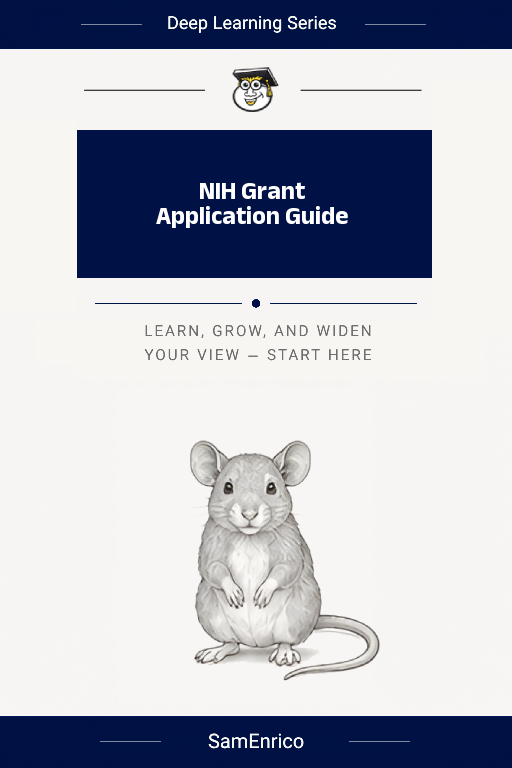
Non-FictionProfessional's Cheat SheetNIH
NIH Grant Application Guide eBook
Navigate NIH grant process including R01, R21, and
Navigate NIH grant process including R01, R21, and SBIR mechanisms for health research.
Formats
Free sample
Chapter 1: The Hidden Truth...--The day Dr. Sarah Chen submitted her first R01, she felt something she had not experienced in years: hope. After eighteen months of preliminary data collection, three agonizing rewrites of her Specific Aims page, and a budget justification that required a minor in accounting, she had finally done it. She had followed every rule. She had read every guide.
She had asked her mentor, her department chair, and her university's grant office for feedback. Her science was solid. Her hypothesis was novel. Her preliminary data were beautiful.Ninety days later, she received the summary statement. The Impact Score was 43.
Not good. Not even close to the 20th percentile required for funding at the National Institute on Aging. The reviewers had written four paragraphs. They called her innovation "modest." They said her approach was "ambitious but potentially unfeasible within the proposed timeline." They described her significance section as "well-written but not compelling."Sarah cried in her office. Then she got angry.
Then she got confused. She had done everything right. How had she failed so completely?The answer, which no one had told her, is the hidden truth of NIH grant writing: reviewers do not read grants. They score them.This is not a metaphor. It is the literal, operational reality of the peer review system.
The average reviewer at a study section receives twenty to thirty applications per round. Each application runs fifteen to forty pages. The reviewer has approximately four to six weeks to review all of them, while also running their own lab, teaching their own students, writing their own grants, and attending their own meetings. They are exhausted before they open the first PDF. They are looking for reasons to triage your application—to put it in the bottom half of the stack so they do not have to read it carefully.
And they will find those reasons within the first ninety seconds of reading your Specific Aims page.Here is what Sarah did not know: her grant failed not because her science was weak, but because she had committed the cardinal sin of grant writing. She had described her work instead of selling a solution to a health problem. She had written for scientists. She should have written for reviewers.This chapter will teach you the hidden truth that separates the 20 percent of applicants who get funded from the 80 percent who do not. You will learn what reviewers are actually thinking when they read your application, why the NIH mission is the only thing that matters, and how to completely reframe your approach from "describing your methods" to "selling a solution to a health crisis." By the end of this chapter, you will never write a grant the same way again.The 90-Second Rule: How Reviewers Actually Read Your Application Let us walk through the mind of a reviewer.
Her name is Dr. Patricia Okonkwo. She is a tenured professor at a major research university. She has been asked to serve on an NIH study section because she is an expert in your broad field. She is not necessarily an expert in your specific niche.
She has twenty-five applications to review. She has already spent six hours this week on the first ten. She is behind schedule. She is drinking her third cup of coffee. And she has just opened your application.What does she do first?She does not read your abstract.
She does not read your Research Strategy. She reads your Specific Aims page. And she spends no more than ninety seconds on it.In that ninety seconds, she is not trying to understand your science. She is trying to answer four questions:Does this research address a significant health problem? (Significance)Is there something novel or creative about the approach?
(Innovation)Can this PI actually do the work? (Investigator)Is there a fatal flaw that allows me to triage this now? (The trap question)If she cannot answer "yes" to the first three questions within ninety seconds, or if she finds a fatal flaw, she will assign a low criterion score (5, 6, or 7) for Impact and move on. Your application will never receive a thorough reading. It will never be discussed in detail at the study section meeting.
It will be triaged—placed in the bottom half of applications that receive only a summary statement and no formal discussion. And you will receive a score that guarantees rejection.This is the 90-Second Rule. It is not written in any NIH manual. It is not taught in any grant writing course. But it is the single most important reality of the peer review process.What reviewers look for in those ninety seconds:First thirty seconds: The first sentence of your Specific Aims page.
If it does not name a specific health burden with numbers (e.g., "Alzheimer's disease affects 6 million Americans and costs $355 billion annually"), the reviewer already suspects you do not understand the NIH mission.Seconds thirty to sixty: Your hypothesis. If it is vague ("We hypothesize that X plays a role in Y") instead of specific and falsifiable ("We hypothesize that phosphorylation of protein X at serine 47 activates pathway Y, leading to neuronal death in Alzheimer's patients"), the reviewer suspects you are not ready for an R01.Seconds sixty to ninety: Your specific aims. If they are tasks ("We will collect tissue samples, perform RNA sequencing, and analyze the data") instead of hypothesis-driven experiments ("Aim 1: Determine whether phosphorylation of X at S47 is necessary and sufficient for neuronal death in vitro"), the reviewer triages you immediately.Sarah Chen's Specific Aims page had committed all three sins. Her first sentence read: "Alzheimer's disease is a devastating neurodegenerative disorder with complex pathophysiology." That is true. It is also meaningless.
Every grant on Alzheimer's says that. She had not quantified the burden. She had not named the specific problem her grant would solve. She had not convinced the reviewer that her research mattered more than the twenty-four other applications on the desk.Her aims were worse. Aim 1: "We will characterize the role of phosphorylation in tau aggregation." A task, not a hypothesis.
The reviewer read that and thought: "Characterize? That is what graduate students do. You are asking me for an R01."Within ninety seconds, Dr. Okonkwo had assigned Sarah's application a criterion score of 5 for Significance, a 5 for Innovation, and a 6 for Approach. The Impact Score would be calculated from those numbers.
The application was dead.The NIH Mission: Why "Interesting Science" Does Not Get Funded The National Institutes of Health is not a science foundation. It is a public health agency. Its mission statement is explicit: "To seek fundamental knowledge about the nature and behavior of living systems and the application of that knowledge to enhance health, lengthen life, and reduce illness and disability."Read that again. The mission has two parts. The first part—"seek fundamental knowledge"—is what academics love.
It is why we study flies, worms, and exotic signaling pathways. But the second part is the one that actually matters for funding: "to enhance health, lengthen life, and reduce illness and disability."If you do not connect your fundamental science to a specific, measurable, significant health problem, you…
This is the end of the free sample. Get the eBook to keep going. Buy now
About this book
Details
- Author
- Carlton Farrah
- Publisher
- SamEnrico
- Language
- English
- Genre
- Non-Fiction, Professional's Cheat Sheet, NIH
- Released
- 2026-05-29
- Pages (approx.)
- 159
- Available as
- eBook, Audiobook

Read better in the ZLOADR app
Your eBooks on your phone or tablet. Sign in with your SamEnrico account and start reading.
More by Carlton Farrah
 Long COVID Sleep MeditationCarlton Farrah$11.99
 Burnout In Psychology ProfessionalsCarlton Farrah$11.99
 Self Monitoring Food Log GuideCarlton Farrah$11.99
 Parent Death Meditation GuideCarlton Farrah$11.99
 Mindful Brushing Teeth PracticeCarlton Farrah$11.99
 The Vanishing Act: How a 19th-Century Magician Disappeared with a FortuneCarlton Farrah$11.99
 The Great Reversal: How One Man Toppled a Government in 90 MinutesCarlton Farrah$11.99
 Employee Retirement Plan TrapCarlton Farrah$12.99
 Night Crew Team MemberCarlton Farrah$11.99
 Understanding Glycogen Storage Disease Type 9Carlton Farrah$17.99
 How to Become a Tone RegulatorCarlton Farrah$11.99
You may also like
 Hong Kong Handover 1997Dunn Johnnie$11.99
 Zumba For Postnatal Recovery CourseNeal Christian$11.99
 Zumba for BeginnersLadner Nikia$11.99
 YouTube Comment Mining GuideHumes Pandora$12.99
 Worry Box MeditationCarlin Rudy$11.99
 Workplace Stress MeditationNguyen Lynn$11.99
 Workplace Stress and Sleep RepairHawley Ivory$11.99
 Workplace Perfectionism CureDelaney Jeffry$11.99
 Workplace Injustice Anger GuideWallen Isabelle$11.99
 Work Addiction and Burnout LinkGreenwood Ester$11.99
 Women in Yoga and WellnessBeattie Galina$11.99
 Women in Stand Up ComedyChun Evangeline$11.99