
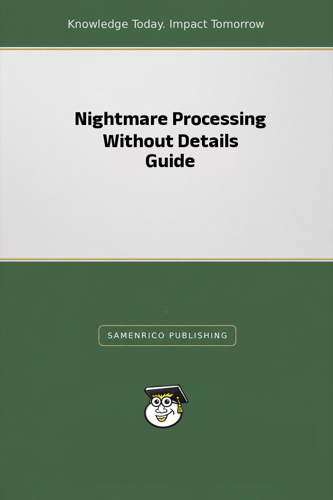
Nightmare Processing Without Details Guide Audiobook
Teaches rescripting techniques that don't require
by Hardesty Jay
Teaches rescripting techniques that don't require retraumatizing narrative disclosure.
Formats
Free sample
Chapter 1: Why Talk Fails...--When Jenna walked into my office for the first time, she sat on the very edge of the chair, her coat still zipped to her chin, her hands gripping her own knees as if she were preparing for turbulence. She had not slept through the night in eleven years. Eleven years of waking up at 2:47 AM—she knew the exact time because she had memorized the pattern—with her heart slamming against her ribs, her sheets soaked through, and a name stuck in her throat that she could never say out loud.Her previous therapist had told her, with kind but misplaced certainty, that she needed to "walk through the fire to get out." That she needed to write down everything that happened in explicit detail. That the nightmare would lose its power once she finally told the whole story from beginning to end. Jenna tried.
She really tried. She sat in that therapist's office for six months, and every week, she would open her mouth to speak, and every week, nothing would come out except a single tear that she would wipe away before anyone could see it.She left therapy feeling like a failure. Not because she was unwilling to heal, but because she was unwilling to hurt herself again in the service of healing. And here is the truth that no one had told her: she was right.The assumption that you must verbally rehash traumatic details to resolve nightmares is not just unhelpful for many people—it is actively harmful. It is based on a misunderstanding of how the brain processes fear during sleep, and it has kept countless trauma survivors suffering in silence, convinced that their inability to "talk about it" means they are broken, resistant, or not ready to heal.This chapter will dismantle that assumption.
You will learn why traditional exposure-based approaches fail for nightmare-specific distress, how the brain's alarm system responds to narrative disclosure, and why the most effective path to nightmare resolution may require no talking at all. Most importantly, you will be given permission to stop trying to tell your story. Your silence is not avoidance. It is strategy.The Myth of Necessary Suffering The idea that you must "feel it to heal it" has become something close to dogma in certain mental health circles. It has roots in valid research on exposure therapy for anxiety disorders…
This is the end of the free sample. Get the Audiobook to keep going. Buy now
About this book
Details
- Author
- Hardesty Jay
- Publisher
- SamEnrico
- Language
- English
- Genre
- Non-Fiction, Self-Help, Non-Disclosure Therapy
- Released
- 2026-06-08
- Pages (approx.)
- 148
- Available as
- eBook, Audiobook

Listen in the VoxFlicks app
Audiobooks and audio dramas wherever you go. Sign in with your SamEnrico account and press play.
More by Hardesty Jay
 The Leverage Covenant DatabaseHardesty Jay$11.99
 The Teen Self Esteem Through StudyHardesty Jay$11.99
 Bipolar And OCD ComorbidityHardesty Jay$11.99
 Criticism Anger TriggersHardesty Jay$11.99
 The Shadow of the Golden Fleece: Australia's First Political Assassination in the Digital AgeHardesty Jay$11.99
 Executive Summary for Annual ReportsHardesty Jay$12.99
 ClassPass GuideHardesty Jay$12.99
 Understanding Progressive Kinking of The Hair, AcquiredHardesty Jay$17.99
 How to Start a Hobby in WatercolorHardesty Jay$11.99
 Customer Relations AssociateHardesty Jay$11.99