
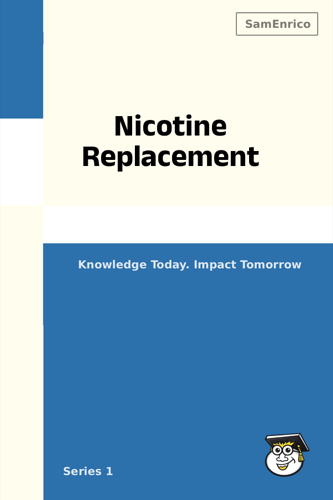
Non-FictionHealth & WellnessNRT
Nicotine Replacement eBook
Teaches patches, gum, and lozenges for withdrawal.
by Dozier Juan
Teaches patches, gum, and lozenges for withdrawal.
Formats
Free sample
Chapter 1: The Willpower Trap--–- Every smoker remembers the moment. The moment they decided, with absolute conviction, that they were done. Maybe it was a cough that lasted too long. The look on a child’s face. The price of a pack crossing an invisible line.
Or simply the exhaustion of waking up each morning already needing something that was killing you.You threw away the pack. You announced it to a friend, a spouse, or just the mirror. You felt light, powerful, righteous.And then, somewhere between six hours and three days later, you found yourself digging through an ashtray for a half-smoked cigarette you would have been disgusted by a week earlier. Or buying a new pack with the automatic numbness of a sleepwalker. Or borrowing one from a stranger outside a bar, hating yourself with every puff.The cold turkey attempt had failed.
Again.If you are reading this book, you have likely lived this scene more than once. Perhaps a dozen times. Each failure leaves a scar—not just on your lungs, but on your sense of self. You begin to believe something dangerous: I don’t have enough willpower. I am weak.
There is something broken in me that other, stronger people possess.This book exists to tell you that every single word of that belief is a lie.The problem is not your willpower. The problem is that you have been using willpower for a job it was never designed to do. You have been asking your conscious mind to fight a biochemical war that it cannot win. And the books and programs that told you to simply “white-knuckle it” or “mind over matter” have, however well-intentioned, set you up to fail.This chapter dismantles the myth of willpower as the primary tool for quitting nicotine. It will show you, with data and neurobiology, why 95 out of 100 cold turkey attempts collapse within six months.
It will explain why the very act of “fighting” a craving can actually make the addiction stronger. And it will introduce you to a different path: not a battle of wills, but a strategy of leverage. A way to use biochemistry against itself, so you can save your willpower for what it is actually good at—making smart plans, not fighting losing battles.Welcome to The Freedom Trap. The trap is believing you must fight alone. The way out is learning to outsmart your own brain.The 95% Statistic That Changes Everything Let us begin with a number that should shock you: 95 percent.According to longitudinal data cited in bestsellers like The Quitter’s Companion and confirmed by clinical research from the University of California, San Francisco, approximately 95 percent of unassisted “cold turkey” quit attempts end in relapse within six months.
That is not a failure rate for “weak” people. That is a failure rate for human beings with normal, functioning brains.To put this in perspective, imagine a medical procedure that killed 95 percent of patients. It would be banned overnight. Imagine a diet where 95 percent of participants gained back more weight than they lost. It would be laughed off the shelves.
Yet we have somehow normalized the idea that quitting nicotine should be a test of character—that if you just want it badly enough, you will join the mythical 5 percent who succeed through sheer force of will.This is not merely unhelpful. It is actively destructive.Because when you fail at something that society tells you should be simple, you internalize shame. You conclude that your desire wasn’t pure enough. That you didn’t really want to quit. That somewhere beneath your conscious resolve, you love smoking more than you love living.The data tells a different story.
The 95 percent failure rate is not a reflection of human weakness. It is a reflection of the mismatch between the tool (willpower) and the problem (neurochemical addiction).The Three-Day Lie Perhaps the most damaging myth in quitting culture is what we might call the “Three-Day Lie.” You have heard it: physical withdrawal only lasts 72 hours. After that, it is all in your head. Just get past three days, and you are home free.This is technically true in the narrowest sense. The half-life of nicotine in your bloodstream is about two hours.
Within 72 hours of your last cigarette, virtually every molecule of nicotine has been eliminated from your body. The acute, physical symptoms of withdrawal—headaches, nausea, tremors—do peak around day three and then subside.But this fact has been weaponized to shame quitters who struggle after the first week. “It is not physical anymore,” they are told. “It is psychological. You are just not trying hard enough.”This distinction is a cruel fiction.
The brain does not reset after 72 hours. Nicotine has changed your neural architecture—specifically, the number and sensitivity of nicotinic acetylcholine receptors in your reward center. These receptors do not disappear when the nicotine leaves your bloodstream. They remain, hungry and upregulated, for weeks or months. They send out distress signals—what we call cravings—that are every bit as physical as the first-day headache.The difference is that these later cravings are triggered by context, not by blood chemistry.
They are the ghost of the addiction, but they are not imaginary. They have a real, biological basis. And they can ambush you on day 14, day 30, or day 100, long after you have been told you should be “over it.”The Three-Day Lie sets you up for a specific kind of failure: the failure of surprise. You believe you have won, you let your guard down, and then a craving hits you with the force of a freight train. Because you thought you were done, you interpret this craving as a sign of your own brokenness.
And that shame, more than the craving itself, drives you back to smoking.The Paradox of Resisted Cravings Here is a strange truth that most quitting guides will not tell you: actively fighting a craving often makes it stronger.This phenomenon has been well documented in the psychological literature under various names—ironic process theory, thought suppression, the white bear problem. The basic finding is simple: when you try not to think about something, you end up thinking about it more. Try, right now, to not think about a white bear. What happened? The white bear appeared immediately.The same principle applies to cravings.
When you treat a craving as an enemy to be crushed, you must first notice it. You must label it. You must marshal your forces against it. All of this attention—even negative attention—feeds the neural pathway associated with the craving. You are watering a weed while trying to pull it out.Allen Carr, whose Easy Way has sold millions of copies, understood this intuitively.
His method does not ask you to fight cravings. It asks you to recognize that there is nothing to fight—that smoking never gave you anything real, only relief from the withdrawal that smoking itself created. This is a powerful reframe. But for many readers, it works only as long as they can maintain the reframe. When a powerful, biochemical craving hits, the intellectual recognition that “cigarettes do nothing for you”…
This is the end of the free sample. Get the eBook to keep going. Buy now
About this book
Details
- Author
- Dozier Juan
- Publisher
- SamEnrico
- Language
- English
- Genre
- Non-Fiction, Health & Wellness, NRT
- Released
- 2026-06-07
- Pages (approx.)
- 153
- Available as
- eBook, Audiobook

Read better in the ZLOADR app
Your eBooks on your phone or tablet. Sign in with your SamEnrico account and start reading.
More by Dozier Juan
 Virtual Assistant Hiring GuideDozier Juan$11.99
 HGH Childhood DeficiencyDozier Juan$11.99
 Humiliation Anger CBT GuideDozier Juan$11.99
 Failure Epigenetics HopeDozier Juan$11.99
 Immediate Feedback LoopDozier Juan$11.99
 Assertiveness for DoormatsDozier Juan$11.99
 Undocumented Worker Money StressDozier Juan$11.99
 The Timbuktu Tandem: A Love Story in NumbersDozier Juan$11.99The Timbuktu Tandem: A Love Story in NumbersDozier Juan$11.99
 The Battle of Nakayama: Yamato's Last Stand Against the Kofun Warlords (4th Century AD)Dozier Juan$11.99
 How to Start a Manganese Dioxide Cells Business (Beginners Guide)Dozier Juan$11.99
 How to Produce Pruning ShearsDozier Juan$11.99
You may also like
 Hong Kong Handover 1997Dunn Johnnie$11.99
 Zumba For Postnatal Recovery CourseNeal Christian$11.99
 Zumba for BeginnersLadner Nikia$11.99
 YouTube Comment Mining GuideHumes Pandora$12.99
 Worry Box MeditationCarlin Rudy$11.99
 Workplace Stress MeditationNguyen Lynn$11.99
 Workplace Stress and Sleep RepairHawley Ivory$11.99
 Workplace Perfectionism CureDelaney Jeffry$11.99
 Workplace Injustice Anger GuideWallen Isabelle$11.99
 Work Addiction and Burnout LinkGreenwood Ester$11.99
 Women in Yoga and WellnessBeattie Galina$11.99
 Women in Stand Up ComedyChun Evangeline$11.99