
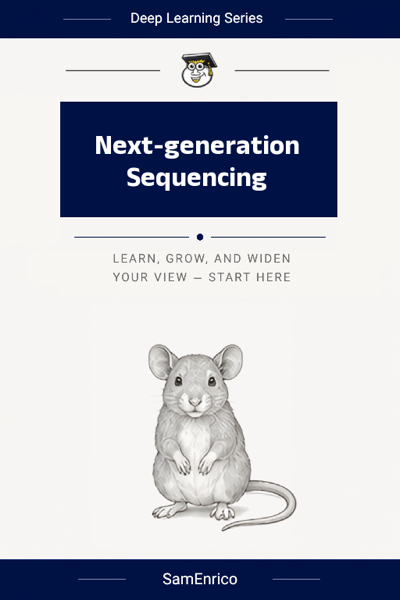
Next-generation Sequencing Audiobook
A Coursebook on Next-generation Sequencing
by Roman Elinor
A Coursebook on Next-generation Sequencing
Formats
Free sample
Chapter 1: The Thousand-Dollar Genome--–- In the spring of 2011, a mysterious outbreak ripped through Germany. What began as a few scattered reports of bloody diarrhea in Hamburg hospitals escalated within days into Europe’s largest recorded foodborne epidemic. Over four thousand people fell ill. Fifty-three died. Epidemiologists raced to identify the culprit – a strain of Escherichia coli so aggressive that it caused hemolytic uremic syndrome, a kidney failure condition normally rare in adults, in nearly a quarter of its victims.Traditional methods failed.
Culturing the bacteria took days. Serotyping suggested O104, but something was wrong. This strain behaved unlike any known O104. Pulse-field gel electrophoresis – the gold standard for bacterial fingerprinting – produced patterns that matched nothing in any database. For three weeks, investigators chased dead ends while patients filled intensive care units.Then, on June 2nd, a team at the University of Münster did something unprecedented.
They took DNA extracted directly from patient samples and ran it on a next-generation sequencing machine. Within sixty-two hours, they had the complete genome of the pathogen. The sequence revealed the truth: this was not a familiar O157:H7 strain, but a hybrid monster – an enteroaggregative E. coli that had acquired the Shiga toxin gene, likely through horizontal gene transfer. The data allowed researchers to design a rapid PCR test, trace the outbreak to contaminated fenugreek seeds from Egypt, and stop the spread.It was a turning point.
In previous decades, sequencing a bacterial genome took years and cost millions. In 2011, it took three days and cost a few thousand dollars. Today, it costs less than a hundred. This revolution – the ability to read the language of life faster, cheaper, and at scale – is the subject of this book.Welcome to the era of next-generation sequencing.The Language of Life, Decoded at Last Every living thing on Earth speaks the same language: DNA. Four chemical letters – adenine, thymine, cytosine, and guanine, abbreviated A, T, C, and G – encode everything from the color of your eyes to your susceptibility to disease, from the shape of a bacterial flagellum to the scent of a rose.
To understand biology, we must learn to read these letters.For most of human history, this was impossible. The discovery of DNA's double helix structure in 1953 by James Watson and Francis Crick opened the door, but reading the sequence remained a formidable challenge. It would take another quarter-century for a…
This is the end of the free sample. Get the Audiobook to keep going. Buy now
About this book
Details
- Author
- Roman Elinor
- Publisher
- SamEnrico
- Language
- English
- Genre
- Non-Fiction, Informative, Educational
- Released
- 2026-05-06
- Pages (approx.)
- 152
- Available as
- eBook, Audiobook

Listen in the VoxFlicks app
Audiobooks and audio dramas wherever you go. Sign in with your SamEnrico account and press play.
More by Roman Elinor
 Grief and Relationship Stress WorkbookRoman Elinor$11.99
 Self Talk for Creativity BlocksRoman Elinor$11.99
 Parental Anger And Child Being BulliedRoman Elinor$11.99
 Vitamin D Bone Health GuideRoman Elinor$11.99
 Mindfulness for Beginner WritersRoman Elinor$11.99
 The Phantom of the Bourse: How a Rogue Trader Shattered a BankRoman Elinor$11.99
 The Last Broadcast: The Mysterious Final Transmission of the SS Marine Sulphur QueenRoman Elinor$11.99
 Understanding Dementia Progressive Lipomembranous PolycystaRoman Elinor$17.99
 AI In Healthtech RegulationRoman Elinor$12.99
 Turkish Internship OpportunitiesRoman Elinor$12.99
 How to Become a Tray FillerRoman Elinor$11.99