
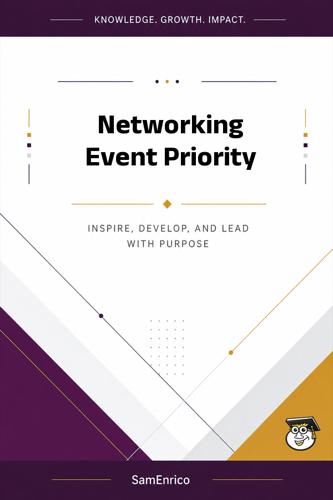
Non-FictionSelf-HelpNetworkingEvents
Networking Event Priority eBook
Rank which conferences, meetups, and mixers deserv
Rank which conferences, meetups, and mixers deserve your limited time.
Formats
Free sample
Chapter 1: The Calendar Audit--–- Look at your calendar for the next thirty days. Scan the evenings, the early mornings, the lunch hours blocked off for “networking.” Count them. Now ask yourself a question you have probably never been taught to ask: What did you say no to in order to say yes to each of those events?Not a single networking book has ever opened with that question. They open with enthusiasm. They open with promises of exponential growth, of handshake magic, of the one cocktail party conversation that changes everything.
And those things do happen. Rarely. Randomly. And never for the person who attends forty events a year hoping for lightning to strike.Your calendar is lying to you. It presents each invitation as neutral, as harmless, as a potential opportunity with no downside.
But every hour you spend standing in a loud bar holding a drink you do not want, listening to someone who cannot help you and whom you cannot help, is an hour stolen from something that actually matters. That hour could have been deep work—the kind of focused, uninterrupted labor that produces your best output. It could have been time with your family or your own mind. It could have been rest, which is not laziness but performance recovery. Instead, you traded it for a plastic badge and a lukewarm beer.This chapter reframes networking from a casual social activity into a serious portfolio of time-based investments.
It introduces the single most important concept you will learn in this book: opportunity cost applied to your social calendar. And it reveals a dangerous trap that almost no one talks about—Networking Debt—the hidden tax that bad events extract from your energy, your focus, and your professional reputation.By the end of this chapter, you will never look at an event invitation the same way again. More importantly, you will have built the mental filter that eliminates ninety percent of potential events before you ever spend a dollar or block a single hour. That filter is the foundation of everything else in this book.The Opportunity Cost You Have Been Ignoring Opportunity cost is not a complicated concept. It is simply this: when you choose to do one thing, you choose not to do everything else you could have done with that same time and energy.
Economists treat opportunity cost as the most real cost of any decision, often more significant than the obvious monetary expense.But somehow, when it comes to networking events, professionals abandon this logic entirely.Imagine you are considering a two-hour mixer on a Tuesday evening. The ticket is free. The venue is a fifteen-minute drive from your office. On the surface, the cost appears to be two hours and fifteen minutes plus parking. But that is not the true cost.
The true cost is everything you cannot do during those two hours and fifteen minutes. You cannot finish the proposal that is due Thursday. You cannot have dinner with your partner. You cannot go to the gym. You cannot read the industry report that has been sitting on your desk.
You cannot simply rest—which, for knowledge workers, is often the most productive thing you can do.Now multiply that by the number of events you attend in a typical year. If you attend two events per month—a conservative estimate for many professionals—that is twenty-four events per year. At two hours each, that is forty-eight hours. Add commute time, and you are easily at sixty to seventy hours. That is nearly two full work weeks.
Two weeks per year of your life, standing in rooms, shaking hands, saying “nice to meet you” on repeat.What could you do with an extra two weeks of focused time? You could write a book. You could land a major client. You could redesign your entire sales process. You could learn a new skill that doubles your market value.
Or you could simply be less tired, less resentful, and more present for the people who actually matter to you.The professionals who succeed at networking are not the ones who attend the most events. They are the ones who attend the right events and invest the time they save into preparation, follow-up, and relationship depth. But you cannot get there until you internalize a brutal truth: every “yes” to an event is a “no” to something else. The only question is whether you are choosing your noes intentionally or letting them happen to you by default.The 80/20 Rule for Networking Events The Pareto Principle, commonly known as the 80/20 Rule, states that roughly eighty percent of effects come from twenty percent of causes. In business, this shows up everywhere: eighty percent of sales come from twenty percent of customers.
Eighty percent of problems come from twenty percent of bugs. Eighty percent of results come from twenty percent of efforts.Networking events are no exception.After studying the calendars of over five hundred professionals across technology, finance, healthcare, and creative industries, a clear pattern emerges. Approximately twenty percent of the events attendees go to generate eighty percent of their meaningful outcomes—job offers, closed deals, strategic partnerships, mentorship relationships, and lasting friendships. The other eighty percent of events produce only twenty percent of the results, and much of that twenty percent is noise: contacts who never reply, coffee meetings that never happen, and business cards that sit in a drawer until they are thrown away.Think about your own experience. Think back over the last twelve months.
Which three events produced the most value for your career or business? Now think about how many events you attended in total. If you are like most professionals, you will find that a small handful of events—perhaps one conference, one meetup, and one unexpected gathering—account for almost everything you gained. The rest were filler. Some were pleasant.
Many were forgettable. A few were actively miserable.The 80/20 Rule is not a law of nature. It is a description of how unmanaged systems tend to distribute themselves. And your event calendar is almost certainly unmanaged. You say yes because someone invited you, because you feel obligated, because you fear missing out, because “that’s what professionals do.” You have never applied a filter.
You have never calculated the return on investment of a Tuesday night mixer against the alternative uses of that time.This book exists to change that. Starting with this chapter, you will learn to identify your twenty percent. You will learn to aggressively eliminate the eighty percent that is stealing your time. And you will learn to pour the hours you save into preparation, follow-up, and the handful of relationships that actually move the needle.But first, we must talk about something darker. Something that no one warns you about.
Something that may be affecting you right now without your conscious awareness.The Networking Debt Trap Debt is easy to understand. You borrow money today, and you pay back more than you borrowed tomorrow. The interest accumulates. The obligation weighs on you. Eventually, the debt itself becomes a drag on your ability to make good decisions.Networking debt works exactly the same way, except you…
This is the end of the free sample. Get the eBook to keep going. Buy now
About this book
Details
- Author
- Keenan Mandie
- Publisher
- SamEnrico
- Language
- English
- Genre
- Non-Fiction, Self-Help, Networking, Events
- Released
- 2026-06-09
- Pages (approx.)
- 142
- Available as
- eBook, Audiobook

Read better in the ZLOADR app
Your eBooks on your phone or tablet. Sign in with your SamEnrico account and start reading.
More by Keenan Mandie
 Eyebrow Hair Loss GuideKeenan Mandie$11.99
 Remote Trust BuildingKeenan Mandie$11.99
 The Senior Empty Nest Self Esteem GuideKeenan Mandie$11.99
 No Man's Sky Exploration FixKeenan Mandie$11.99
 The Ghosts of Soweto: South Africa's Cold Case BreakthroughsKeenan Mandie$11.99
 Understanding Mental Retardation Progressive SpasticityKeenan Mandie$17.99
 How to Start a Pea Splitting, Milling or Grinding Business (Beginners Guide)Keenan Mandie$11.99
 World Bank Gender Equality CareersKeenan Mandie$12.99
 Promotion Business Case For ExecutivesKeenan Mandie$12.99
 Short Form Video Production SystemsKeenan Mandie$11.99
You may also like
 Hong Kong Handover 1997Dunn Johnnie$11.99
 Zumba For Postnatal Recovery CourseNeal Christian$11.99
 Zumba for BeginnersLadner Nikia$11.99
 YouTube Comment Mining GuideHumes Pandora$12.99
 Worry Box MeditationCarlin Rudy$11.99
 Workplace Stress MeditationNguyen Lynn$11.99
 Workplace Stress and Sleep RepairHawley Ivory$11.99
 Workplace Perfectionism CureDelaney Jeffry$11.99
 Workplace Injustice Anger GuideWallen Isabelle$11.99
 Work Addiction and Burnout LinkGreenwood Ester$11.99
 Women in Yoga and WellnessBeattie Galina$11.99
 Women in Stand Up ComedyChun Evangeline$11.99