
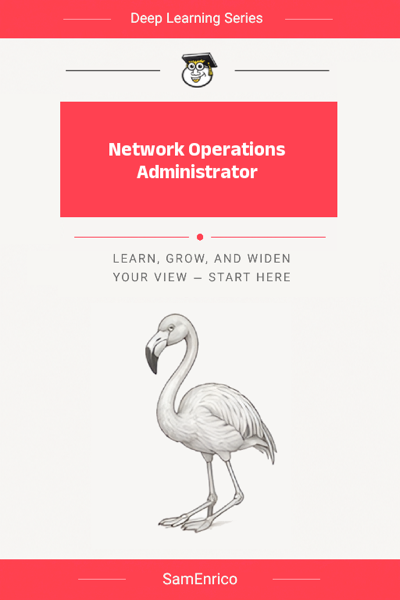
Non-FictionInformativeEducational
Network Operations Administrator eBook
A Coursebook on Network Operations Administrator
by Santana Dyan
A Coursebook on Network Operations Administrator
Formats
Free sample
Chapter 1: Zero to Pager...--It is 2:47 AM on a Tuesday. Your phone vibrates across the nightstand – not a text, not a spam call, but the distinctive, gut-punch buzz of the pager or monitoring alert. You were dreaming about something mundane, like grocery shopping or a beach you have never visited. Now you are awake, heart already pounding, eyes struggling to focus on the screen.The alert reads: "CRITICAL: Core-SW-01 – Link down. BGP peer 10.0.0.2 unreachable. 72 users affected."Seventy-two people just woke up. Not literally, but their work – their VPN connection to the finance database, their Zoom call with a client, their commit to the production repository – just died. And you are the one they will never see, the name they will never know, the person who exists only as a ticket number in a system they cannot access.This is the life of a Network Operations Administrator. You are not the architect who designed the beautiful, theoretical network on a whiteboard. You are not the engineer who unboxes shiny new hardware and configures it during business hours with a change request signed in triplicate. You are the person who gets the page at 2:47 AM when the beautiful theory collides with ugly reality.And this book is not about the theory.This book is about the 2:47 AM.It is about knowing exactly which commands to type when your hands are shaking from adrenaline and your brain is fogged from sleep. It is about having a runbook so well rehearsed that your fingers find the right keys before your conscious mind catches up. It is about understanding, deep in your bones, that the network is not a diagram – it is a living, breathing, failing, recovering organism.But before you can fix the 2:47 AM outage, you need to understand something more fundamental. You need to understand that your job is not “fixing things when they break.” That is what firefighters do, and firefighters spend ninety percent of their time cleaning trucks and inspecting hydrants and running drills so that when the ten percent comes, they do not panic.Your job is the same. Your job is the entire lifecycle of the network: Operation, Administration, Maintenance, and Provisioning. The industry calls this the OAM&P model, and if you master it, you will never again feel that cold dread when the pager goes off. You will feel purpose.Let us begin.The One Framework You Cannot Ignore (FCAPS)Most networking books open with the OSI model. Seven layers. Neat stacked boxes. Data flows down one side, up the other. It is elegant. It is also almost useless when you are standing in a data center at 2:47 AM staring at a switch console that says “%SYS-2-MALLOCFAIL: Memory allocation of 4096 bytes failed.”The OSI model tells you where the problem might be. It does not tell you what to do about it.There is another model, less famous but infinitely more practical for the NOC administrator. It is called FCAPS, and it was standardized by the ISO in the 1980s precisely because the OSI model was insufficient for the messy reality of running a network. FCAPS stands for Fault, Configuration, Accounting, Performance, and Security. These are not layers. They are disciplines. They are the five things you will spend your entire career managing, whether you know it or not.Fault Management is what most people think the NOC does. An alert fires. A link goes down. A router crashes. Fault management is detection, isolation, and resolution. It is the 2:47 AM page. It is the screaming client. It is the moment of truth. But fault management is less than twenty percent of your actual job, and if you spend all your time fighting fires, you are either in a badly run NOC or you are not doing the other four disciplines.Configuration Management is the quiet work. It is tracking which version of IOS is running on which switch. It is knowing that the VLAN named “Guest_Wi Fi” exists on all eighteen access switches, but not on the two that were added last quarter. It is the discipline of configuration backups, change tracking, and – most importantly – knowing exactly what changed in the last hour that might explain why the network is now behaving strangely. In a well-run NOC, configuration management is the difference between a thirty-minute outage and a two-hour outage. When the pager goes off, your first question should not be “what is broken?” It should be “what changed?”Accounting Management sounds like something for finance, and it is. But it is also for capacity planning. Accounting management tracks who is using the network, how much they are using, and when. Is the engineering department saturating the uplink every afternoon at 2 PM? That is not a fault. That is accounting data telling you to order a bigger pipe. Is the backup server sending terabytes across the WAN during business hours? That is not an emergency. That is a policy problem revealed by accounting.Performance Management is the layer above fault management. Faults tell you something is broken. Performance tells you something is about to break. Latency creeping up. Jitter increasing on the Vo IP subnet. Packet loss at 0.5 percent, then 0.8 percent, then 1.2 percent. Performance management is the dashboard, the trend line, the alert that fires at 8 AM saying “Hey, this link is going to fail around noon” – giving you four hours to fix it before anyone notices.Security Management is every control that keeps unauthorized people off your equipment and your data. It is RADIUS and TACACS+. It is SSH instead of Telnet. It is the jump box that sits between the internet and your core routers. It is the principle of least privilege, which says that a Tier 1 NOC technician should never be able to accidentally reload a core switch. Security management is also auditing – knowing that someone logged in at 3:14 AM, and that it was not you, and that you need to find out who.FCAPS is not a checklist. It is a lens. When you sit down at your desk at the start of your shift, you should mentally run through all five. Fault – is anything down? Configuration – did any changes happen in the last shift? Accounting – are any links near saturation? Performance – are any indicators trending toward a threshold? Security – are there any failed login attempts or configuration changes from unknown sources?The best NOC administrators do this automatically within the first ten minutes of every shift. They do not call it FCAPS. They just know what to look for. But they learned it somewhere.You Are Not an Architect (And That Is Good)One of the fastest ways to fail as a Network Operations Administrator is to confuse your role with the roles above and below you. Let us draw three clear lines.The Architect draws the map. She decides that the core will be a spine-leaf topology with 100-gigabit uplinks. She chooses the vendor – Arista, Cisco, Juniper – based on features, cost, and support. She designs the IP addressing scheme, the routing protocol (OSPF, BGP, or both), and the high-availability strategy (HSRP, VRRP, MLAG). She does this months before any equipment is racked, and…
This is the end of the free sample. Get the eBook to keep going. Buy now
About this book
Details
- Author
- Santana Dyan
- Publisher
- SamEnrico
- Language
- English
- Genre
- Non-Fiction, Informative, Educational
- Released
- 2026-05-08
- Pages (approx.)
- 145
- Available as
- eBook, Audiobook

Read better in the ZLOADR app
Your eBooks on your phone or tablet. Sign in with your SamEnrico account and start reading.
More by Santana Dyan
 Body Image for Ostomy Patients CourseSantana Dyan$11.99
 Shift Work Earplug GuideSantana Dyan$11.99
 Vanadium And Blood SugarSantana Dyan$11.99
 The Referral EngineSantana Dyan$11.99
 Self Esteem and Different LibidosSantana Dyan$11.99
 The Silk Road of Science: How China’s Secret Genome Heist Changed Biology ForeverSantana Dyan$11.99
 The Last Transmission: The Haunting of Shortwave RadioSantana Dyan$11.99
 How to Become a Internal-combustion-engine SubassemblerSantana Dyan$11.99
 ToS Common MistakesSantana Dyan$12.99
 Executive Summary Cheat Sheet for ManagersSantana Dyan$12.99
 Understanding Ewing's SarcomaSantana Dyan$17.99
You may also like
 Hong Kong Handover 1997Dunn Johnnie$11.99
 Zumba For Postnatal Recovery CourseNeal Christian$11.99
 Zumba for BeginnersLadner Nikia$11.99
 YouTube Comment Mining GuideHumes Pandora$12.99
 Worry Box MeditationCarlin Rudy$11.99
 Workplace Stress MeditationNguyen Lynn$11.99
 Workplace Stress and Sleep RepairHawley Ivory$11.99
 Workplace Perfectionism CureDelaney Jeffry$11.99
 Workplace Injustice Anger GuideWallen Isabelle$11.99
 Work Addiction and Burnout LinkGreenwood Ester$11.99
 Women in Yoga and WellnessBeattie Galina$11.99
 Women in Stand Up ComedyChun Evangeline$11.99