
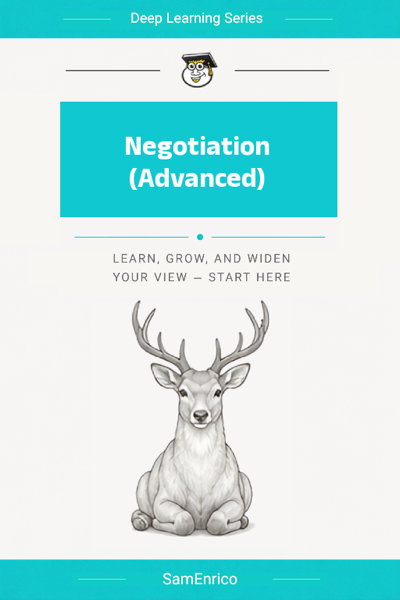
Non-FictionInformativeEducational
Negotiation (Advanced) eBook
A Coursebook on Negotiation (Advanced)
by Hurt Shanika
A Coursebook on Negotiation (Advanced)
Formats
Free sample
Chapter 1: The Mirror Trap--– Most negotiators believe their greatest challenge is the person across the table. They study tactics, rehearse arguments, and plan countermoves against an opponent they imagine as the primary obstacle. This is the first and most expensive mistake of the advanced negotiator’s career. The person across the table is not your greatest challenge. You are.
Before you can read anyone else’s intentions, before you can deploy a single calibrated question or leverage point, you must confront what we call the Mirror Trap: the tendency to enter negotiations blind to your own patterns, biases, and default responses, then wonder why your carefully planned strategy collapsed the moment pressure arrived.The Mirror Principle is simple but unforgiving: you cannot manage what you cannot see. Every negotiation is filtered through the lens of your own psychology—your habitual ways of reacting under stress, your unconscious assumptions about how the world works, your emotional triggers that fire before your rational brain can intervene. Advanced negotiators do not merely accept this fact. They exploit it. They turn inward first, building a map of their own terrain before attempting to navigate someone else’s.
This chapter provides the tools for that inward journey: identifying your negotiation default script, diagnosing the cognitive biases that distort your judgment, and calibrating your alternatives not as static numbers but as dynamic, living ranges that shift with every new piece of information. By the end, you will understand why self-awareness is not soft psychology but hard leverage—and why the negotiator who knows herself has already won half the battle before the first word is spoken.The Four Default Scripts: Recognizing Your Automatic Pilot Every negotiator has a default script—an automatic behavioral pattern that emerges under pressure, often without conscious choice. Think of it as your negotiation personality when you stop thinking and just react. Researchers and practitioners have identified four primary scripts, and understanding yours is the first step toward breaking free of its constraints.The Competitor script sees negotiation as war. The goal is victory.
The other side is an adversary to be outmaneuvered, pressured, or outlasted. Competitors love leverage, relish hard bargaining, and view concessions as losses. Their strength is drive—they push through obstacles and rarely leave value on the table due to timidity. Their blind spot is relationships. Competitors win battles and lose wars, burning trust that future negotiations require.
When a Competitor feels threatened, they attack, escalate, or walk away. The script is invaluable in one-shot, zero-sum transactions. It is disastrous in long-term partnerships.The Avoider script sees negotiation as threat. The goal is peace, usually achieved by sidestepping conflict or conceding early. Avoiders hate tension, fear confrontation, and often agree to terms they later regret just to end the discomfort.
Their strength is harmony—they preserve relationships and rarely create unnecessary friction. Their blind spot is value. Avoiders leave enormous sums on the table because they would rather lose the deal than endure the argument. When an Avoider feels threatened, they disappear, delay, or capitulate. The script is useful when the issue is trivial and the relationship matters enormously.
It is catastrophic when stakes are high.The Accommodator script sees negotiation as relationship-building. The goal is mutual liking and trust, often at the expense of outcome. Accommodators prioritize the other side’s satisfaction, offer unilateral concessions, and assume that goodwill will be reciprocated. Their strength is connection—they build deep trust and often gain access to information that competitors never hear. Their blind spot is chronic underselling.
Accommodators consistently achieve worse economic outcomes than their alternatives would justify. When an Accommodator feels threatened, they give more ground to restore harmony. The script works when you truly have nothing to lose. It fails when you have something to protect.The Collaborator script sees negotiation as problem-solving. The goal is joint value creation.
Collaborators invest time in uncovering interests, brainstorming options, and trading across differences. Their strength is innovation—they frequently find solutions that neither party initially imagined. Their blind spot is inefficiency. Collaborators overinvest in low-stakes negotiations, spend hours on trivial issues, and can be exploited by Competitors who use their openness against them. When a Collaborator feels threatened, they try harder to find common ground, sometimes mistaking abuse for complexity.
The script is ideal for complex, long-term, high-trust negotiations. It is wasted on simple transactions or adversarial contexts.Here is the uncomfortable truth that most negotiation books avoid: no single script is always right. The advanced negotiator does not try to become a Collaborator in every situation. Instead, they learn to recognize their default script, then consciously choose whether to deploy it, modify it, or override it based on context. This is the first act of strategic architecture: knowing your automatic pilot so you can decide when to let it fly and when to take the controls yourself.Cognitive Biases: The Hidden Distorters Even when you know your default script, your brain plays tricks on you.
Cognitive biases are systematic errors in thinking that affect every decision, and negotiation is their favorite hunting ground. Three biases destroy more deals than any external opponent.Anchoring is the gravitational pull of the first number mentioned. Research by Tversky and Kahneman demonstrated that even arbitrary anchors—a judge rolling dice before setting a sentence—influence final outcomes. In negotiation, the party who makes the first offer sets the anchor, and every subsequent move is a departure from that reference point. Experienced negotiators know this and often anchor aggressively.
But here is the subtlety that advanced practitioners understand: anchors work even when they are ridiculous. A sky-high opening demand changes the range of acceptable outcomes, pulling the final agreement upward even if the demand itself is rejected. The counter to anchoring is not to ignore the anchor—you cannot—but to reframe. Do not say “That’s too high.” Say “Help me understand how you arrived at that number.” Then introduce a competing anchor based on objective criteria. Two anchors are better than one.Overconfidence is the mother of all negotiation errors.
Negotiators systematically underestimate uncertainty and overestimate their leverage. They believe their BATNA is stronger than it is, their case is more persuasive than it is, and their counterparty has fewer options than they actually do. Overconfidence leads to risk-taking that blows up deals. It leads to walking away from agreements that were actually favorable. The antidote is not pessimism but calibration.
Before every negotiation, write down your best guess of the outcome. Then write down your worst-case scenario. Then write down a probability distribution across possible outcomes. The act of forcing yourself to consider the range—not just the hoped-for point—reduces overconfidence bias more effectively than any pep talk about humility.The endowment effect is the tendency to overvalue what you already have. Once you own something—a car, a job, a contract term, a proposal—you value it more highly than you did before you owned it.
This leads to irrational resistance to trade. In negotiation, the endowment effect appears when parties refuse to concede on issues they have already “won,” even when the concession would unlock greater value elsewhere. The advanced negotiator recognizes the endowment effect in…
This is the end of the free sample. Get the eBook to keep going. Buy now
About this book
Details
- Author
- Hurt Shanika
- Publisher
- SamEnrico
- Language
- English
- Genre
- Non-Fiction, Informative, Educational
- Released
- 2026-05-04
- Pages (approx.)
- 121
- Available as
- eBook, Audiobook

Read better in the ZLOADR app
Your eBooks on your phone or tablet. Sign in with your SamEnrico account and start reading.
More by Hurt Shanika
 Mindfulness For Emotional Eating GuideHurt Shanika$11.99
 Meniere's Sleep MeditationHurt Shanika$11.99
 Burnout Prevention Somatic WorkHurt Shanika$11.99
 Stimulus Control Eating GuideHurt Shanika$11.99
 LGBTQ Grieving Parent DeathHurt Shanika$11.99
 The Quantum Whisperer: How a Teenager Cracked Einstein's CodeHurt Shanika$11.99
 The Phantom Tide: The Vanishing of the SS BaychimoHurt Shanika$11.99
 How to Start a Speakers - Independent BusinessHurt Shanika$11.99
 European Union Grants UKHurt Shanika$12.99
 Employee Parental Leave TrapHurt Shanika$12.99
 Understanding Glycogen Storage Disease Type 6, Due to PhosphorylationHurt Shanika$17.99
You may also like
 Hong Kong Handover 1997Dunn Johnnie$11.99
 Zumba For Postnatal Recovery CourseNeal Christian$11.99
 Zumba for BeginnersLadner Nikia$11.99
 YouTube Comment Mining GuideHumes Pandora$12.99
 Worry Box MeditationCarlin Rudy$11.99
 Workplace Stress MeditationNguyen Lynn$11.99
 Workplace Stress and Sleep RepairHawley Ivory$11.99
 Workplace Perfectionism CureDelaney Jeffry$11.99
 Workplace Injustice Anger GuideWallen Isabelle$11.99
 Work Addiction and Burnout LinkGreenwood Ester$11.99
 Women in Yoga and WellnessBeattie Galina$11.99
 Women in Stand Up ComedyChun Evangeline$11.99