
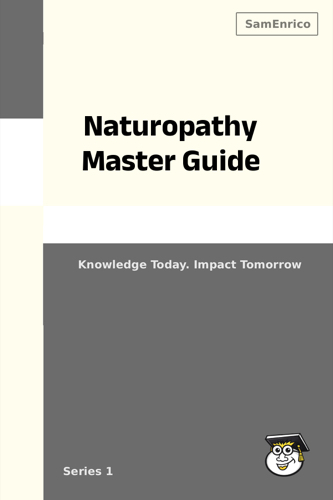
Naturopathy Master Guide eBook
Complete reference for principles and practices.
Complete reference for principles and practices.
Formats
Free sample
Chapter 1: The Body Lies--You have been lied to about your body.Not by any single person or institution with malicious intent. The lie is woven into the fabric of modern medicine, nutrition advice, wellness culture, and even the way you talk to yourself in the mirror. The lie sounds reasonable, scientific, even compassionate. Here it is: Your body is a machine. When it breaks, you need an expert to find the broken part and fix it.
If the expert cannot find anything broken, then the problem must be in your head.This chapter exists to dismantle that lie. Not because doctors are wrong or medicine is useless, but because the machine metaphor is catastrophically incomplete. It has led you to believe that feeling terrible with normal lab results means you are imagining things. It has led you to try protocol after protocol, each one promising to "hack" or "optimize" or "detox" a body that was never designed to be hacked. And it has led you to a place of quiet despair where you wonder if perhaps your body really is broken beyond repair.Your body is not a machine.
It is an ecosystem.An ecosystem does not break like a machine. It becomes unbalanced. It adapts to stressors in ways that sometimes look like illness but are actually intelligent survival strategies. It communicates through symptoms that are not errors but messages. And most importantly, an ecosystem possesses something no machine ever will: the innate ability to heal itself when the conditions for healing are restored.This is the foundational principle of naturopathy.
It has a Latin name—Vis Medicatrix Naturae—but you do not need Latin to understand it. You have experienced it every time a cut healed without you telling your skin what to do, every time a fever broke and you felt stronger afterward, every time your body craved water when dehydrated or sleep when exhausted. Your body is not working against you. It is working for you, constantly, in ways you cannot see. The problem is not that your healing intelligence has failed.
The problem is that modern life has buried it under an avalanche of obstacles.This chapter will teach you to see your body differently. It will introduce the single question that will guide every therapy in this book. It will help you distinguish between treatments that support your innate healing intelligence and treatments that override it. And it will give you your first actionable step—not a supplement or a diet, but an entirely new way of listening to the body you thought was broken.The Machine That Never Was Let us begin with a thought experiment. Imagine two patients.Patient A goes to a conventional doctor with crushing fatigue, brain fog, joint pain, and digestive distress.
Her blood work comes back "normal." Her thyroid panel is within reference range. Her inflammatory markers are not elevated enough to diagnose anything. The doctor tells her, with genuine kindness, that nothing is wrong. Perhaps she should consider stress reduction or an antidepressant.Patient B goes to the same doctor with a broken arm. The X-ray shows a clear fracture.
The doctor sets the bone, puts it in a cast, and tells her exactly how long it will take to heal.Both doctors are practicing good medicine within the machine model. Patient B has a clear mechanical problem with a clear mechanical solution. Patient A has no identifiable broken part, so within the machine model, there is nothing to fix. The implicit message is devastating: if the tests say nothing is wrong, then your suffering is not real, or it is your fault, or it is "just anxiety."But here is what the machine model misses. Patient A's symptoms are real.
Her suffering is real. And her body is not failing—it is adapting to an environment that has overwhelmed its ability to maintain balance. The machine metaphor cannot accommodate adaptation because machines do not adapt. They break. Ecosystems adapt.
They shift, compensate, and find new ways to survive. What looks like illness is often a survival strategy that has become maladaptive only because the environment has not changed.Consider a simpler example. When you are cold, your body constricts blood vessels in your extremities to preserve heat for your vital organs. Your hands and feet become cold. Within the machine model, cold hands are a problem to be fixed—perhaps poor circulation, perhaps a thyroid issue.
But within the ecosystem model, cold hands are an intelligent adaptation. Your body is choosing to sacrifice your fingers temporarily so your heart and brain can survive. The symptom is not the error. The symptom is the solution.The same logic applies to fatigue, inflammation, anxiety, and almost every other symptom you have been taught to suppress. Fatigue is not a design flaw.
It is your body's way of forcing you to rest when rest is what you most need. Inflammation is not random destruction. It is your immune system's way of repairing tissue and fighting infection. Anxiety is not a chemical imbalance. It is your nervous system's way of keeping you alert to threats.These adaptations become problems not because your body is broken, but because the adaptations persist long after they are useful.
Chronic fatigue remains after the infection is gone. Chronic inflammation damages tissue when the original injury has healed. Chronic anxiety freezes you even when there is no predator in sight. But the solution is not to suppress the symptom. The solution is to understand what your body is adapting to and change that.Docere: The Doctor as Teacher If the machine model casts the doctor as a mechanic—find the broken part, repair or replace it—then the naturopathic model casts the practitioner as something else entirely.
The Latin word is docere. It means teacher.This is not a semantic distinction. It changes everything about how healing works. A mechanic takes responsibility for fixing your car. A teacher gives you the tools to understand and maintain your own system.
A mechanic's success depends on their skill. A teacher's success depends on your understanding.Within the docere model, you are not a passive recipient of treatments. You are an active participant in your own healing. The practitioner's role is to help you identify the obstacles that are blocking your innate healing intelligence—poor sleep, chronic stress, hidden infections, environmental toxins, unresolved trauma—and then guide you as you remove those obstacles. The healing itself is done by your body, not by the practitioner and not by the treatment.This is why naturopathy has sometimes been dismissed as "doing nothing." From the outside, removing obstacles looks passive.
You are not administering a powerful drug or performing a dramatic surgery. You are helping someone sleep better, eat whole foods, manage stress, and address hidden infections. But from the inside, removing obstacles is the most active thing you can do because it allows your body to do what it has been trying to do all along.Think of a garden. If your tomato plants are wilting, you could spray them with chemicals to force them green again. That is the machine model—treat the symptom.
Or you could ask why they are wilting. Is the soil depleted? Are they getting enough water? Is there a…
This is the end of the free sample. Get the eBook to keep going. Buy now
About this book
Details
- Author
- Barnhart Nickole
- Publisher
- SamEnrico
- Language
- English
- Genre
- Non-Fiction, Health & Wellness, Complete
- Released
- 2026-06-05
- Pages (approx.)
- 149
- Available as
- eBook, Audiobook

Read better in the ZLOADR app
Your eBooks on your phone or tablet. Sign in with your SamEnrico account and start reading.
More by Barnhart Nickole
 Parental Stress And DivorceBarnhart Nickole$11.99
 Fear Of Earthquakes GuideBarnhart Nickole$11.99
 Leftovers Transformation GuideBarnhart Nickole$11.99Leftovers Transformation GuideBarnhart Nickole$11.99
 Validation for Eating DisordersBarnhart Nickole$11.99
 The Flow State ProtectorBarnhart Nickole$11.99
 Gym Consistency TriggerBarnhart Nickole$11.99
 REIT Guide For BeginnersBarnhart Nickole$11.99
 The Goryeo Gambit: How a Korean Dynasty Almost Defeated the MongolsBarnhart Nickole$11.99
 Iron and Steam: The Titans of the Industrial RevolutionBarnhart Nickole$11.99
 How to Produce Rolling PIN AccessoriesBarnhart Nickole$11.99
 Pinterest VA Account Audit ServiceBarnhart Nickole$12.99
You may also like
 Men's Master GuideGass Viviana$11.99
 Injury Master GuideStuckey Berenice$11.99
 Macronutrient Master GuideTillery Carlita$11.99
 Sleep Master GuideDesantis Dominique$11.99
 PCOS Master GuideOtoole Sierra$11.99
 Flexibility Master GuideSamples Lawrence$11.99
 IBS Master ReferenceBolin Meryl$11.99
 Hormonal Master GuideOswald Elda$11.99
 Food Intolerances Complete GuideTitus Earleen$11.99
 Beginner Fitness MasterSharkey Vinita$11.99
 Napping Complete Health GuideEnnis Laronda$11.99
 Group Fitness MasterHolly Lashawnda$11.99