
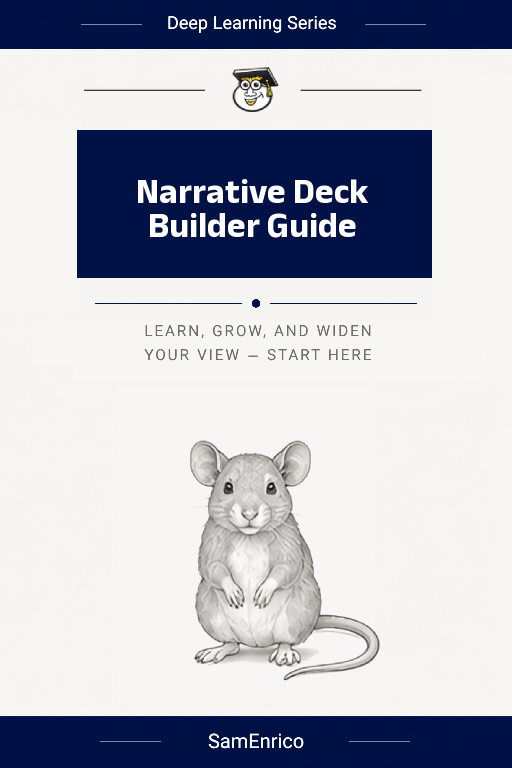
Non-FictionAI OperatorCorporate CommunicationsSkills Guide
Narrative Deck Builder Guide eBook
Generate complete slide decks with logical flow, t
by Mott Maurice
Generate complete slide decks with logical flow, talking points, and visual suggestions from raw content using AI. Includes outline generation, slide splitting, and transition prompts.
Formats
Free sample
Chapter 1: The Scaffolding Mindset--–- The VP of Strategy stared at the blinking cursor on her laptop. It was 11:47 PM on a Sunday. Forty-seven pages of user research notes sat on her desk—printed, highlighted, dog-eared, and utterly overwhelming. Tomorrow at 9:00 AM, she had to present a strategic recommendation to the executive committee. She had been at this for three hours and had produced exactly one slide: the title slide.
Her problem was not a lack of data. Her problem was not a lack of intelligence or effort. Her problem was the blank slide.This scene repeats itself millions of times every day, in every industry, across every time zone. Consultants, product managers, educators, marketers, and executives all share the same quiet agony: staring at an empty digital canvas, knowing they have something important to say, but unable to translate their knowledge into a coherent, compelling presentation. The result is either a data dump—every piece of information crammed onto slides with six-point font and twenty bullet points—or a design-first disaster—hours wasted on aligning boxes and choosing fonts before the story is even solid.This book is not about making better slides.
It is about a fundamental shift in how you think about presentations altogether. It is about moving from the role of builder to the role of architect.The Hidden Cost of the Blank Slide Let us begin with an uncomfortable truth. Most professionals spend sixty to eighty percent of their presentation time on formatting, alignment, word-smithing, and design tweaking—not on thinking. They agonize over whether a chart should be blue or green while the logical flow of their argument remains a mess. They rearrange bullet points for an hour when the real problem is that they have not identified the single most important thing their audience needs to hear.This is not laziness.
This is not incompetence. This is a structural failure of the traditional presentation workflow.Consider the old linear model that most of us were never taught but somehow absorbed: First, you gather your content. You write notes, collect data, maybe outline some ideas. Then you move to design. You open Power Point or Keynote or Google Slides.
You choose a template, pick colors, arrange boxes. Then you agonize. You second-guess every word. You move a chart from slide five to slide seven and then back again. You add an animation because it looks "professional." You delete the animation because it feels "gimmicky." Finally, you present.
The process is linear, sequential, and slow.The problem with this model is that it asks you to make two kinds of decisions at the same time: structural decisions (what story am I telling?) and aesthetic decisions (what should it look like?). Your brain is terrible at this. Cognitive psychologists call this "dual-task interference." When you try to think about narrative logic and visual design simultaneously, you perform both tasks worse than if you had done them sequentially. But even sequential is inefficient if the order is wrong.The order has been wrong for decades.From Builder to Architect: A New Metaphor Here is the central insight of this book: You are not the builder of slides. You are the architect of meaning.An architect does not pour concrete.
An architect does not hammer nails. An architect designs the structure, defines the flow of spaces, specifies the materials, and then hands detailed plans to builders who execute. The architect's value is not in physical labor but in strategic vision, structural integrity, and user experience.For presentations, AI is your builder. It handles the mechanical, repetitive, and structural tasks—generating outlines, writing first drafts of bullet points, suggesting layouts, creating visual metaphors. You handle the narrative intent, the emotional arc, the strategic decisions about what to include and what to leave out, the final curation that turns a competent deck into a compelling one.This is not about replacing human judgment.
It is about amplifying it. The architect still inspects every beam before the building is signed off. Similarly, you will edit, refine, and verify everything AI produces. But you start from a place of having something to work with, not from a blank slide.Let me introduce the new workflow that will replace your old habits: the iterative loop.Raw Content → AI Structuring → Human Curation → Refine → Repeat.Notice what is missing from this loop: the blank slide. You never start from nothing.
You start from raw content—your notes, reports, transcripts, brain dumps, whatever you have. You feed that content to AI with a structured prompt (which you will learn in Chapter 3). AI produces a first draft of structure. You curate—edit, delete, rearrange, add your unique insight. Then you refine, perhaps asking AI to generate visuals or rewrite sections.
Then you repeat the loop as many times as needed.The key difference is that you are always reacting to something, not creating from the void. Reaction is faster than creation. Editing is faster than writing. Curating is faster than building from scratch.The Three-Pass Method Within the iterative loop, I recommend a specific technique called the Three-Pass Method. It enforces the separation of structural, narrative, and visual decisions that the old linear model conflates.Pass One: Structure Only.
In this pass, AI generates nothing but an outline. No visuals, no full sentences, no design suggestions. Just headlines, sub-headlines, and the logical relationship between them. The prompt might look like: "Based on the attached research notes, generate a 12-slide outline with headlines only. Do not write full sentences.
Do not suggest visuals. Just the structural flow." Your job in Pass One is to edit the logic. Does the sequence make sense? Is there a clear beginning, middle, and end? Is the recommendation positioned appropriately?
You move slides around, delete redundant sections, add missing ones. You are thinking only about structure.Pass Two: Narrative Depth. Now you ask AI to expand each headline into bullet points, key messages, and supporting evidence. The prompt: "Using the revised outline from Pass One, write 3-5 bullet points per slide. Each bullet should be a complete sentence.
Focus on clarity and persuasion, not design." Your job in Pass Two is to edit the story. Does each bullet point actually support its headline? Is the evidence convincing? Are there logical leaps? You rewrite, rephrase, and refine.
You are thinking only about content.Pass Three: Visual Intelligence. Finally, you ask AI to suggest visuals, layouts, and design elements. The prompt: "For each slide in the approved outline, suggest a visual metaphor or chart type. Generate image prompts where appropriate. Recommend slide layouts." Your job in Pass Three is to curate the visuals.
You select which suggestions to use, generate images, and make final design decisions. You are thinking only about communication effectiveness.Separating these passes is the single most effective way to reduce the time you spend on presentations. It also dramatically improves quality because you are making one type of decision at a time, not juggling all three.The 5-Minute Outline Challenge Before you dismiss this as theoretical, let me prove it works. Here is a challenge: take any piece of raw content you have right now—a report, a meeting transcript, even a collection of…
This is the end of the free sample. Get the eBook to keep going. Buy now
About this book
Details
- Author
- Mott Maurice
- Publisher
- SamEnrico
- Language
- English
- Genre
- Non-Fiction, AI Operator, Corporate Communications, Skills Guide
- Released
- 2026-06-01
- Pages (approx.)
- 127
- Available as
- eBook, Audiobook

Read better in the ZLOADR app
Your eBooks on your phone or tablet. Sign in with your SamEnrico account and start reading.
More by Mott Maurice
 Resentment Toward Successful PeersMott Maurice$11.99
 The Vagus Nerve And MemoryMott Maurice$11.99
 Wedding Planner Crisis Management WorkbookMott Maurice$11.99
 The Gambling Addiction and Insomnia GuideMott Maurice$11.99
 Branch Davidian Escapee StoryMott Maurice$11.99
 The Trial of the Century: The Unseen Battle for the Mona LisaMott Maurice$11.99
 Understanding Larsen-like Syndrome Lethal TypeMott Maurice$17.99
 How to Become a Coat-hanger-shaper-machine OperatorMott Maurice$11.99
 Trucking Capacity Utilization GuideMott Maurice$12.99
 Butternut HarvestingMott Maurice$11.99
You may also like
 Hong Kong Handover 1997Dunn Johnnie$11.99
 Zumba For Postnatal Recovery CourseNeal Christian$11.99
 Zumba for BeginnersLadner Nikia$11.99
 YouTube Comment Mining GuideHumes Pandora$12.99
 Worry Box MeditationCarlin Rudy$11.99
 Workplace Stress MeditationNguyen Lynn$11.99
 Workplace Stress and Sleep RepairHawley Ivory$11.99
 Workplace Perfectionism CureDelaney Jeffry$11.99
 Workplace Injustice Anger GuideWallen Isabelle$11.99
 Work Addiction and Burnout LinkGreenwood Ester$11.99
 Women in Yoga and WellnessBeattie Galina$11.99
 Women in Stand Up ComedyChun Evangeline$11.99