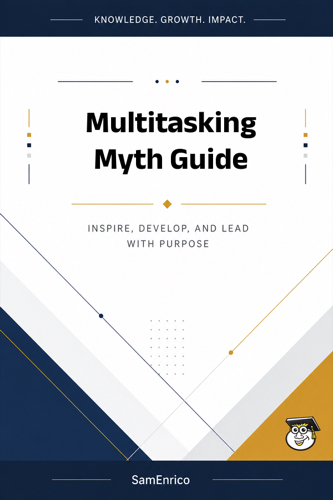
Multitasking Myth Guide eBook
undefined
by Mull Dorla
undefined
Formats
Free sample
Chapter 1: The Expensive Party Trick--–- In 2016, a thirty-four-year-old software developer named Mateo sat down at his desk at 9:00 AM, determined to finish a critical code deployment by noon. He opened his IDE, pulled up the deployment script, and began reviewing the final lines. Three minutes later, a Slack notification pinged. He glanced at it—a teammate asking a quick question about a different project. He typed a brief response, which took forty-five seconds.
Then he returned to the deployment script.But he did not simply resume. First, he had to remember where he had stopped. He scrolled up, found his place, reread the last two lines, and continued. Two minutes after that, his email chimed. A marketing manager needed approval on a landing page.
Mateo opened the email, skimmed the request, typed “Looks good,” and sent it. He returned to the deployment script. Again, he had to reorient. Again, he lost time.This pattern repeated for three hours. By noon, the deployment script was not finished.
Mateo felt exhausted, scattered, and vaguely guilty. He had worked continuously for three hours. He had answered fourteen Slack messages, responded to six emails, and even checked Twitter twice. But the one thing that mattered—the deployment script—remained incomplete.Mateo decided to track his time the next day. He installed a simple timer and clicked it every time he switched tasks.
At the end of the day, he reviewed the data. He had switched tasks 147 times in eight hours. Each switch cost him an average of twenty-three seconds of refocusing time. That added up to 3,381 seconds—fifty-six minutes—spent not doing work, but recovering from the act of switching. Add the latency of disengagement and activation, and the total exceeded ninety minutes.
An hour and a half of his day had vanished into a cognitive black hole.Mateo’s story is not unusual. It is not extreme. It is, by the standards of the modern workplace, completely normal. And that is the problem.This chapter reveals the true cost of switchtasking—the habit of rapidly toggling between conscious tasks that we mistakenly call multitasking. You will learn the switching cost theory, the 28% Tax that steals nearly two and a half hours from every workday, and the urgency illusion that keeps you trapped in a cycle of perpetual distraction.
By the end of this chapter, you will understand not just that switchtasking is expensive, but exactly how expensive—down to the minute, the dollar, and the year of your life.The Switching Cost: A Mathematical Certainty The concept of switching cost emerged from the laboratories of cognitive psychologists David Meyer and David Kieras at the University of Michigan in the 1990s. Meyer and Kieras were interested in a seemingly simple question: what happens to human performance when people move from one task to another?Their experiments were elegant in their simplicity. Participants performed Task A, then Task B. The researchers measured response times and error rates. Then participants performed Task A, switched to Task B, and switched back to Task A.
The difference in performance—the extra time and extra errors—was the switching cost.The results were consistent across dozens of experiments. Switching between tasks costs an average of 40% of productive time. That does not mean you lose 40% of your day. It means that every time you switch, the time required to complete the next task increases by approximately 40% compared to if you had continued without switching. A task that would take ten minutes of focused attention takes fourteen minutes when preceded by a switch.
A task that would take one hour takes one hour and twenty-four minutes.Meyer and Kieras identified three components of the switching cost. First, goal shifting: the brain must stop pursuing the goal of the previous task and start pursuing the goal of the next task. This takes approximately 0.2 to 0.5 seconds per switch. Second, rule activation: the brain must retrieve the rules and procedures for the new task from long-term memory. This takes approximately 0.5 to 1 second.
Third, context reinstatement: the brain must reestablish the mental context of the new task—where you were, what you were doing, what you intended to do next. This is the most expensive component, taking anywhere from 2 to 25 seconds depending on task complexity.When you add these components together, the average switch costs between 2.5 and 30 seconds of pure cognitive overhead. But that is only the direct cost. The indirect cost—the time required to return to full focus—is even larger. Research by Gloria Mark at the University of California, Irvine, found that after a switch, it takes an average of twenty-three minutes to return to the original task with the same level of focus.
Twenty-three minutes. Nearly half an hour of cognitive drift before you are fully back.Mateo’s twenty-three seconds per switch was actually an underestimate. Twenty-three seconds is the refocusing time for simple switches—checking a notification while writing an email. For complex switches—leaving a coding environment to answer a detailed question—the refocusing time can exceed five minutes. But for the sake of conservatism, we will use the twenty-three-second figure throughout this book.
Even with that conservative estimate, the cost is staggering.The 28% Tax: Your Daily Theft Let us do the math that Mateo did. An eight-hour workday contains 480 minutes. If the average knowledge worker switches tasks every three minutes, that is 160 switches per day. Multiply 160 switches by twenty-three seconds of refocusing time, and you get 3,680 seconds—61.3 minutes—of pure refocusing. Add the direct switching cost of 2.5 seconds per switch (the minimum estimate), and you get another 400 seconds, or 6.7 minutes.
The total is 68 minutes per day.Sixty-eight minutes per day. That is 340 minutes per five-day workweek. Nearly six hours. Over a fifty-week work year (accounting for two weeks of vacation), that is 17,000 minutes—283 hours—almost twelve full days. Not twelve working days.
Twelve full, twenty-four-hour days. Over a thirty-year career, that is 360 days—an entire year of your working life spent recovering from task switches.But wait. That calculation uses the most conservative possible estimates. What if the average switch takes 40 seconds to recover from? What if, as many workplace studies suggest, the average knowledge worker switches not every three minutes but every two minutes?
What if complex tasks require five minutes of refocusing? The numbers quickly become absurd. Under realistic conditions, the cost of task-switching exceeds 28% of an eight-hour workday.That is the 28% Tax. For every hour you spend at your desk, 16.8 minutes are stolen by switching. For every dollar you earn, 28 cents pay the cognitive overhead of distraction.
For every year you work, three and a half months vanish into the gap between tasks.This is not a metaphor. This is arithmetic. And arithmetic does not care about your good intentions, your work ethic, or your belief that you are the exception to the rule.The Urgency Illusion: Why Interruptions Feel Unavoidable If switchtasking is so expensive, why do we do it constantly? Why do we answer emails during meetings, check phones during conversations, and toggle between browser tabs like caffeinated squirrels? The answer lies in what this book calls the urgency illusion.The urgency illusion is the cognitive bias that makes interruptions feel more important than…
This is the end of the free sample. Get the eBook to keep going. Buy now
About this book
Details
- Author
- Mull Dorla
- Publisher
- SamEnrico
- Language
- English
- Genre
- Non-Fiction, Self-Help / Cognitive
- Released
- 2026-06-06
- Pages (approx.)
- 135
- Available as
- eBook, Audiobook

Read better in the ZLOADR app
Your eBooks on your phone or tablet. Sign in with your SamEnrico account and start reading.
More by Mull Dorla
 Methamphetamine in LGBTQ NightlifeMull Dorla$11.99
 Gambling Addiction and Depression ComorbidityMull Dorla$11.99
 Guilt Versus Shame GuideMull Dorla$11.99
 Alcohol Seizure PreventionMull Dorla$11.99
 Pregnancy Loss HelplinesMull Dorla$11.99
 Gambling Addiction And ParentingMull Dorla$11.99
 Child Suicide Grief GuideMull Dorla$11.99
 Tangaroa and Hina: The Tide That BindsMull Dorla$11.99
 Silent Visions: The Hidden Pioneers of Latin America's First FilmsMull Dorla$11.99
 Growing AthamantaMull Dorla$11.99
 Student CV for Europe GuideMull Dorla$12.99
 Freemium Data Rollover FeatureMull Dorla$12.99