
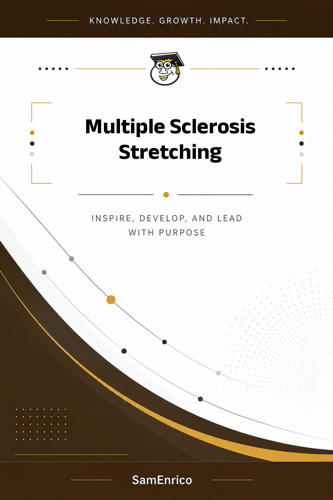
Non-FictionHealth & WellnessMS
Multiple Sclerosis Stretching eBook
Manage spasticity and maintain mobility with gentl
Manage spasticity and maintain mobility with gentle, frequent stretches.
Formats
Free sample
Chapter 1: The 30-Second Lie...--You have been lied to. Not by a malicious enemy, but by the entire fitness and rehabilitation industry that assumes your body works like everyone else's. The lie sounds reasonable. It sounds scientific. It goes like this: *Any stretching is good stretching.
A quick 10-second hamstring pull while you wait for your coffee to brew is better than nothing.*For someone with multiple sclerosis, that statement is not just harmless advice. It is actively dangerous.Here is the truth that most physical therapists forget to tell you, and that no fitness influencer will ever post on social media: a stretch held for less than thirty seconds does not change your muscle length. It only temporarily sedates your nervous system. And for the MS nerve—which is already misfiring, already overexcited, already sending constant "contract" signals to muscles that should be resting—a half-hearted stretch can actually trigger the exact spasm you are trying to relieve.This chapter is not a collection of exercises. This chapter is the foundation upon which every single movement in this book is built.
If you skip this chapter, you will be doing physical therapy blindfolded. If you read it carefully, you will understand why your muscles feel like concrete, why your well-meaning attempts to stretch have probably failed, and how to turn a thirty-second lie into a thirty-second truth that will change the way you move for the rest of your life.The Static in the Wires: Understanding the MS Nerve Before you can stretch an MS muscle, you have to understand the wire that controls it. Your nerves are not unlike electrical cables. A healthy nerve has insulation—myelin—that keeps the signal clean, fast, and directed. When that insulation is damaged, the signal leaks.
It jumps to neighboring wires. It fires when it should be silent. It echoes long after the command has ended.This is not a theory. This is the physiology of multiple sclerosis.When your brain sends a signal to your quadriceps saying, "Lift the leg," that signal travels down the spinal cord through a series of insulated nerve fibers. In a person without MS, the signal arrives clean, the quadriceps contracts once, and then the nerve quiets down.
In a person with MS, the damaged myelin causes the signal to scatter. It bounces around. It triggers adjacent nerves that control the hamstrings, the hip adductors, even the opposite leg. The result is not a clean, single contraction but a chaotic storm of overlapping commands.Your muscles are not trying to hurt you. They are trying to obey a broken signal.This is why spasticity in MS behaves so differently from the normal muscle tightness that healthy people experience after a workout.
Normal muscle tightness is a mechanical issue: the muscle fibers have shortened from lack of use or from being held in a contracted position. Stretching those fibers mechanically pulls them apart. It is like stretching a rubber band that has been left in the cold.MS spasticity is not primarily a mechanical issue. It is a neurological issue. The muscle itself may be perfectly healthy.
But the nerve controlling that muscle is screaming "CONTRACT" at full volume, all the time, for no reason. You cannot mechanically pull apart a nerve signal. You have to teach the nervous system to turn down the volume.This is where the thirty-second rule enters the picture.The Thirty-Second Rule: Why Shorter Stretches Are Worse Than Nothing Let me be absolutely clear so there is no confusion later in this book. The thirty-second rule applies to passive, sustained stretching of a large muscle group. That is, when you deliberately lengthen a muscle and hold that position without moving.
This is what most people mean when they say "stretching."Here is the physiology.Inside every muscle, there is a sensory organ called the muscle spindle. Its job is to detect changes in muscle length. When a muscle lengthens too quickly or too far, the muscle spindle sends an urgent signal to the spinal cord: "Emergency! This muscle is being overstretched! Contract immediately to protect it!"This is the stretch reflex.
It is the reason a doctor taps your knee with a hammer and your leg kicks out. It is automatic, unconscious, and very fast.When you hold a stretch for a short period—say, ten or fifteen seconds—you activate the muscle spindle, trigger the stretch reflex, and then release the stretch before your nervous system has time to figure out what is happening. The result is that you have briefly increased muscle tension, not decreased it. You have told the muscle to fight against you. You have strengthened the very spasticity you are trying to reduce.This is why so many people with MS say, "I tried stretching and it made my spasms worse." They were not wrong.
They were stretching the wrong way.When you hold a stretch for thirty seconds or longer, something different happens. Around the fifteen-second mark, another sensory organ—the Golgi tendon organ, located where the muscle meets the tendon—begins to send a competing signal. The Golgi tendon organ detects tension, not length. When it senses that a muscle is under sustained tension for more than a few seconds, it sends a signal that says, "This tension is not an emergency. This is a deliberate lengthening.
Stand down."The Golgi tendon organ overrides the muscle spindle. It tells the spinal cord to inhibit the motor neurons that are causing the contraction. The muscle relaxes. The spasticity quiets. And over time, with repeated thirty-second holds, the nervous system learns that lengthening is safe.A ten-second stretch is a fight.
A thirty-second stretch is a conversation.I want you to remember this distinction when we reach Chapter Ten, which contains the Flare Up Protocol. In that protocol, I recommend thirty-second active micro-movements—ankle pumps, chin tucks, finger spreads—for high-fatigue days. Those are not passive stretches. They are active movements with a different purpose: joint lubrication, neuromuscular activation, and habit maintenance. They do not violate the thirty-second rule because they are not attempting to lengthen muscle fibers.
They are sending a different message to the nervous system: "We are still here. We still move." That message matters. But it is not the same as lengthening spastic muscle.For now, focus on the rule: passive stretch for less than thirty seconds is useless. Passive stretch for thirty to sixty seconds is medicine.Flexor Spasms versus Extensor Spasms: Know Your Enemy Not all spasticity is the same. In fact, spasticity in MS tends to follow one of two patterns, and you need to know which pattern you have because the stretching approach is different.Flexor spasms pull your limbs inward, toward the center of your body.
Your hip pulls up toward your chest. Your knee bends. Your ankle points downward. Your arm crosses your chest. Your wrist curls.
Flexor spasms are more common in the later stages of MS and often occur at night, causing the characteristic "curled up" sleeping position that leads to joint contractures over time.The muscles involved in flexor spasms are the iliopsoas (hip flexor), hamstrings, tibialis anterior (shin muscle), biceps, and wrist flexors.…
This is the end of the free sample. Get the eBook to keep going. Buy now
About this book
Details
- Author
- Willoughby Olene
- Publisher
- SamEnrico
- Language
- English
- Genre
- Non-Fiction, Health & Wellness, MS
- Released
- 2026-06-09
- Pages (approx.)
- 131
- Available as
- eBook, Audiobook

Read better in the ZLOADR app
Your eBooks on your phone or tablet. Sign in with your SamEnrico account and start reading.
More by Willoughby Olene
 Restorative Sleep Sound BathWilloughby Olene$11.99
 Loneliness WorkbookWilloughby Olene$11.99
 GDPR Email Compliance GuideWilloughby Olene$11.99
 Ash and Fury: The Untold Story of Mount Tambora's Global CatastropheWilloughby Olene$11.99
 The Silk and Gold Heist: The Magnificent Deals of the Black Merchants of the Swahili CoastWilloughby Olene$11.99
 Understanding Hypoparathyroidism Familial IsolatedWilloughby Olene$17.99
 How to Become a Chucking-and-boring-machine OperatorWilloughby Olene$11.99
 Small Business Insurance Guide 2025Willoughby Olene$12.99
 Hyperloop Cargo TechnologyWilloughby Olene$12.99
 Climate Risk Assessment LeaderWilloughby Olene$11.99
You may also like
 Hong Kong Handover 1997Dunn Johnnie$11.99
 Zumba For Postnatal Recovery CourseNeal Christian$11.99
 Zumba for BeginnersLadner Nikia$11.99
 YouTube Comment Mining GuideHumes Pandora$12.99
 Worry Box MeditationCarlin Rudy$11.99
 Workplace Stress MeditationNguyen Lynn$11.99
 Workplace Stress and Sleep RepairHawley Ivory$11.99
 Workplace Perfectionism CureDelaney Jeffry$11.99
 Workplace Injustice Anger GuideWallen Isabelle$11.99
 Work Addiction and Burnout LinkGreenwood Ester$11.99
 Women in Yoga and WellnessBeattie Galina$11.99
 Women in Stand Up ComedyChun Evangeline$11.99