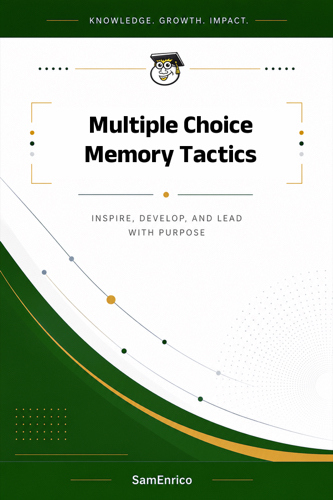
Multiple Choice Memory Tactics eBook
Eliminates distractors and cues recall.
by Wingate Minh
Eliminates distractors and cues recall.
Formats
Free sample
Chapter 1: The 68% Confession--–- I failed a test that I should have aced. Not by a small margin, but by a humiliating gap that made me question whether I had learned anything at all. The exam was multiple choice. The subject was one I had studied for six weeks. And when I saw my score—68%, barely above guessing—I did something I had never done before: I walked back to my dorm room, sat on the floor, and stared at the wall for an hour.The worst part was not the grade.
The worst part was the certainty I had felt while taking the test. Every question seemed familiar. Every answer option looked plausible. I had read the textbook, highlighted the key passages, and reviewed my notes three times. By every measure of traditional studying, I had done the work.
And yet, when the test maker presented me with four options, I consistently picked the wrong one. Not because I didn't know the material. Because I didn't understand how multiple choice actually works.This book exists because of that 68%. In the years that followed, I dedicated myself to understanding the strange, counterintuitive psychology of multiple-choice testing. I analyzed thousands of questions from the SAT, LSAT, MCAT, bar exam, nursing boards, and college final exams.
I interviewed test makers, cognitive psychologists, and high-scoring students. And I discovered a truth that most educators never tell you: multiple-choice tests do not measure knowledge. They measure recognition under deception.The Great Misunderstanding Every year, millions of students walk into examination rooms believing they understand what is about to happen. They believe that if they have studied hard enough, the correct answer will somehow reveal itself. They believe that multiple choice is easier than essay tests because the answer is "right there" on the page.
They believe that their first instinct is usually correct. Every single one of these beliefs is wrong.The fundamental misunderstanding begins with the difference between two types of memory: recall and recognition. Recall is what happens when someone asks you, "What is the capital of South Dakota?" and you generate the answer "Pierre" from scratch, with no cues or prompts. Recognition is what happens when someone shows you a list of four cities—Sioux Falls, Rapid City, Pierre, Aberdeen—and you identify the correct one. Recognition is neurologically easier because the correct answer itself acts as a retrieval cue.
Your brain does not have to search through its entire catalog; it only has to verify which of the presented options matches the memory trace.This ease is the trap.Because recognition feels easier, students study less rigorously for multiple-choice exams. They skim instead of drill. They reread instead of self-test. They assume that seeing the correct answer on the page will trigger the memory automatically. And for straightforward, fact-based questions, this assumption sometimes works.
But professional test makers are not in the business of asking straightforward, fact-based questions. Their job is to write questions that separate students who truly understand from those who merely recognize.The Anatomy of a Distractor Every multiple-choice question contains three essential components: the stem (the question or incomplete statement), the key (the correct answer), and the distractors (the incorrect options). The word "distractor" is telling. These options are not random. They are carefully constructed to distract you from the correct answer by appealing to common misunderstandings, plausible but incorrect facts, or tempting patterns.Consider this simple example from a basic biology exam:Which of the following is the primary function of mitochondria?A) Protein synthesis B) ATP production C) Lipid storage D) DNA replication If you know biology, you recognize that B is correct.
But notice what the test maker has done. Option A (protein synthesis) is a real cellular function, just performed by ribosomes instead of mitochondria. Option C (lipid storage) is also real, performed by adipocytes. Option D (DNA replication) is real, performed in the nucleus. Every distractor is a true statement about biology.
None of them are nonsense answers. The test maker has deliberately selected facts that are correct in other contexts but incorrect for this specific question. This is the signature move of professional test design: the best distractors are true statements that do not answer the question asked.Now consider a more sophisticated example from a law school exam:A police officer stops a driver for speeding. During the stop, the officer sees a firearm on the passenger seat. The driver does not have a concealed carry permit.
Under the state's "plain view" doctrine, can the officer seize the firearm without a warrant?A) Yes, because the officer observed the firearm from a lawful vantage point B) Yes, because speeding is a crime that justifies a full search C) No, because the firearm is not evidence of the speeding violation D) No, because the driver has a reasonable expectation of privacy in the vehicle All four options sound legally sophisticated. All four contain phrases that appear in real case law. But only one correctly applies the plain view doctrine. Option A states the correct legal test but misses a key element. Option B is wrong because speeding is an infraction, not a crime justifying a full search.
Option C is close but misstates the requirement that evidence must be "immediately apparent" as contraband. Option D is wrong because vehicle privacy expectations are reduced. The test maker has written four answers that each require the student to hold multiple legal principles in working memory simultaneously and compare them against the facts. This is not a recognition test. It is a test of discrimination under pressure.The Enemy Within: How Anxiety Hijacks Your Memory Understanding distractors is only half the battle.
The other half is understanding what happens inside your brain when you sit down to take a high-stakes exam. And what happens is not pretty.The Sympathetic Nervous System—commonly known as the fight-or-flight response—evolved to protect you from predators. When a saber-toothed tiger chased your ancestors, their bodies released adrenaline, redirected blood flow to the muscles, and shut down non-essential functions like digestion and higher reasoning. This was an excellent survival strategy. It is a terrible strategy for taking a multiple-choice test.Here is what happens during The Freeze, as I call it.
You read a question. You recognize the topic. You know that you studied this material. But the answer does not come. Your heart rate increases.
Your palms sweat. Your brain, sensing a threat, begins to divert resources away from the prefrontal cortex—the seat of working memory, logic, and executive function—toward the amygdala and the survival circuits. The very act of panicking makes it harder to think. And the harder it becomes to think, the more you panic. This is a vicious cycle, and it is responsible for more lost points than ignorance ever could be.I have watched this happen to hundreds of students.
One moment they are competent, prepared, knowledgeable. The next moment they are staring at four answer choices that all look equally plausible, because the brain region that would discriminate between them has been partially shut down by stress. They guess. They guess wrong. And then they spend the rest of…
This is the end of the free sample. Get the eBook to keep going. Buy now
About this book
Details
- Author
- Wingate Minh
- Publisher
- SamEnrico
- Language
- English
- Genre
- Non-Fiction, Self-Help, Test Strategy
- Released
- 2026-06-06
- Pages (approx.)
- 131
- Available as
- eBook, Audiobook

Read better in the ZLOADR app
Your eBooks on your phone or tablet. Sign in with your SamEnrico account and start reading.
More by Wingate Minh
 Franchising Your Local Brand Across Borders Gray MarketWingate Minh$11.99
 Sleep Optimization for TestosteroneWingate Minh$11.99
 NVC For Perfectionism GuideWingate Minh$11.99
 Alcoholism in the Workplace Recovery GuideWingate Minh$11.99
 Stimulant Nutrition GuideWingate Minh$11.99
 Senior Cohousing Business ModelWingate Minh$11.99
 Clomiphene For MenWingate Minh$11.99
 The Last Stand at Dien Bien Phu: Vietnam's Valley of ShadowsWingate Minh$11.99
 Love and Ashes: A Sarajevo Romance Amid the SiegeWingate Minh$11.99
 How to Produce Colored Rubbing Oil StainWingate Minh$11.99
 Mastering The Art of Daitō-ryū Aiki-jūjutsu (大東流合気柔術)Wingate Minh$11.99
 EU VAT Cross Border Refund PrimerWingate Minh$12.99