
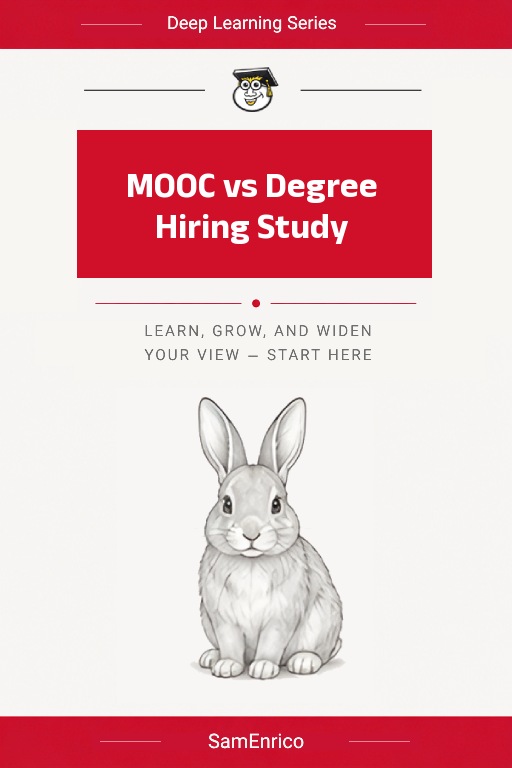
MOOC vs Degree Hiring Study
Compare hiring outcomes for MOOC certificates vers
by Gifford Mary
Compare hiring outcomes for MOOC certificates versus traditional degrees across tech, business, and creative fields.
Formats
About this book
Free sample
Chapter 1: The $1.7 Trillion Question--For the past four decades, a single question has shaped the lives of over 200 million people worldwide. It has dictated career trajectories, determined household wealth, influenced marriage decisions, and even affected life expectancy. That question is not "What do you want to do with your life?" It is something far more specific, far more consequential, and far more expensive: Where did you go to college?The answer to that question has historically functioned as a social and economic sorting mechanism more powerful than almost any other variable outside of race and class. A degree from Harvard, Stanford, or MIT opened doors that remained welded shut for graduates of community colleges. A bachelor's degree in any field, from any accredited institution, provided a statistical earnings premium of approximately 84% over a high school diploma—a gap that widened from 40% in 1980 to nearly 100% by 2020.
The degree was not merely a credential; it was a passport. And like any passport, it determined which borders you could cross, which opportunities you could access, and which zip codes you could afford to call home.But something strange began happening around 2012, the year that Stanford professors Andrew Ng and Daphne Koller launched Coursera and Sebastian Thrun launched Udacity. Strange is perhaps the wrong word. Disruptive is better. A fundamental shift began to ripple through the labor market—quietly at first, then with increasing velocity.
Employers who had demanded degrees for decades started dropping those requirements. Google, Apple, IBM, Bank of America, and Accenture all announced that they would no longer require four-year degrees for thousands of positions. At the same time, millions of learners began accumulating alternative credentials: MOOC certificates, nanodegrees, specializations, and micro-credentials that cost a fraction of a traditional degree and could be completed in months rather than years.The result is a labor market caught between two competing realities. The first reality is that a bachelor's degree remains the single most reliable pathway to middle-class stability. The second reality is that the degree's monopoly on signaling job readiness has been fractured—perhaps irreversibly—by the rise of digital credentials that are cheaper, faster, and…
This is the end of the free sample. Get the eBook to keep going. Buy now
Contents
- Chapter 1
- Chapter 2
- Chapter 3
- Chapter 4
- Chapter 5
- Chapter 6
- Chapter 7
- Chapter 8
- Chapter 9
- Chapter 10
- Chapter 11
- Chapter 12
Details
- Author
- Gifford Mary
- Publisher
- SamEnrico
- Language
- English
- Genre
- Non-Fiction, Student's Shortcut
- Released
- 2026-05-30
- Pages (approx.)
- 156
- Available as
- eBook, Audiobook

Read better in the ZLOADR app
Your eBooks on your phone or tablet. Sign in with your SamEnrico account and start reading.
More by Gifford Mary
 Mindfulness for College StudentsGifford Mary$11.99
 Customer Service Text AnalyticsGifford Mary$11.99Customer Service Text AnalyticsGifford Mary$11.99
 Teresa's Concept of MortificationGifford Mary$11.99
 Neurodivergent Social ConnectionGifford Mary$11.99
 The Hypnosis Audio File ManagementGifford Mary$11.99
 Operation: Secret Dossier – The 1994 USA World Cup HeistGifford Mary$11.99
 Ambassador Program Pre LaunchGifford Mary$12.99
 Learn to Play the Air HornGifford Mary$11.99
 Artificial Intelligence Systems DevelopmentGifford Mary$11.99
 How to Start a Phosphatic Straight Fertiliser Business (Beginners Guide)Gifford Mary$11.99
You may also like
 Hong Kong Handover 1997Dunn Johnnie$11.99
 Zumba For Postnatal Recovery CourseNeal Christian$11.99
 Zumba for BeginnersLadner Nikia$11.99
 YouTube Comment Mining GuideHumes Pandora$12.99
 Worry Box MeditationCarlin Rudy$11.99
 Workplace Stress MeditationNguyen Lynn$11.99
 Workplace Stress and Sleep RepairHawley Ivory$11.99
 Workplace Perfectionism CureDelaney Jeffry$11.99
 Workplace Injustice Anger GuideWallen Isabelle$11.99
 Work Addiction and Burnout LinkGreenwood Ester$11.99
 Women in Yoga and WellnessBeattie Galina$11.99
 Women in Stand Up ComedyChun Evangeline$11.99