
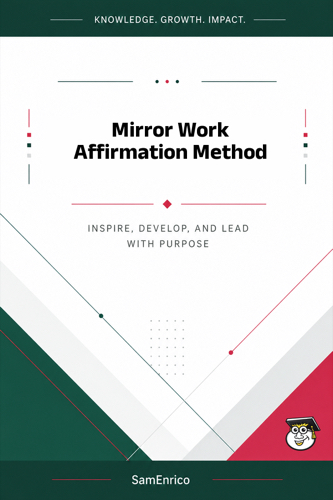
Mirror Work Affirmation Method eBook
Speak loving statements to your reflection to buil
by Meeks Hollis
Speak loving statements to your reflection to build self-acceptance.
Formats
Free sample
Chapter 1: The Flinch Reflex--–- Before you can heal the words you speak to your reflection, you must first understand why you look away. This chapter is not about affirmations. It is not about self-love or positive thinking or manifesting your best life. This chapter is about something far more primal, far more honest, and far more uncomfortable: the flinch. That micro-moment—barely a third of a second—when your eyes land on your own face in a mirror, a store window, a phone screen in selfie mode, and your gaze skitters away like a startled animal.
You have done this thousands of times. Probably today. Probably in the last hour. You likely do not even notice it anymore. That is precisely the problem.The flinch is the foundational wound of low self-worth made visible.
It is not the wound itself, but the scar tissue’s reflex. Every time you avoid your own eyes, you are not protecting yourself from pain. You are confirming to your nervous system that there is something dangerous in your own face. This chapter will dismantle that reflex. It will show you, with science and story and somatic practice, why looking away is not humility but avoidance, and why avoidance is the engine that drives every critical voice you have ever believed about yourself.
By the end of these pages, you will have done something radical: you will have looked at yourself for sixty uninterrupted seconds without looking away. And you will have written down exactly what you saw and felt, not to judge it, but to create a baseline. This baseline will become your map. Twenty-one days from now, you will return to it. The difference between those two moments is the entire purpose of this book.The Anatomy of Avoidance Let us begin with a simple experiment.
Stop reading. Find the nearest reflective surface. A bathroom mirror, a phone screen turned to black, a window at night. Look at your own face. Do not do anything else.
Do not fix your hair. Do not suck in your stomach. Do not smile to make yourself look better. Do not judge. Just look.
Count how many seconds pass before you feel the urge to look away. Be honest.If you are like most people who pick up this book, the answer is somewhere between two and seven seconds. Some cannot make it past one. A small percentage—usually those who have already done significant healing work—can hold their own gaze for fifteen or twenty seconds before the discomfort rises. Almost no one, on the first try, can hold their own gaze for a full minute without intense internal resistance.That resistance is not a character flaw.
It is a neurological survival mechanism. Your brain has been trained, through years of repetition, to associate your own reflection with threat. Not physical threat—you are not afraid the mirror will attack you. But social threat. Evaluative threat.
The kind of threat that once meant exile from the tribe and now manifests as the voice that says you are not enough, you look tired, you have gained weight, you are aging, no one would want that face.Here is what happens inside your skull during those few seconds of eye contact. Your prefrontal cortex—the part of your brain responsible for self-awareness, decision-making, and emotional regulation—lights up. Simultaneously, your amygdala, the almond-shaped cluster of neurons that processes fear, begins to fire. For most people, the amygdala’s signal is stronger. Your brain interprets the sustained gaze as a confrontation.
And because you have historically used mirrors to criticize rather than to connect, your brain has learned a simple equation: mirror equals danger equals look away.Each time you look away, you reinforce that equation. Each time you flinch, you tell your nervous system: Good job. We survived. Keep avoiding. Over years, that pathway becomes a superhighway.
The flinch becomes automatic. You stop noticing it entirely. You start believing that you simply “don’t like mirrors” or that you are “not photogenic” or that “selfies are vain.” But underneath those socially acceptable explanations is a raw, unexamined truth: you have been trained to reject your own face.The Lie of Humility Many people, when confronted with this pattern, defend it as humility. “I don’t stare at myself because I’m not vain,” they say. “I don’t need to look at myself.
I know who I am.” This sounds noble. It is not. It is avoidance dressed in moral clothing.True humility is not the inability to look at yourself. True humility is the ability to look at yourself accurately—including your flaws and your gifts—without either grandiosity or shame. The person who cannot look in the mirror is not humble.
They are hiding. And what they are hiding from is not their physical appearance. It is the emotional content that appearance has come to represent: the fear of being seen as inadequate, the shame of not measuring up, the grief of feeling unloved or unseen.Vanity and avoidance are opposite sides of the same coin. Both are fixated on the surface. Both are driven by the fear that underneath the surface, there is something unacceptable.
The vain person compulsively checks their reflection, trying to control the image. The avoidant person compulsively looks away, trying to ignore the image. Neither one is actually seeing themselves. Neither one is at peace.This book is for the avoidant. It is for the person who has learned to scroll past their own reflection in a phone screen.
It is for the person who tilts their head down when passing a store window. It is for the person who has gone years without really looking into their own eyes. You are not broken. You are not shallow. You have simply learned a survival strategy that no longer serves you.
And like any learned behavior, it can be unlearned.Neuroplasticity: Your Brain’s Ability to Change The most hopeful word in the neuroscience lexicon is neuroplasticity. It means that your brain is not a fixed, static organ. It is a living, changing structure that rewires itself based on your repeated thoughts, behaviors, and experiences. Every time you do something new, your brain builds a new pathway. Every time you repeat that action, the pathway gets stronger.
Every time you avoid something, the pathway of avoidance gets stronger.This is why the flinch feels so automatic. You have practiced it thousands of times. But it is also why you can reverse it. You can build a new pathway—a seeing pathway, a staying pathway, a kindness pathway—by practicing the opposite behavior. Each time you hold your own gaze for one second longer than you want to, you are laying down new neural real estate.
Each time you look at your reflection and say something neutral or kind instead of critical, you are weakening the old superhighway of shame.The exercises in this book are not spiritual fluff. They are neurosurgical. They are designed to exploit neuroplasticity’s rules: repetition, emotional salience, and focused attention. When you combine all three—repeating a loving statement while looking into your own eyes with full attention—you create…
This is the end of the free sample. Get the eBook to keep going. Buy now
About this book
Details
- Author
- Meeks Hollis
- Publisher
- SamEnrico
- Language
- English
- Genre
- Non-Fiction, Self-Help, Self-Esteem
- Released
- 2026-06-10
- Pages (approx.)
- 146
- Available as
- eBook, Audiobook

Read better in the ZLOADR app
Your eBooks on your phone or tablet. Sign in with your SamEnrico account and start reading.
More by Meeks Hollis
 Sexual Harassment Stress GuideMeeks Hollis$11.99
 TM for JournalistsMeeks Hollis$11.99
 HGH Nootropic Stack GuideMeeks Hollis$11.99
 Alternate Day Fasting GuideMeeks Hollis$11.99
 Group Idea Escalation ProtocolMeeks Hollis$11.99
 Understanding Bipolar Stigma WorkbookMeeks Hollis$11.99
 HGH And Stem CellsMeeks Hollis$11.99
 Czech Green Tax CreditsMeeks Hollis$11.99
 Crowns and Chaos: The Year the British Monarchy Almost FellMeeks Hollis$11.99
 The Silk Road to the Stars: Ancient Cosmologists of Central AsiaMeeks Hollis$11.99
 The Mind of a Monster: Unraveling the Psychology of Richard RamirezMeeks Hollis$11.99
 The Dancer's Guide to MapaleMeeks Hollis$11.99
You may also like
 Repairing Self-Worth in RecoveryPrado Hermine$11.99
 Affirmations For Self Worth WorkbookVail Kristian$11.99
 Shopping Addiction And Self Esteem CourseBaugh Dee$11.99
 Ego Strengthening Script TemplatesBest Debroah$11.99
 Assertiveness for Recovering DoormatsBlanchette Elicia$11.99
 Affirmations for Self EsteemQuinonez Machelle$11.99
 Workaholism and Self WorthThorn Kami$11.99
 Rebuilding Self Esteem After DivorceMansfield Elton$11.99
 Low Self Worth Anger SourceNegron Nohemi$11.99
 Gambling Addiction And Self EsteemStoddard Kathern$11.99
 Financial Stress and Self WorthRidley Graham$11.99
 Buying Dignity Recovery PlanStamper Arnette$11.99